Call us on: 07876 794098

Tag - woodland

family woodland christmas event

Woodland Christmas Gathering & Wreath Making

Celebrate Christmas in the Woods with Your Family

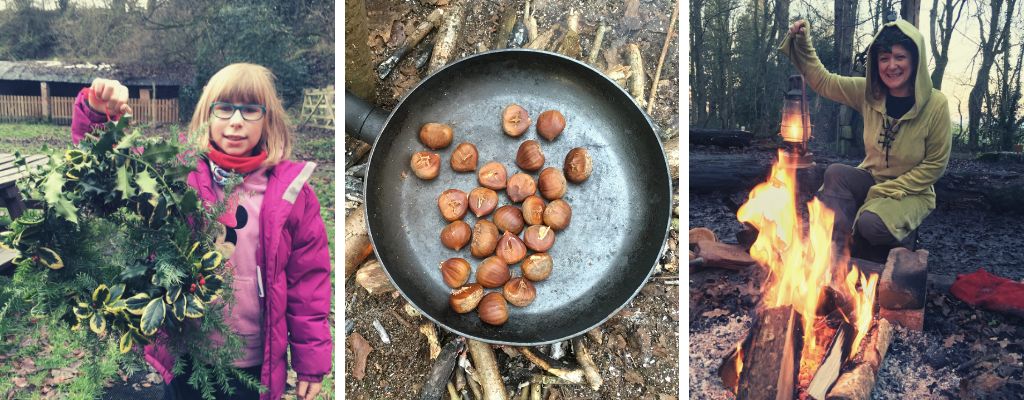
Give your family the gift of quality time in nature this Christmas and add a bit of wild to your festive season. Join our festive celebration surrounded by the beautiful woodland of Park in the Past.

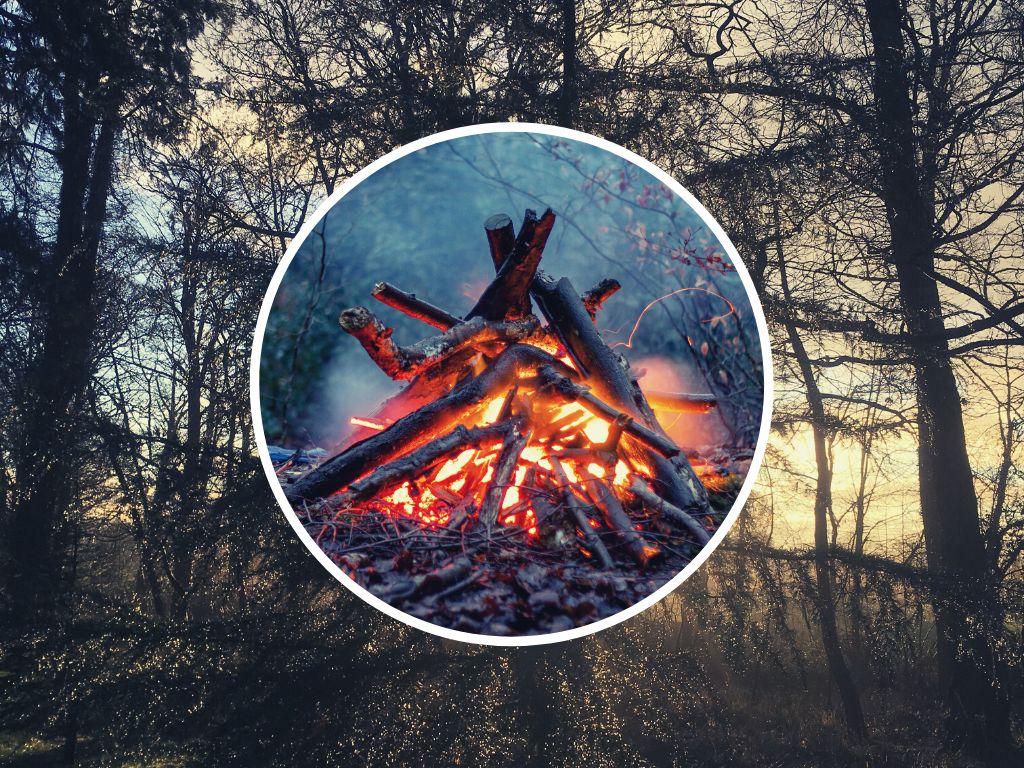
Families with children of all ages are welcome to join us at our Forest School circle where we will be stoking the campfire to bring light to the darkest time of the year.

James and Lea will guide you and your children through a range of festive craft activities that will get you all in the festive mood for Christmas. This is going to be a very special and magical event with music, food and good company.

You will return home with a Christmas wreath you have made along with hand-crafted decorations for your tree.

“My son and I attended a lovely winter solstice event on 21st December. It was a truly magical night and we loved the vibe. We will be back again. Loving that my birth tree is Oak by the way!” Nicole Netzband-Piggot

  • Enjoy a winter warmer; hot spiced apple juice from our campfire
  • Take a guided foraging walk for natural craft materials
  • Make a Christmas woodland wreath to take home
  • Taste roasted chestnuts, campfire popcorn and other hot snacks
  • Sing along to the mandolin with Christmas Carols around the campfire
  • Craft willow stars & other rustic decorations to hang in your Christmas tree
  • Listen to the tale of how the Robin got his red breast
  • Scoff a campfire-warmed mince pie – yum!

Event details

Date: Sat 9th Dec 2023

Time: 10am – 12:30pm

Venue: Park in the Past

Cost: £35 per family

family Christmas celebration in woods

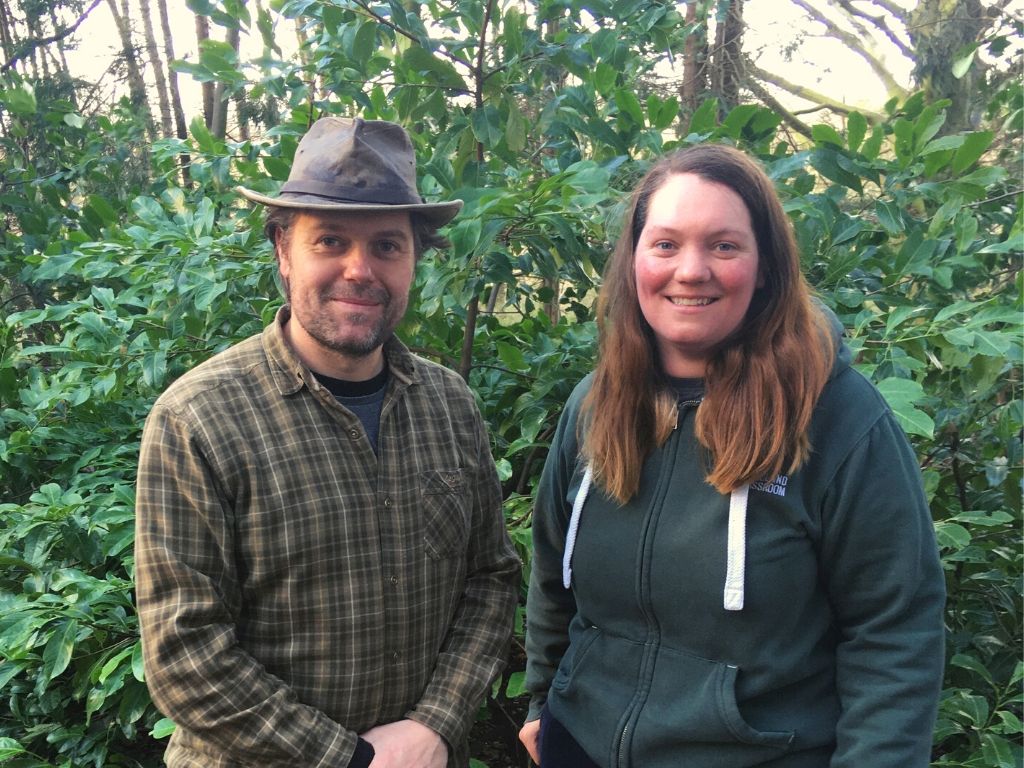
Your Guides: James & Lea Kendall

James is the Head Bushcraft Instructor at Woodland Classroom, having worked in environmental education & conservation for over 10 years. James’ approach to teaching  steers his students toward fostering a deeper connection with nature through understanding the landscape around us; “Bushcraft skills are an effective way to do this as we learn how to make use of natural materials and live lightly with the land, whilst also connecting with our own ancient past by seeing the land through the eyes of our ancestors.”

Lea is a qualified Counsellor and Mindfulness in a Woodland Setting practitioner. She is a firm believer in the power of nature to be therapeutic for everyone. Lea is an active forager, passionate about how we can use common plants for both food and medicine. She enjoys making her own tinctures and medicinal remedies for treating common ailments.

james and lea kendall - outdoor education tutors
christmas forest school for families

Skills you will learn

Over the course of the session you will enjoy a range of activities, including…

null

Nature Connection

null

Campfire snacks

null

Bushcraft for families

null

Campfire Cooking

Book now

This session costs £35 per family (to a maximum of 2 adults and 3 children per family). Additional children (over 2 years of age) are charged £5 separately. Additional children aged under 2 are free.

The event is 2.5 hours long. You can read our Event Terms & Conditions here.

wassail ceremony in north wales

Wassail & Lantern Making

Celebrate This Ancient Apple Festival with your Family

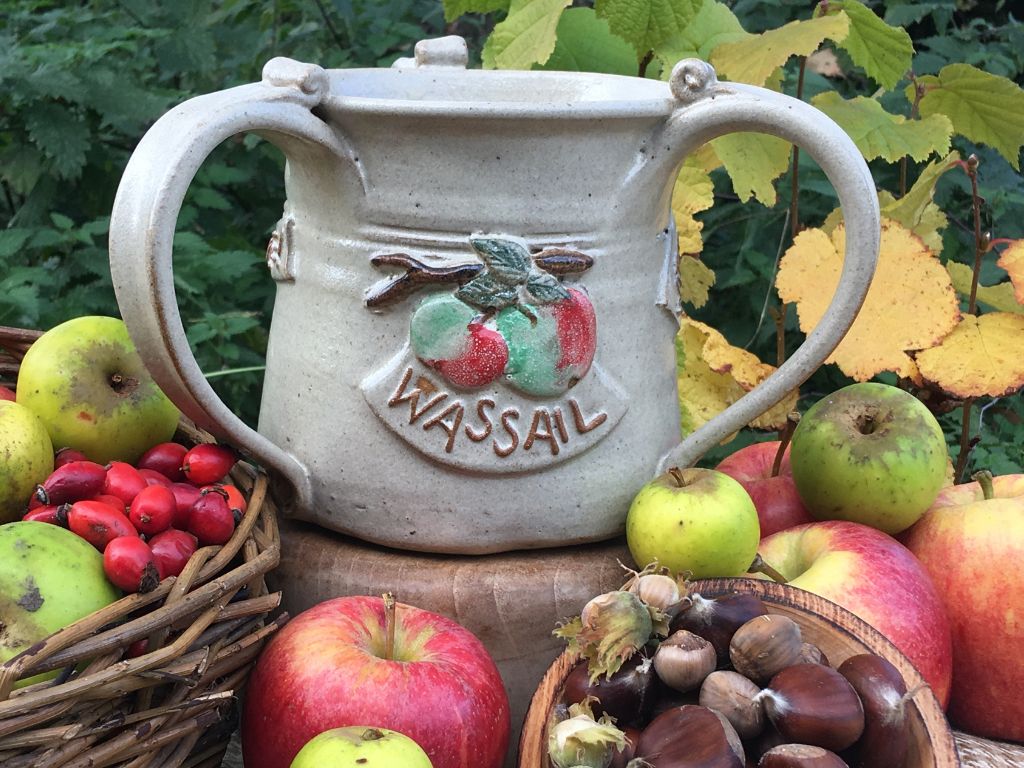
Crackling fire, glowing lanterns, steaming hot mulled apple juice and merriment a-plenty for all the family! Celebrate a traditional Wassailing with us as we bless the fruit trees for a bountiful harvest. Let’s face it, January is a rubbish month when nothing much happens, but in villages up and down the country, around Old Twelfth Night, traditional Wassails are returning, so let’s bring some light and celebration to this time of year. Families with children of all ages are welcome to join us under our big parachute shelter at Park in the Past for an event which promises to be very special and magical with music, food and good company. “Wassail!”
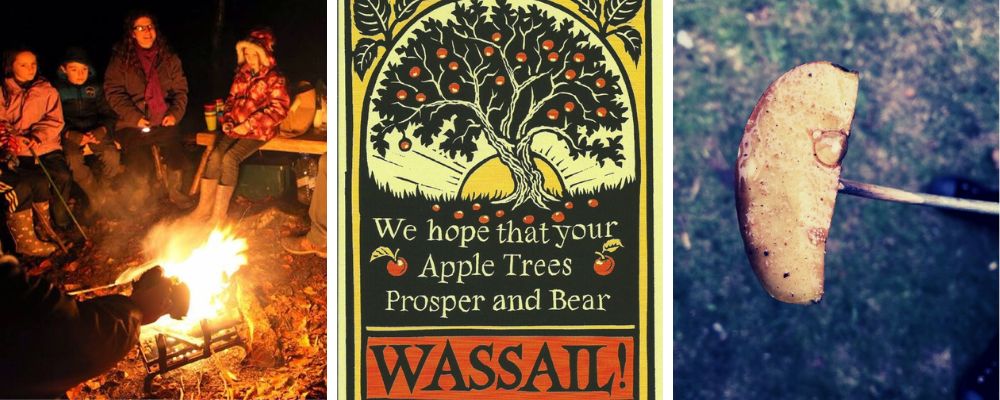
Make a lantern with your family and join our procession to the orchard where you will learn about the tradition of wassailing and take part in the ceremony. We will be passing around the traditional wassail bowl filled to the brim with our secret winter-warming recipe, sharing slices of home-made apple cake and cooking up sticky toffee apple slices over the campfire. Come a-wassailing, as we sing-along to traditional songs of the season with live music provided by James’ mandolin.

Lea and James will be your guides to this traditional celebration as we gather under our huge parachute canopy and share the warmth of the winter fire.

  • Craft a willow lantern with your family
  • Enjoy hot mulled apple cider (non-alcoholic)
  • Traditional Wassailing ceremony – blessing of the trees
  • Cook up toffee apple slices on our blazing campfire
  • Join the lantern procession to the orchard
  • Share a sip from the wassail bowl & munch on apple cake
  • Sing-along with wassail songs; James will have his mandolin
  • Discover the ancient traditional of Wassailing & learn the history behind it

WHAT IS WASSAILING?

Wassailing refers to drinking (and singing) the health of trees in the hopes that they might better thrive. The purpose of wassailing is to awake the cider apple trees and to scare away evil spirits to ensure a good harvest of fruit in the autumn. The ceremonies of each Wassail vary from village to village but they generally all have the same core elements. A wassail King and Queen lead the song and procession to be played from one orchard to the next. This ancient British tradition is still very much thriving today.
Want to know what Wassailing is all about? Come along and find out what roles soggy toast, pots & pans and a child up a tree have to play in this ancient tradition. By wassailing the apple and pear trees we will be blessing them for a bountiful harvest next autumn. The old call will go out for “Hatfuls, capfuls, three bushel bagfuls and little heaps under the stairs!”

Event details

Date: Sat 13th Jan 2024

Time: 3:00 pm – 5:30 pm

Venue: Park in the Past

Cost: Family (up to 4) £35

wassail in north wales

Your Guides: James & Lea Kendall

James is the Head Bushcraft Instructor at Woodland Classroom, having worked in environmental education & conservation for over 10 years. James’ approach to teaching  steers his students toward fostering a deeper connection with nature through understanding the landscape around us; “Bushcraft skills are an effective way to do this as we learn how to make use of natural materials and live lightly with the land, whilst also connecting with our own ancient past by seeing the land through the eyes of our ancestors.”

Lea is a qualified Counsellor and Mindfulness in a Woodland Setting practitioner. She is a firm believer in the power of nature to be therapeutic for everyone. Lea is an active forager, passionate about how we can use common plants for both food and medicine. She enjoys making her own tinctures and medicinal remedies for treating common ailments.

james and lea kendall - outdoor education tutors
wassail in north wales

Skills you will learn

Over the course of the evening you will experience a range of activities, including…

null

Nature Connection

null

Campfire Treats

null

Family Bushcraft

null

Ancestral Skills

Book now

Tickets are £35 for a family of up to 4 people. Additional family members are £5 each Additional children aged under 3 come free. You can read our Event Terms & Conditions here.

wassailing event apples in north wales
woodland winter solstice in north wales

Woodland Winter Solstice

Celebrate a Magical Midwinter with your Family

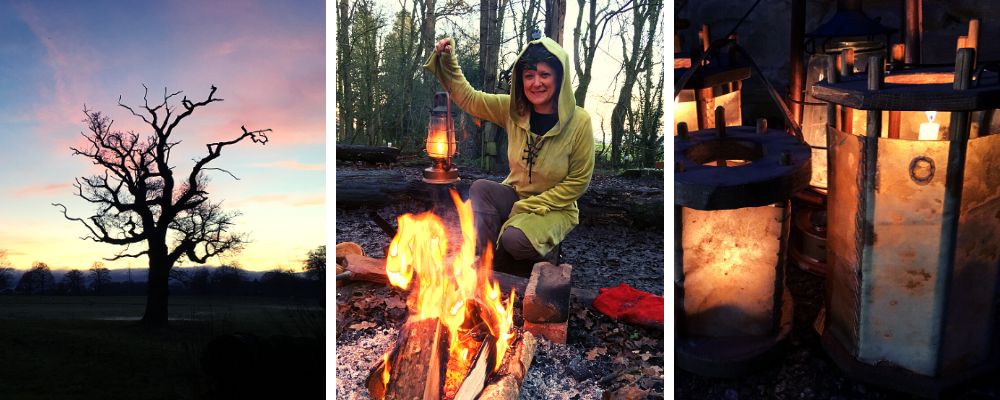
Celebrate the Winter Solstice with us in the woods. Adults or families with children of all ages are welcome to join us at our sheltered fire circle hidden in the beautiful woodland of Park in the Past for an early evening session of solstice celebration around the campfire. We will start with a lantern-lit walk along the trail, across the river and into the woods where our crackling campfire will give us a warm and welcome light at the darkest time of the year. Our previous events have been amazing, and this year promises to be a very special and magical event with music, food and good company.

Be sure to wrap up well with appropriate clothing as old Jack Frost will be out and about.
“We can look back on our journey since Summer Solstice, to acknowledge what we have completed in this cycle, what we have experienced and what wisdom we have gained. It is also a moment to look forward, to name the new seeds and intentions we wish to take into the next cycle.” Glennie Kindred

Lea and James will be your guides as we gather under our huge parachute canopy and share the warmth of the midwinter fire.

We are hosting this session on two consecutive nights so if this date fills up, check out our event on the Sat 21st Dec.

  • Lantern walk down the trails to the fire circle
  • Hot spiced apple cider (non-alcoholic)
  • Festive fireside storytelling
  • Wishing Tree
  • Gentle games for the kids; night-line, glow worm trail & more
  • Roasted chestnuts
  • Sing-along with seasonal songs; James will bring his mandolin
  • Light a candle of your own and make a wish for the coming year

Event details

Date: Fri 20th Dec 2024

Time: 4:30 am – 6:30 pm

Venue: Park in the Past

Cost: Adult £14, Child £11, Under 3’s Free

Want a sneak preview of this event? Watch this short video of a previous Woodland Winter Solstice gathering we hosted.

Your Guides: James & Lea Kendall

James is the Head Bushcraft Instructor at Woodland Classroom, having worked in environmental education & conservation for over 10 years. James’ approach to teaching  steers his students toward fostering a deeper connection with nature through understanding the landscape around us; “Bushcraft skills are an effective way to do this as we learn how to make use of natural materials and live lightly with the land, whilst also connecting with our own ancient past by seeing the land through the eyes of our ancestors.”

Lea is a qualified Counsellor and Mindfulness in a Woodland Setting practitioner. She is a firm believer in the power of nature to be therapeutic for everyone. Lea is an active forager, passionate about how we can use common plants for both food and medicine. She enjoys making her own tinctures and medicinal remedies for treating common ailments.

james and lea kendall - outdoor education tutors
winter solstice in the woods event

Skills you will learn

Over the course of the evening you will experience a range of activities, including…

null

Nature Connection

null

Campfire Treats

null

Family Bushcraft

null

Ancestral Skills

null

Campfire

null

Stargazing

null

Tree & Plant identification

null

Wellbeing in Nature

Book now

Adults tickets £14 each, Child tickets £11 each. Under three’s come for FREE. Children of all ages are welcome. You can read our Event Terms & Conditions here.

woodland winter solstice in north wales

Woodland Winter Solstice

Celebrate a Magical Midwinter with your Family

Celebrate the Winter Solstice with us in the woods. Adults or families with children of all ages are welcome to join us at our sheltered fire circle hidden in the beautiful woodland of Park in the Past for an early evening session of solstice celebration around the campfire. We will start with a lantern-lit walk along the trail, across the river and into the woods where our crackling campfire will give us a warm and welcome light at the darkest time of the year. Our previous events have been amazing, and this year promises to be a very special and magical event with music, food and good company.

Be sure to wrap up well with appropriate clothing as old Jack Frost will be out and about.
“We can look back on our journey since Summer Solstice, to acknowledge what we have completed in this cycle, what we have experienced and what wisdom we have gained. It is also a moment to look forward, to name the new seeds and intentions we wish to take into the next cycle.” Glennie Kindred

Lea and James will be your guides as we gather under our huge parachute canopy and share the warmth of the midwinter fire.

We are hosting this session on two consecutive nights so if this date fills up, check out our event on Fri 20th Dec. UPDATE: Tickets for this evening are now SOLD OUT but you can still grab tickets for Fri 20th Dec HERE.

  • Lantern walk down the trails to the fire circle
  • Hot spiced apple cider (non-alcoholic)
  • Festive fireside storytelling
  • Wishing Tree
  • Gentle games for the kids; night-line, glow worm trail & more
  • Roasted chestnuts
  • Sing-along with seasonal songs; James will bring his mandolin
  • Light a candle of your own and make a wish for the coming year

Event details

Date: Sat 21st Dec 2024

Time: 4:30 am – 6:30 pm

Venue: Park in the Past

Cost: Adult £14, Child £11, Under 3’s Free

Want a sneak preview of this event? Watch this short video of a previous Woodland Winter Solstice gathering we hosted.

Your Guides: James & Lea Kendall

James is the Head Bushcraft Instructor at Woodland Classroom, having worked in environmental education & conservation for over 10 years. James’ approach to teaching  steers his students toward fostering a deeper connection with nature through understanding the landscape around us; “Bushcraft skills are an effective way to do this as we learn how to make use of natural materials and live lightly with the land, whilst also connecting with our own ancient past by seeing the land through the eyes of our ancestors.”

Lea is a qualified Counsellor and Mindfulness in a Woodland Setting practitioner. She is a firm believer in the power of nature to be therapeutic for everyone. Lea is an active forager, passionate about how we can use common plants for both food and medicine. She enjoys making her own tinctures and medicinal remedies for treating common ailments.

james and lea kendall - outdoor education tutors
winter solstice in the woods event

Skills you will learn

Over the course of the evening you will experience a range of activities, including…

null

Nature Connection

null

Campfire Treats

null

Family Bushcraft

null

Ancestral Skills

null

Campfire

null

Stargazing

null

Tree & Plant identification

null

Wellbeing in Nature

Book now

Adults tickets £14 each, Child tickets £11 each. Under three’s come for FREE. Children of all ages are welcome. You can read our Event Terms & Conditions here.

woodland solstice celebration

Midwinter’s Day Celebration

Celebrate Winter Solstice Immersed In Nature

Give yourself the gift of quality time in nature as you join us around the midwinter campfire, for a celebration of the Winter Solstice. You will be guided through a range of activities aimed at deepening your nature connection whilst we mark this special moment in the calendar year together.

Experiencing nature with all our senses is a powerful doorway to practising mindfulness which is proven to improve your health & well-being. Practising bushcraft brings us closer to our ancestors and a very old way of understanding the natural world around us. It also fosters a stronger connection to nature. Fire has a hypnotic quality which can really aid getting into a mindful head space. Lighting fires at the darkest time of the year is also an ancient custom and symbolises creating our positive intentions for the new year.

“Winter Solstice, like Summer Solstice, is a moment of pause between two cycles, a moment of transition that can be held and savoured, a doorway, an opening, a place on the edge, when we can stop our busy lives and take a moment to experience this edge between these two great cycles of the year.” Glennie Kindred

Lea and James will guide you through a range of seasonal activities aimed at giving you real techniques which you can use to foster a deeper nature connection in your own time.

You will join us around the campfire amoungst the beautiful woodland of Park in the Past in North East Wales for a relaxing session of learning and celebrating in amongst the trees.

  • Enjoy a winter warmer; hot spiced apple cider (non-alcoholic) from our campfire
  • Awaken your ‘five animal senses’
  • Use traditional tools; knife, axe and froe
  • Identify native tree species in winter
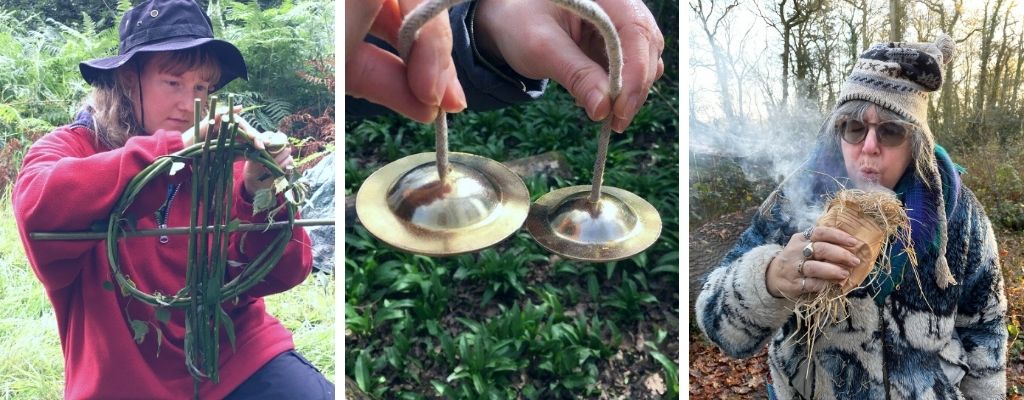
  • Craft your own wild weaving to take home
  • Unwind with a tree meditation
  • Roast chestnuts on an open fire
  • Use traditional firelighting tools; flint & steel
  • Build your own Midwinter campfire; bring light to the dark
  • Set your intentions for the new year ahead
  • Make herbal teas from wild plants
  • Discover what your Celtic Birth Tree is and what it says about you

Event details

Date: Sat 21st Dec 2024

Time: 10:00 am – 2:00 pm

Venue: Park in the Past

Cost: £35

midwinter solstice event in the woods

Your Tutors: James & Lea Kendall

James is the Head Bushcraft Instructor at Woodland Classroom, having worked in environmental education & conservation for over 10 years. James’ approach to teaching  steers his students toward fostering a deeper connection with nature through understanding the landscape around us; “Bushcraft skills are an effective way to do this as we learn how to make use of natural materials and live lightly with the land, whilst also connecting with our own ancient past by seeing the land through the eyes of our ancestors.”

Lea is a qualified Counsellor and Mindfulness in a Woodland Setting practitioner. She is a firm believer in the power of nature to be therapeutic for everyone. Lea is an active forager, passionate about how we can use common plants for both food and medicine. She enjoys making her own tinctures and medicinal remedies for treating common ailments.

james and lea kendall - outdoor education tutors
midwinter solstice gathering in the woods

Skills you will learn

Over the course of the programme you will learn a range of skills, including…

null

Nature Connection

null

Hedgerow Medicine

null

Mindfulness

null

Greenwood crafts

null

Firelighting Skills

null

Ancestral Skills

null

Tree & Plant identification

null

Meditation techniques

Book now

This session costs £35 per person and is open to adult learners aged 16 years and over. You can read our Event Terms & Conditions here.

wassail ceremony in north wales

Wassail & Lantern Making

Celebrate This Ancient Apple Festival with your Family

Crackling fire, glowing lanterns, steaming hot mulled apple juice and merriment a-plenty for all the family! Celebrate a traditional Wassailing with us as we bless the fruit trees for a bountiful harvest. Let’s face it, January is a rubbish month when nothing much happens, but in villages up and down the country, around Old Twelfth Night, traditional Wassails are returning, so let’s bring some light and celebration to this time of year. Families with children of all ages are welcome to join us under our big parachute shelter at Park in the Past for an event which promises to be very special and magical with music, food and good company. “Wassail!”
Make a lantern with your family and join our procession to the orchard where you will learn about the tradition of wassailing and take part in the ceremony. We will be passing around the traditional wassail bowl filled to the brim with our secret winter-warming recipe, sharing slices of home-made apple cake and cooking up sticky toffee apple slices over the campfire. Come a-wassailing, as we sing-along to traditional songs of the season with live music provided by James’ mandolin.

Lea and James will be your guides to this traditional celebration as we gather under our huge parachute canopy and share the warmth of the winter fire.

  • Craft a paper lantern with your family
  • Enjoy hot mulled apple cider (non-alcoholic)
  • Traditional Wassailing ceremony – blessing of the trees
  • Cook up toffee apple slices on our blazing campfire
  • Join the lantern procession to the orchard
  • Share a sip from the wassail bowl & munch on apple cake
  • Sing-along with wassail songs; James will have his mandolin
  • Discover the ancient traditional of Wassailing & learn the history behind it

WHAT IS WASSAILING?

Wassailing refers to drinking (and singing) the health of trees in the hopes that they might better thrive. The purpose of wassailing is to awake the cider apple trees and to scare away evil spirits to ensure a good harvest of fruit in the autumn. The ceremonies of each Wassail vary from village to village but they generally all have the same core elements. A wassail King and Queen lead the song and procession to be played from one orchard to the next. This ancient British tradition is still very much thriving today.
Want to know what Wassailing is all about? Come along and find out what roles soggy toast, pots & pans and a child up a tree have to play in this ancient tradition. By wassailing the apple and pear trees we will be blessing them for a bountiful harvest next autumn. The old call will go out for “Hatfuls, capfuls, three bushel bagfuls and little heaps under the stairs!”

Event details

Date: Sat 11th Jan 2025

Time: 3:00 pm – 6:00 pm

Venue: Park in the Past

Cost: Family (up to 4) £35

wassail in north wales

Your Guides: James & Lea Kendall

James is the Head Bushcraft Instructor at Woodland Classroom, having worked in environmental education & conservation for over 10 years. James’ approach to teaching  steers his students toward fostering a deeper connection with nature through understanding the landscape around us; “Bushcraft skills are an effective way to do this as we learn how to make use of natural materials and live lightly with the land, whilst also connecting with our own ancient past by seeing the land through the eyes of our ancestors.”

Lea is a qualified Counsellor and Mindfulness in a Woodland Setting practitioner. She is a firm believer in the power of nature to be therapeutic for everyone. Lea is an active forager, passionate about how we can use common plants for both food and medicine. She enjoys making her own tinctures and medicinal remedies for treating common ailments.

james and lea kendall - outdoor education tutors
wassail event in north wales

Skills you will learn

Over the course of the evening you will experience a range of activities, including…

null

Nature Connection

null

Campfire Treats

null

Family Bushcraft

null

Ancestral Skills

Book now

Tickets are £35 for a family of up to 4 people. Additional family members are £5 each Additional children aged under 3 come free. You can read our Event Terms & Conditions here.

wassail event north wales

The Perfect Wild Mushroom For Beginner Foragers: Parasols

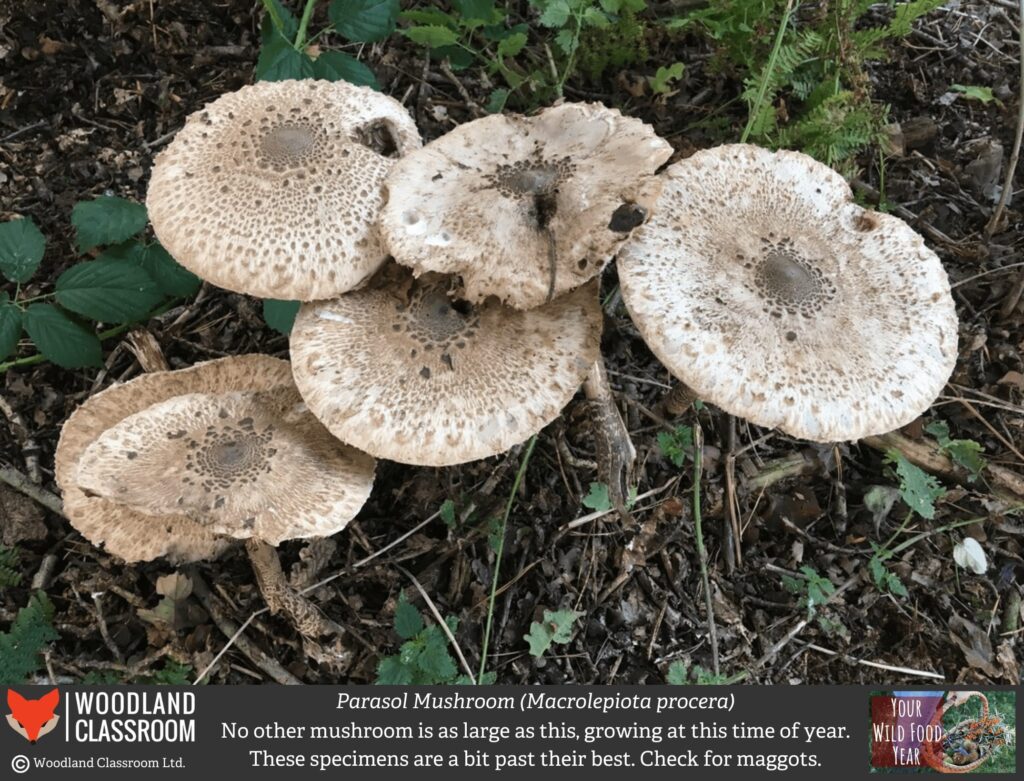
There is something magical about the idea of going out to the countryside and finding wild mushrooms to cook with. It scratches an ancient itch in our hunter-gather brains. If you’re looking to get into this addictive hobby then the Parasol Mushroom (Macrolepiota procera) is a great beginners fungi for anyone wanting to start wild mushroom foraging.

My name is James, I teach Bushcraft and Foraging in North Wales. I am the co-creator of Your Wild Food Year, an online course for anyone wanting to gain confidence in identifying, harvesting and cooking with wild foods. In this article I will introduce you to this commonly found edible fungi. You will learn how to identify it, where and when to find it, how to cook with it and what poisonous lookalikes you will need to avoid. Let’s dive in.

how to identify parasol mushrooms - wild food & foraging

Where & When Can you Find Them

We have found good specimens as early as late July but it’s most often seen from late August and through September.

You’re most likely to find it in meadows and unimproved grassland. I’ve also found it at the edges of ancient woodland. The three locations I see it often are all National Trust estates, so that points to land that has been consistently managed over a long period.

At what growth stage should you harvest them? Well you can pick them when they’re not yet fully opened. But if doing this be sure you’re not confusing them for the Shaggy Parasol (more on that below). Basically if the specimen looks like it’s in good condition you’re good to go. Ensure you fungi is free of mold, sliminess on the gills and the cap is not starting to wilt. One word of caution, you do often get the odd maggot or two inside the cap, which you only find when you’ve taken them home and started to chop them up. These are more typically found in older specimens. If there’s just one or two, I pick them out and use the mushroom anyway. What you do is down to personal preference.

how to identify parasol mushrooms - wild food & foraging

how to identify parasol mushrooms - wild food & foraging

How To Identify Parasol Mushrooms

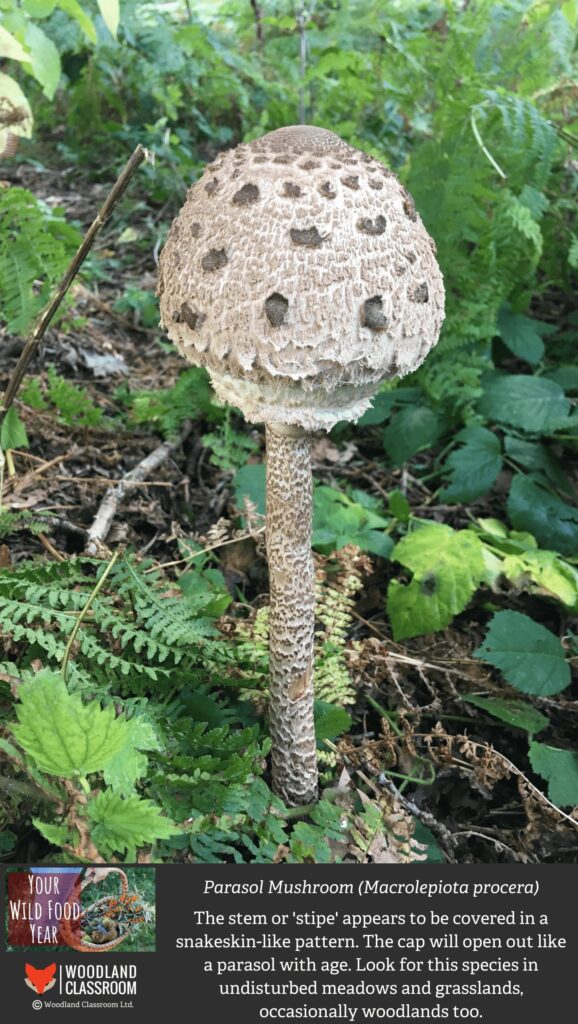
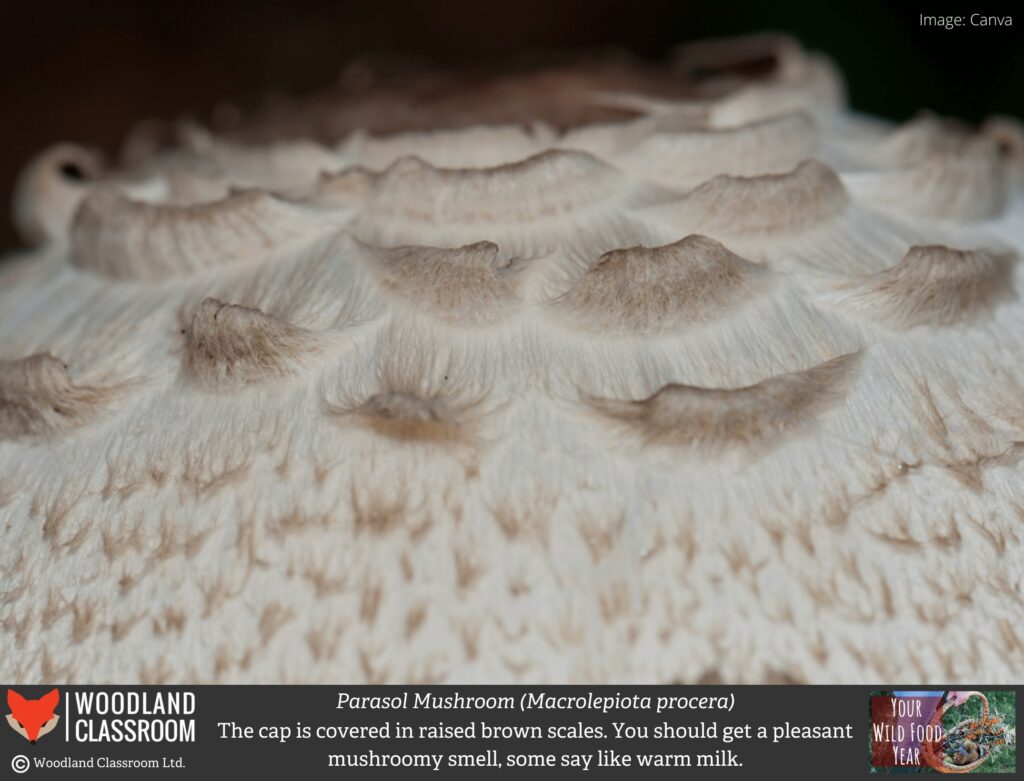
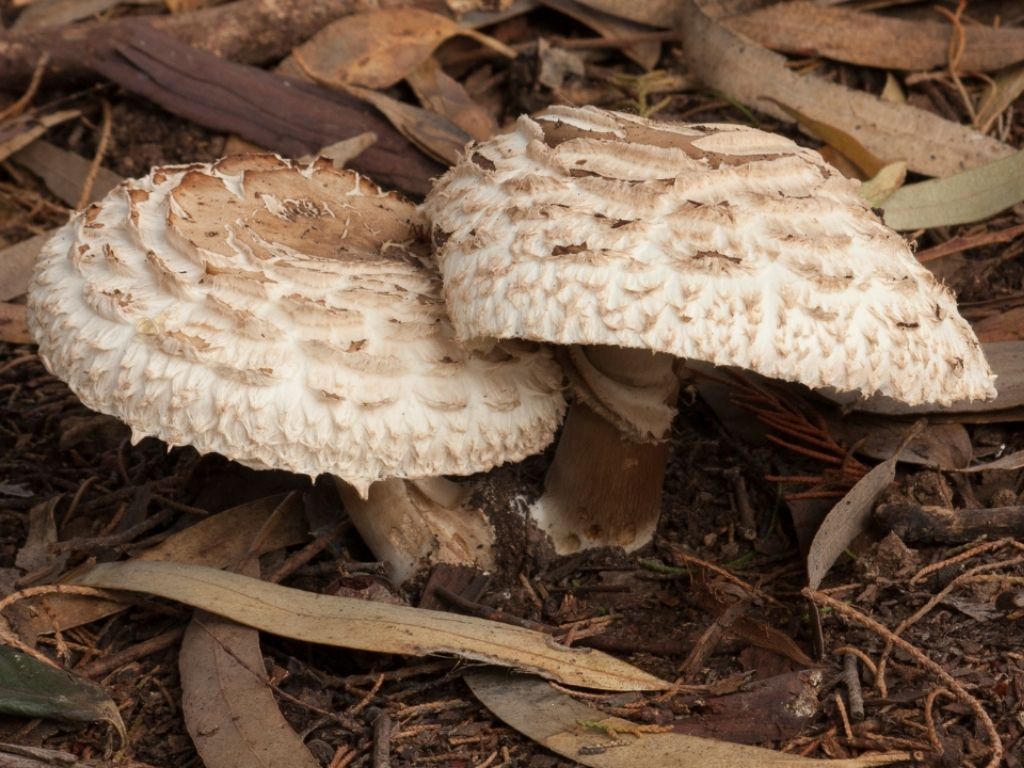
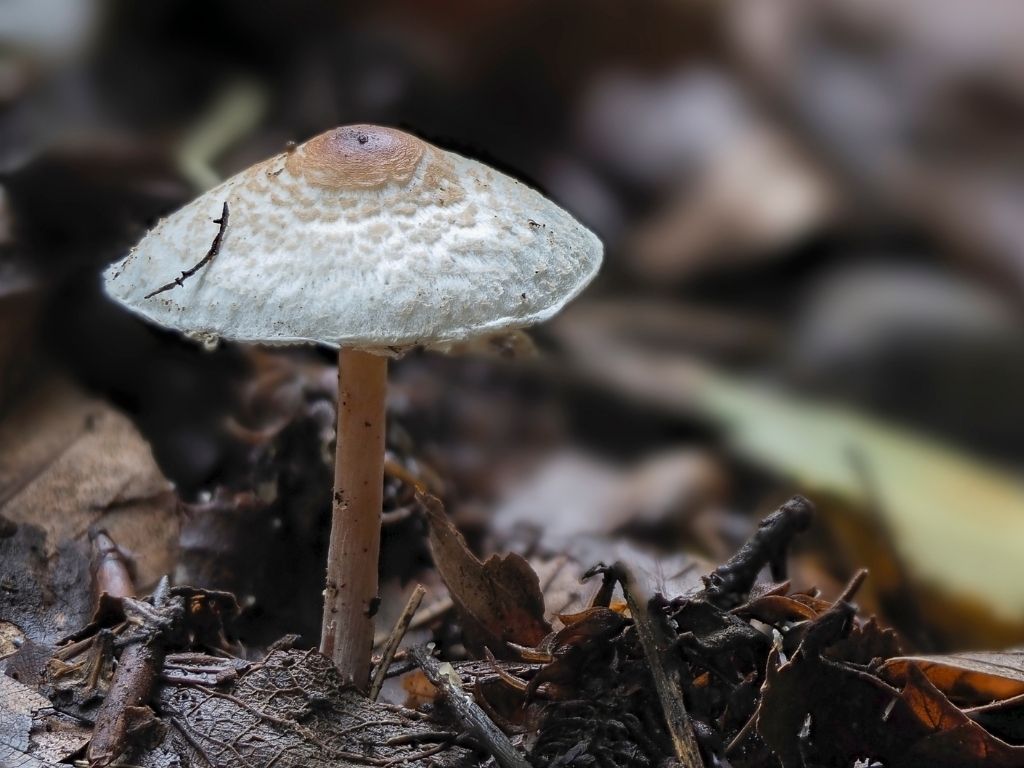
Well, true to its name it resembles a parasol umbrella. You’ll find a distinctive brown ‘nipple’ raised in the centre of the cap. The cream-white cap meanwhile is also patterned with light brown scales. Something that is important (you’ll see why later) is the typical size of the cap. When fully open they can grow to 15-35cm across diameter, so they get seriously big! You’re getting a lot of food from your forage here.

Looking underneath the cap you will find gills rather than pores. These are cream-white in colour. The flesh of the mushroom doesn’t discolour when bruised, it stays cream-white.

The stem (otherwise known as a stipe) is again cream-white in colour and looks like it’s covered in a snakeskin pattern. It can grow quite tall, reaching up to 25cm in height. You will also typically find a ring surrounding the stem. If handled carefully this can be separated from the stem and then it runs up and down freely. Another good way to identify this fungi.

You shouldn’t forget to use your nose when learning to identify wild mushrooms. Some fungi have really distinctive aromas, like Dryad’s Saddle which smells surprisingly like melon. Parasols have a pleasant mushroom-like smell which some say reminds them of warm milk.

how to identify parasol mushrooms - wild food & foraging

how to identify parasol mushrooms - wild food & foraging

How To Use Parasol Mushrooms In Cooking

Parasols have a nice, firm texture and a pleasant mushroom flavour. They do dry well, retaining their smell and flavour. So, we often slice up any excess mushrooms and pop them in our dehydrator. This means you can enjoy them right through the winter in your cooking.

Some people prefer just eating the caps but you can eat the stem, in fact some experts say there’s more goodness to be found in the stem of fungi than the cap. The flesh is not as soft as the cap though, so some folks use these for making a mushroom stock.

Like most mushrooms they go great in an omelette, in a quiche, stir fry or added to a stew. Try deep-frying them in breadcrumbs and serving with lemon and garlic mayo. The sheer size of the cap makes them an excellent replacement for the a large field mushroom in your cooked breakfast. Lovely stuff all round!

wild mushroom and nettle tart

We made this tasty wild mushroom and nettle tart, cooked in our dutch oven over the campfire.


Caution: Beware The Shaggy Parasol

As with any foraging of wild mushrooms, you need to widen your knowledge beyond just the species you’re looking for, or think you’re looking at. As the old saying goes; “There are old foragers and bold foragers, but there are no old, bold foragers.” Heed these wise words folks.

If you’re going out looking for Parasols then you need to be aware of the closely related and similar looking Shaggy Parasol (Macrolepiota rhacodes). This is not a poisonous species, however with around 20% of people it’s been known to give them a bit of an upset stomach.  It’s found in similar habitats and at the same time of year. Let’s learn more about the differences between the two fungi.

As the name suggests it is shaggier in appearance. Also the base of the stem is typically more bulbous than with the Parasol. It also doesn’t grow as large as the Parasol, the cap only getting to around 8-15cm in diameter and the stem reaching 12-18cm height. So a good way to avoid Shaggy Parasols would be to only pick fungi that are larger than this.

Remember that the flesh of the Parasol doesn’t bruise when handled? With the Shaggy Parasol this isn’t the case. The gills will bruise red and the flesh will turn an orange/red when you cut it.

This fungi also has a ring around the stem, but unlike the Parasol, this ring will not separate from the stem. So there’s another method of differentiating between the two.

shaggy parasol - wild mushroom foraging

Shaggy Parasol (Macrolepiota rhacodes). It can give some people an upset stomach. Image by Canva.

So, can you eat this mushroom? Well yes, but as I’ve said it can disagree with some people. So good practise is to try just a little bit and leave it 48 hrs to see if your stomach is happy. If so, tuck in. Be aware though if you are going to eat the Shaggy Parasol, it must be cooked first.

One last fungi to mention here are the Dapperlings (Lepiota spp.) They are poisonous so need to be avoided. How could they be confused with Parasols though? Well they have a distinctive brown spot in the centre of the cap too. However, the saving grace is that they do grow much smaller than the Parasols. As a general rule, avoid picking any Parasols whose cap is less than 12cm in diameter.

Hopefully this has not put you off heading out the door for your first Parasol mushroom. If anything I hope it will make the thrill of the hunt even more enjoyable and the reward of positively identifying your Parasol all the more satisfying.

dapperling - a poisonous wild mushroom

Stinking Dapperling (Lepiota cristata). A common member of this poisonous group. Note how much smaller it is than the Parasols when fully opened out. Get to know them. Image by Canva.


Discover More Wild Food

If all this talk of wild food and foraging has whetted your appetite then you can take your learning further with us either outdoors or online.

You can immerse yourself in the world of foraging through our outdoor courses hosted in beautiful National Trust estate woodlands in North-East Wales. Or if that’s too far afield for you we also host regular online workshops, live through Zoom where we focus on wild foods of the season and give you delicious recipe ideas, foraging tips and expertise from special guest speakers. If this all sounds interesting, check out what’s coming up on our Events page right here.

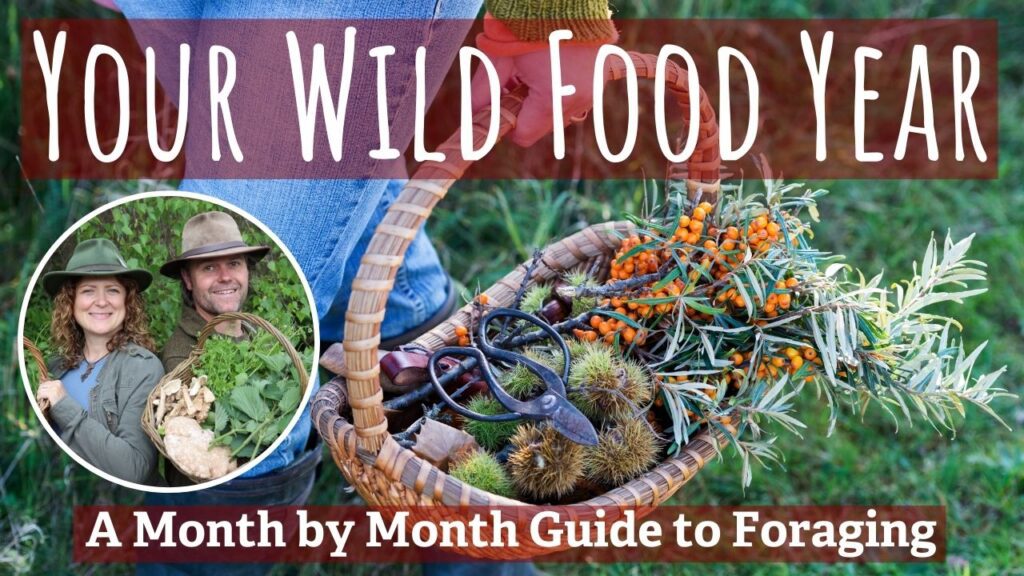
I think you’ll also be interested in our flagship online foraging course called Your Wild Food Year. When you enrol on this course you will go from clueless to confident on your journey to enjoying foraged plants, fungi, fruits and more with this detailed guide to identifying and cooking with the best wild edibles of Great Britain & Ireland.

Discover the joy of finding, harvesting and cooking with wild food with the very best each month has to offer. You will learn what to look for, where to look, and what to do with it in the kitchen. You will have videos, photo galleries, recipes and more at your fingertips, all taught by experienced foragers. Discover over 70 wild foods!

Crucially, you’ll also learn when to look. As each month we bring you the edible fungi, flowers, fruits and foliage which are in season from January to December.

There is even a FREE TASTER version of the course so you can try before you buy and see if the larger course is something that’s a good fit for you. So, start your journey to becoming a confident wild food forager today. Find out more right here.

“I’d always loved the idea of foraging for wild mushrooms but was too scared to try it. This course has shown me which species I can pick with confidence. The wild fungi hot spots I’ve discovered in my local area are now my closely guarded secret 😉 Thanks Lea and James.” Matt Corcoran

Your Wild Food Year - online foraging course

Until next time, stay safe and remember to always be 100% sure you have correctly identified a wild edible before consuming it. Good luck with your own foraging journey.

James

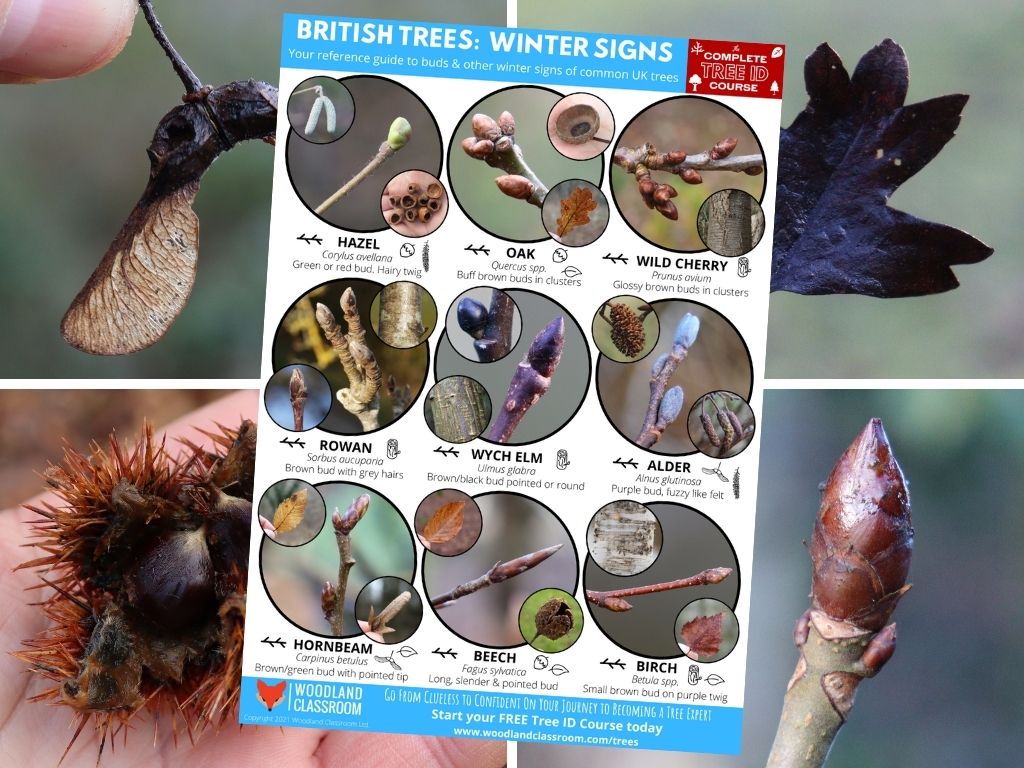
free winter tree id guide to UK & Ireland

FREE Winter Tree ID Guide

Many of us might well be able to spot an oak in winter by looking for fallen acorns or the familiar leaves, but could you tell me the difference between blackthorn and hawthorn in winter just by looking at the buds? Or do you know which trees give themselves away in winter by their bark? We might be able to identify trees in summer when their leaves are on but winter is a whole different ball game.

For anyone looking to improve their tree identification skills winter provides us with many distinctive signs such as buds, bark, twigs and fallen leaf litter that we can use to recognise our native and common tree species. The clues are all there if you know how to look.

In this blog I’ll introduce you to some of clues to look out for in winter and break down the differences between common trees which often get confused. You can get outdoors and spot these clues for yourself with a free download I’ve created; Winter Trees Guide, which you can get your hands on just below.

free winter tree id guide to download

By the way, if you love trees, but struggle to tell one species from another, then you could enrol in my FREE Tree Identification Course online. More details can be found at the end of the article.


Bud Arrangement: The BIG Giveaway

One of the first things you can ask a tree when you are trying to identify it in winter is this; “Are the buds arranged alternately or in opposite pairs?”

This is absolutely key to nailing the species of tree as once you’ve answered that question it allows you to eliminate a whole bunch of species from your enquiry.

The majority of native tree species in Britain have their buds arranged alternately along the branch.

One last thing to remember; it’s important to select a young healthy twig to answer this question because as a branch matures it will often self-select the healthiest of the twigs to grow on and will drop it’s near partner. So, you can be looking at an older branch and thinking that they definitely don’t grow in opposite pairs, but then on closer inspection you might well notice the old scar left over from where it’s opposite equivalent was self-selected to be dropped by the tree in favour of it’s partner.

When you become practised at this you will begin to start noticing the bud arrangement from a distance, as you look at the form of tree. This is when tree identification can become very satisfying and you can really start showing off.

In the Free Winter Tree ID Guide I’ve grouped alternate budding trees separate from opposite budding trees for easy reference.


Blackthorn vs. Hawthorn

Let’s take two very common trees which often get confused. Not only are their names similar, but they also are thorny, shrubby trees which populate our hedgerows, often growing side by side.

To help confuse matters both these species have alternate buds and the buds are very small and grow in cluster at the end of the twig. So, we need to look at other clues to help us out.

hawthorn and blackthorn winter tree identification

Above: Blackthorn (Prunus spinosa) on the left, Hawthorn (Crataegus monogyna) on the right. The difference is clear.

The first thing to look for is leaf litter below the tree. As you can see from the picture, the leaves shapes are very different. However, this method is unreliable when you’re looking at a dense hedgerow and the two species are intertwined. How can you tell which tree the leaf has fallen from? Luckily, there are other signs we can go to also.

identifying blackthorn and hawthorn in winter

Above: Blackthorn on the left, Hawthorn on the right. Bark is a feature you can use year round to identify a tree.

Looking at the bark is going to be useful here as, like the leaf litter, they are very different. The bark of blackthorn, as its name suggests, is very dark and seems to soak up the light. It is also generally quite smooth. The bark of hawthorn is much more grey to brown and fissures readily, being much more craggy.

As well as the bark you can look at the thorns, which typically you will see a lot more of on blackthorn than you will compared to hawthorn. The last sign to help us here is the autumn fruits, which can often be found still hanging on in winter.

comparing blackthorn and hawthorn in winter

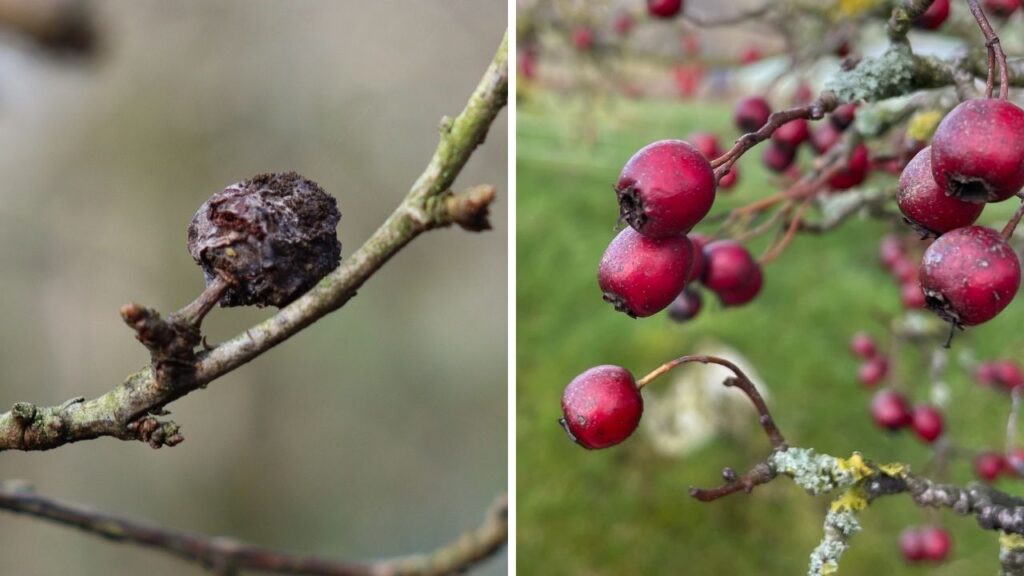
Above: On the left, Blackthorn can hang on to a few withered & dried sloes in winter. On the right, hawthorns often has smaller, deep red berries on show in winter.

The autumn fruit of blackthorn is the sloe. A good size fruit, around 1.5cm diameter and purple to black in colour. In winter though they are shrivelled and looking much worse for wear, with most of them having fallen already. Hawthorn in comparison holds onto it’s berries better in winter. Look for smaller, dark red berries, with an ovoid shape, growing in sparse clusters. As they dry out they darken in colour.


Looking Under The Tree

Have a good kick about in the leaf litter under a tree and you might find another big hint to what species you’re looking at. The old saying goes “the apple never falls far from the tree” and that’s good news for us in this case. I’m talking about fallen fruits and nut cases, many of which can still be found in the depths of winter, if not in the best condition.

winter tree identification: fallen fruits and nuts

Top Left: Crab Apples. Mid Top: Sweet Chestnut. Top Right: Hazelnuts, nibbled by wildlife. Bottom Left: Conkers from Horse Chestnut. Mid Bottom: Beech mast and leaf litter. Bottom Right: A bract from a Lime tree.

Some trees, like the Crab Apple, have a dead giveaway with the fallen, rotting fruits. Look under an established hazelnut and you’ll most likely find empty nut shells, nibbled away by rodents and birds. Then there’s tree like out three native Limes which have special leaves called bracts, which look like nothing else you’ll find on the woodland floor and can only belong to a Lime tree. Beech mast is very reliable under mature trees and you’ll find yourself crunching in underfoot as it carpets the woodland floor. There’s much to be gained by looking down.

Now this only works if there’s something to find and also you should be wary of relying on this too heavily where the tree is crowded with others as  what you’re looking at may have fallen from it’s neighbour.

By the far the most reliable method of winter tree identification is to begin with a branch and study a healthy twig and it’s buds. That way we can be sure we’re investigating the right tree and the knowledge of bud and twig is transferable no matter whether the ground below is humous or concrete.


Get Your FREE Winter Tree Guide

I’ve created a handy guide you can use when you’re out and about looking at trees during winter. The guide features 18 native and common British trees which have buds, twigs and leaf litter that you might already be familiar with but also there’s other signs here that you’ve probably never noticed before. I’ve laid out similar looking species side by side so that you can easily distinguish between them.

The guide puts the focus firmly on the winter buds but you’ll also see smaller images featuring other clues you can look for in each species such as old fruits, leaf litter, nut cases, bark and catkins. Where I’ve included these they act as dead giveaways to which tree species you’re looking at.

I hope you find it useful on your journey to understanding the trees around us.

DOWNLOAD YOUR GUIDE HERE


Discover more About Trees

It can be so interesting to really look in to the details of our native trees and notice the changes that they undergo throughout the four seasons. That’s just what I’ve created for my FREE introductory online course called Kickstart Your Tree ID Skills. Here you will find a whole host of resources to take you from clueless to confident on your way to really knowing your trees.

REGISTER FOR THE FREE COURSE HERE

kickstart your tree id skills, free online course

When you sign up to this free mini-course you’ll be identifying common trees with video tutorials and photo galleries at your fingertips. Start your journey to becoming a fully fledged Tree Expert today. The course includes Tree ID Cheat Sheets which you can download and take outdoors with you.

“I’ve been frustrated for so long trying to learn my trees myself and haven’t gotten far. This course answered everything and has seriously upped my game.” Dr. Patrick Alexander


Happy tree hunting folks.

James

bushcraft skills course in north wales

My Weekend in the Woods

Have you ever wanted to learn skills that would help you thrive in the wild, from how to read the landscape to lighting a fire with natural materials? My name is Emily Fox and I was asked to write about my experience attending a Bushcraft Skills Weekend with Woodland Classroom.

Woodland Classroom host outdoor courses that cover everything from tree identification, foraging and outdoor survival skills, but in reality those lines often blur as there is so much cross-over in these subjects, so I was looking forward to a little of everything. In this blog I’ll be taking you along with me as I tell you what I got up to in my weekend in the woods. To check out what other outdoor courses we have coming up click here. 

I’m already a pretty outdoorsy person, I’m really into my climbing and love hiking, especially around Snowdonia and the Lake District.

I spend a lot of time hiking and running around in the woods wherever possible and have even managed a little wild camping, so I’m used to being outdoors. I saw the bushcraft weekend as an opportunity to really step up my skill level and become better at understanding the land around me and how to survive if I found myself short on anything on a wild camp or out in the woods. It was something I’d not really done before so I was excited to see what skills I could learn. Having arrived late on the Friday evening though I didn’t know it would be straight into the deep end!

I was offered the option to sleep out in what looked like the ultimate den of sticks… my answer was, of course, yes. My tent, stayed in the backpack.

natural lean-to survival shelter

Above: My home from home for the weekend. Notice the bed of fresh brush which kept me off the cold floor.

Waking Up In A House Made of Sticks

Waking up on Saturday morning after a full, busy week of fast-paced work and modern living to the sun filtering through the pine trees as I lay on a bed of bracken under the canopy of the lean-to shelter was the most relaxing start to the weekend I’ve ever had. It put me right in the zone. I’d jumped at the chance to come and help at a bushcraft weekend in Wales as it sounded like the perfect getaway, and I was even more excited when I was offered an outdoor shelter to sleep in for the night. My lean-to was made of just sticks, leaves and branches, not a plastic tarp in sight, but despite it having rained the whole day before this natural shelter was bone dry and I slept like a baby the whole night!

After introducing ourselves to the group James, our Head Instructor, took us into the woods and asked us to look at our surroundings and share what we could tell about the landscape around us. I was asked to read the landscape; what did I notice about the age of the trees, did I recognise any plant species, how might the land-use have changed over time and where could water possibly be found? This was all about waking up our inner-ancestor and looking at the land through ancient eyes, those people that relied on the land for their survival. We were then tasked with going and having a look to see what natural materials we could gather that could be useful to us. Spruce resin for fire building, blackberries for eating, flexible willow branches for weaving and spruce needles for natural medicine were all things students brought back.

making survival shelters

Above: Constructing a kennel shelter. The whole thing is held up by just 3 poles. No rope is used.

Sharp Tools & Shelters

The first activity was to whittle a tent peg from greenwood, something that would come in handy later. James showed us safe ways to use a knife, cutting techniques and knife grips to use in making the peg. I was pleased with my finished peg and tucked it into my backpack for tomorrow. Having shown we were safe with the knives we were allowed to keep them on us for the weekend. Next we were onto natural shelter building, similar to the one I’d slept in last night.

The group was split into two and each team was guided through making a different style of lean-to we split into two groups and got to work building different types of lean-to shelters. James showed us how to use bundles of bracken, like thatching, to make a layered waterproof covering to keep the shelters dry. Working in smaller groups let us be super involved in each activity and allowed us to get to know the people we were working with a lot better. Using these materials was time-consuming, compared to putting up a tent, but they were also surprisingly effective and I got a real sense of achievement from creating this structure. It’s an empowering experience and I can see why bushcraft skills can be addictive – the idea of being able to fend for yourself, accessing “secret” knowledge.
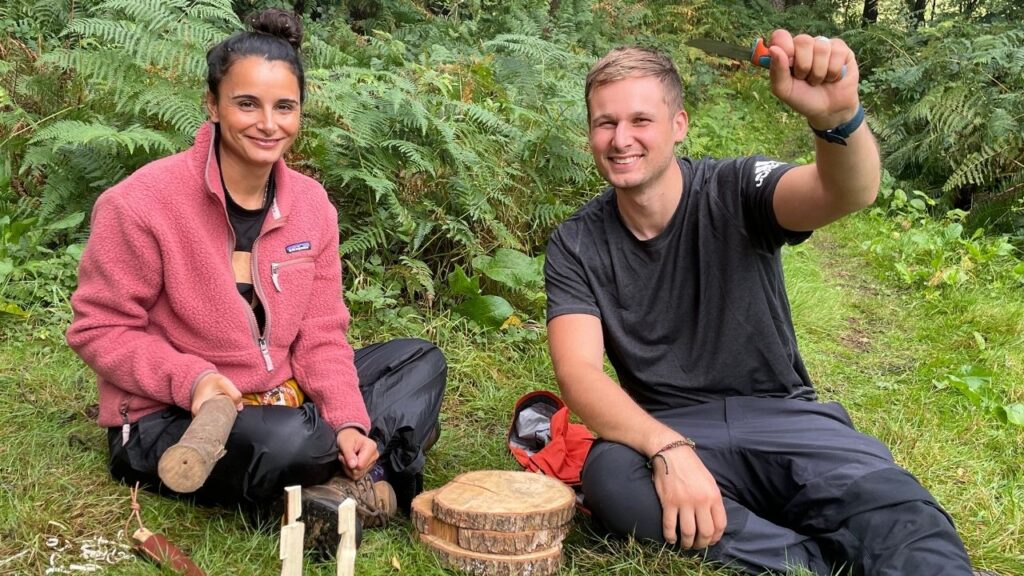
whittling skills on a bushcraft course

Above: Other folks on the course very happy with their brand new tent pegs.

Playing with Fire

After lunch at basecamp we went back into the woods to start on fire making. We began by looking at all the components we needed to actually light and sustain a fire. The three essential aspects of a fire are heat, fuel and oxygen. I would need all of these things in abundance to keep my fire healthy. I experimented with lighting fires using modern fire-steel and traditional flint & steel. I was given cotton wall and char-cloth (made my baking natural fabrics) and I soon saw that without any substantial fuel the flame only lasted for a few seconds before dying off.

I learned that by adding an accelerant, either something I could bring with me like vaseline or something gathered from the woods, such as spruce resin. My little fire lasted a lot longer, around thirty seconds instead. We then used this principle to find natural tinder, kindling and accelerants before building our own fires, gradually building our firewood thickness until we got from a small flame to our own roaring campfire that could sustain us through the night if needed.

It really is true that once you have a simple roof over your head and a fire going, you can feel at home anywhere. The cup of tea helped.


Identifying Trees in the Dark?!

Just as the sun was setting James ran a night-time tree identification walk. Now this sounds intriguing; how can we possible identify trees in the dark? We took a stroll in the darkening woods to see if we could hone our skills, with James teaching us how to recognise trees based on just the leaf shapes, texture of the bark and shape of the tree against the sky. There were some really interesting conversations about how we each recognised certain trees. For example, someone commented on the fact that the oak tree was easy to identify by its outline because it was often used on pub signs. James encouraged us to closely examine the trees we came across; see what the leaves felt like, how the branches were structured, all whilst encouraging us to draw on what knowledge we already had. I was also encouraged to engage my other senses. I discovered that I could recognise a mature beech with my eyes shut as I could hear the crunch of the thick layer of beech mast beneath my feet – result! James was giving out ‘bushcraft points’ to anyone with correct answers. I earned 5 bushcraft points for remembering that holly leaves further up the tree aren’t spiky because animals don’t graze on them, then lost another two for excessive gloating, oops!


Easy Like Sunday Morning

Another comfortable night in my stick home, with the tawny owls hoots for company. James had explained that by crafting a raised bed from, logs brash and bracken layered up that it raised my body off the cold ground and so added a lot of insulation. It’s said that layers below you are much more valuable than a layer on top when sleeping on the earth.

I started Sunday with a nature-awareness exercise, called the Sit Spot. James talked to us about connecting with nature by taking a moment to sit outside and quietly observe what was happening around us, without expectation or agenda. With that we each slunk off into the woods to find a quiet comfortable spot. I sat for 20 minutes to take in everything going on around me before coming back and reporting what we had seen, heard or felt. It was lovely to start the day by connecting deeply with our environment. Tis is a real contrast to the attitude I adopt when hiking where the purpose of being outdoors is to get from one place to another, rather than simply allowing myself and nature to be.

water filtering and billy can cooking

Above: Hanging out billy can above the fire using campcraft skills. Filtering dirty water using natural materials.

Making My Ultimate Woodland Getaway

The majority of today was all about putting together the skills we had learnt so far. The goal was to be able to set up our own shelters, start a fire and make a cup of tea in our camps. I would need to use my knife for cutting, shelter building skills, I’d need a way to hang my billy can over the fire and I’d need plenty of firewood. Lots to be getting on with.

The first activity was to filter water using natural materials we could find in the woods as well as artificial ones to. We would not be drinking the water we filtered aa this should only be done in a real situation, but it was good to see the principles at work. We then worked on making natural cordage using nettles and bramble. This cordage could be used for our shelters or for hanging our billy can. James showed us how to identify the most suitable bits of plant to use and how to dry and braid the strands to make a strong cord which could be used for years.

Since yesterday we all made a natural shelter, today we were given a one-person tarp (called a basha) to rig over our makeshift camps. James introduced me to a couple of knots for getting it all taught. Our group decided to combine the tarp alongside the lean-to I slept out in so we had a covered area for our outdoor fire – very cosy indeed. Our whittled tent pegs and natural cordage came in handy here and we saw how strong this natural fibre really was when put to the test of holding up our shelter.

Next we worked we turned to campcraft skills with the challenge of creating something that could be used to hang our billy can for boiling our brew over the fire. I worked with a couple of others, each of us made a different part of the frame from hazel wood before moving the various components over to our camp. Each group came up with a totally different way of solving the problem which was good to see. My trusty tent peg came in handy to anchor the pot pole. I used my wild cord to make the billy can adjustable so we could lower it down or back up depending on how intense we wanted the boil.
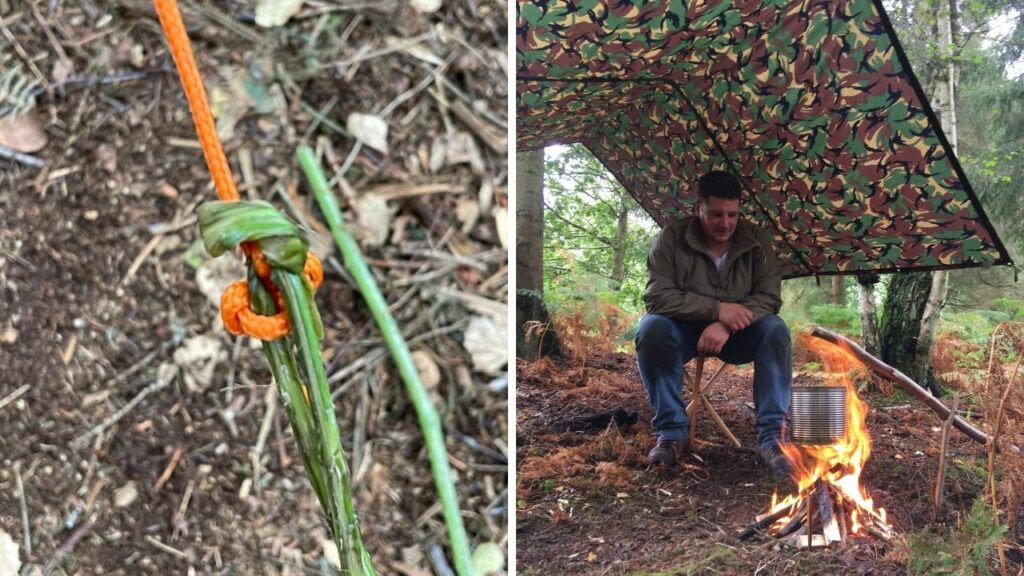
natural cordage and survival shelter

Above: We combined paracord with our bramble cord to tie off our shelter. Matt looking very content in his woodland home.

Making Fire… in Heavy Rain!

It was time for the big finish, practising ancient fire by friction skills. Something I had read about and seen on YouTube but not done myself yet. Now it’s very important that certain components of this traditional fire-starting kit be kept bone dry. We were all set, feeling somewhat confident… and then the heavens opened! We were to make our fires using bow drills and due to the rain coming down we decided to work in teams to increase our chances of success rather than everyone struggling individually in unideal conditions. I get the feeling this is how our ancestors would have pulled together in a real situation… so it’s not cheating.

Once James showed us the technique I was surprised how quickly we achieved smoke and the beginnings of an ember. James tressed how success comes not from powering through to eventual success but using good technique and communication with each other to ensure the best chance of making fire. Unfortunately, for a beginner like me, these were not ideal conditions. The rain was getting heavier and this made it hard for us to create any sparks or for a flame to catch in our tinder nest, but with a little help, we eventually managed to get a roaring fire going and enjoyed a well-earned hot cup of tea from our billy can. Job done! 

fire by friction skills course

Above: Me working with my group on fire-by-friction to get a good ember for our fire.

Home & Dry

At the end of the day, we had practiced the skills to go out into the woods and thrive on what we could find around us in a sustainable and nature-focused way.

There was something very rewarding about managing to make the bow drilling a success despite the elements being against us. We were shouting when we finally got it going it was an amazing feeling and even though we were all pretty tired at the end of the weekend I definitely felt like I had learnt so much. It was more than just learning skills to use outdoors, it was changing the way I thought about nature and being creative with how I solved any problems I might face if I was in the woods without certain tools. I’ve definitely caught the bushcraft bug.


Ready For Your Own Adventure?

I can highly recommend this course and I’m looking forward to attending more in the future, especially the Wild Food and Foraging Day. If you’re looking for a quality and fun experience like this then do check out our upcoming courses.

Woodland Classroom host outdoor courses on bushcraft skills, wild food & foraging, nature connection and tree identification all surrounded by the beautiful National Trust estate woodland of Erddig and Chirk Castle in North-East Wales. Courses are available for adult learners, families and private bookings. Get in touch if you’d like to know more.

SEE OUR UPCOMING COURSES HERE

Hope to see you in the woods,

Emily

Emily Fox is our Outdoor Activities Assistant, on placement to Woodland Classroom for 12 months. She hopes one day to run her own outdoor activity business where she can share her passion with others.


how to pick wild rosehips - foraging and wildcraft

The Best Way To Eat Rosehips

If you’re not eating rosehips already, you need to start. Not only are they really good for you, but they taste amazing… like a burst of tropical fruit. They are also very common and easy to identify. So, what’s stopping you?

I really look forward to the season for rosehips, they are one of my favourite wild foods. The bright red scattering of rosehips in our hedgerows is one of the biggest indicators that winter is settling in. These vibrant fruits stand out to our eyes and that bright colour could mislead you into thinking that you should stay away from them, but the rosehip can make some delicious winter recipes to keep you going through the colder months.

I made this short video to show you the best way to eat rosehips raw, right off the branch. They make a great ‘pick-me-up’ on a country walk. There’s a couple of essential tips you need to know, so check it out…

Where & When To Find Rosehips

Rosehips grow on wild rose bushes. In the UK there are two species which you can forage from; the dog rose (Rosa canina) and the field rose (Rosa arvensis). Dog rose is found in most parts of the UK, unlike the field rose which is only found in England and Wales. Both species can be eaten so it’s not particularly important to know the difference between the two. These plants are climbers, trailing their way through hedgerows with their stems covered in thorns.

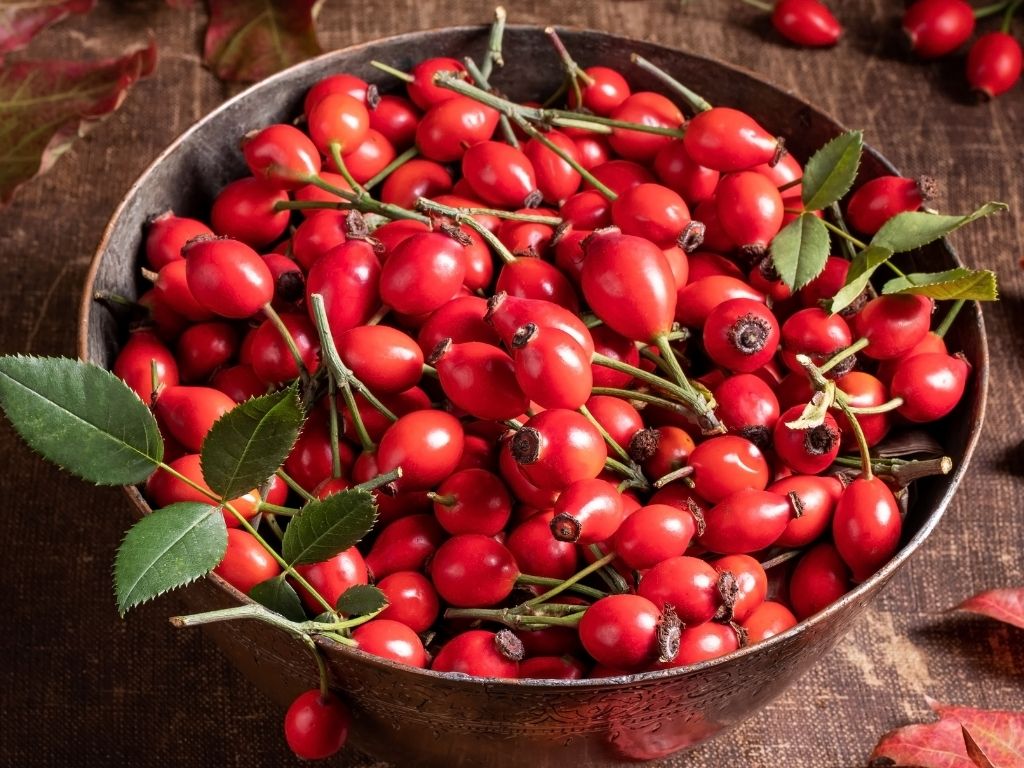
The rosehips themselves are easy to identify as oval fruits which develop behind the summer flower, turning from green to red as they ripen. In the summer the petals for both wild roses are large, being pink to white in colour with a yellow stamen. They have a beautiful fragrance, as you’d expect from a rose.

The best spots for finding rosehips is hedgerows and woodland edges, where the hips can ripen with plenty of sunshine. Scrubland and brownfield sites are also good places to look.

It’s from September that the hips begin to ripen enough to be harvested. They should only be eaten once they are fully red, don’t eat them if they’re still a bit green. There isn’t a particular firmness they are best at; they can be harvested when squishy or hard so don’t worry if you don’t get them right at the beginning of the season. What is important though is that you’re only eating the red flesh. The hairy, yellow seeds in the centre of the hip need to be removed before they can be eaten. These hairs are very fine and can lodge in your throat, being very uncomfortable to digest.

If you haven’t watched our video above already, do check it out so you can learn how to easily remove the flesh from the hairy seeds. Another method can be used back in the kitchen, whilst processing the hips back at home using a muslin cloth (see our method for rosehip syrup below) but if you’re out in the field after a quick hot of that tropical taste then here’s what you need to do:

  • Look for the softer squishy ones with a wrinkled skin. These are found more so at the back end of autumn.
  • To remove the hip cleanly, and avoid being spiked, twist is away from you and toward the stalk. This will usually give a clean break.
  • Hold the rosehip between both thumbs and index fingers equally, with the stalk side facing you.
  • Squeeze the hip with even pressure. A ‘red worm’ of pulp should rise from the hole.
  • Eat the tasty red flesh, discard the squeezed hip.
how to forage rosehips

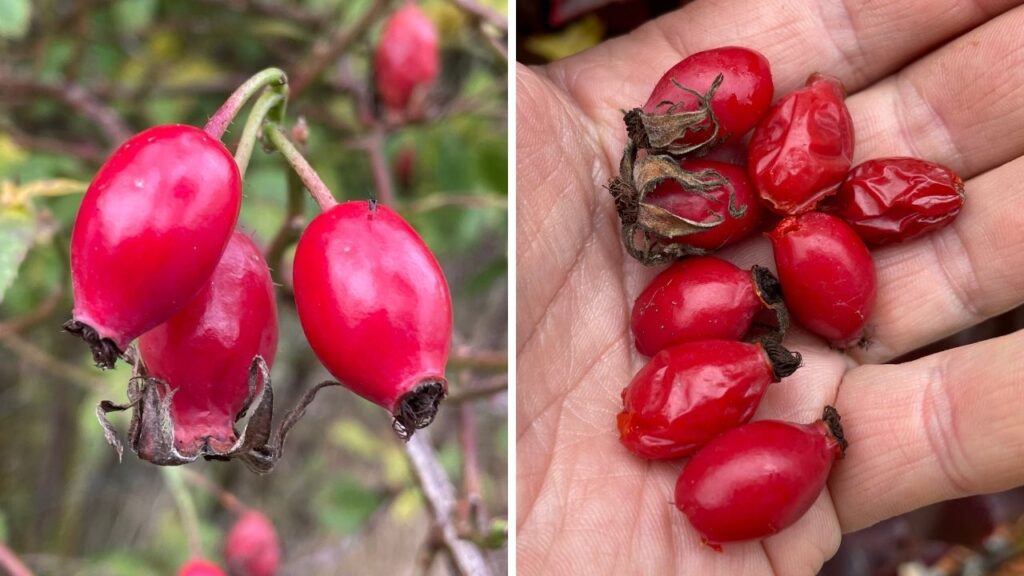
Above Left: Rosehips looking perfectly ripe on the branch. Above Right: These hips are softer and more wrinkled. Perfect for the squeezing method as explained in the video.

How To Make Rosehip Syrup

A more traditional use for them would be rosehip syrup, which was a common sight in the household during the second world war. Due to the UK’s inability to import fruit from other countries, the public were recommended to collect and make their own rosehip syrup to prevent scurvy; two tablespoons of rosehip syrup would more than provide you with your daily dose of vitamin C.  As well as being very good for you, the syrup is deliciously sweet and goes really well drizzled on top of hot sponges, pancakes, and other desserts or you could try adding a little to some lemonade to make a cordial. Below is a recipe for rosehip syrup so you can make your own.

To make a litre of syrup you need: 

  • 1 kilogram of rosehips
  • 3 litres of water
  • 450g of sugar (or honey)

Method:

  1. Remove any leaves and the green ends of the rosehips, then chop them by hand or in a food processor and add to a saucepan with the water. 
  2. Bring to the boil and simmer for 20-30 minutes before straining with a muslin into a clean bowl. Once the juice has been strained, re-strain in a clean muslin cloth. This ensures that all the hairs inside that cause irritation have been removed. 
  3. In a new saucepan add the sugar and simmer together until it has dissolved and the liquid has thickened. 
  4. Transfer to a sterilised jar and keep in a cool place. 

As well as being delicious on pancakes and packed with vitamin C, rosehips also have a fantastic range of health benefits. Amazingly, rosehips contain 2000mg per 100g, compared with the equivalent weight of orange with just 50mg! This little fruit can boost heart health by lowering cholesterol and blood pressure. Rosehips also have anti-inflammatory properties and there is some evidence it can reduce pain and stiffness in joints with osteoarthritis, possibly due to the high level of antioxidants they contain. Cold pressed rosehip oil can also help protect against ultraviolet light, pollution, and cigarette smoke as well as increasing skin elasticity. They also contain high levels of fibre, vitamin A, calcium, and potassium.

I’ve also used them to make a cup of rosehip tea. To try this yourself; halve ten hips and scrape out the seeds and hairs. Cover the hips in boiling water and leave to infuse for a few minutes. You could add a little honey or sugar to sweeten your tea, but rosehips contain their own natural sweetness, so adding sugar is not essential, just see how you like it.
You could always try slicing and drying the hips to make a longer-lasting tea ingredient. If you don’t have a dehydrator, put the halved hips on a parchment covered baking tray and cook on a very low heat with the door slightly open for a few hours to remove the moisture. Rosehips can also be used to make a sweet jam to go on toast or on plain yoghurt. We added halved rosehips to a hedgerow crumble for a burst of colour and flavour amongst the apples and blackberries.

how to make rosehip syrup

Above Left: Rosehip syrup. Above Right: Fruit leather with rosehips, crab apple and hawthorn.

Can I Eat My Garden Roses?

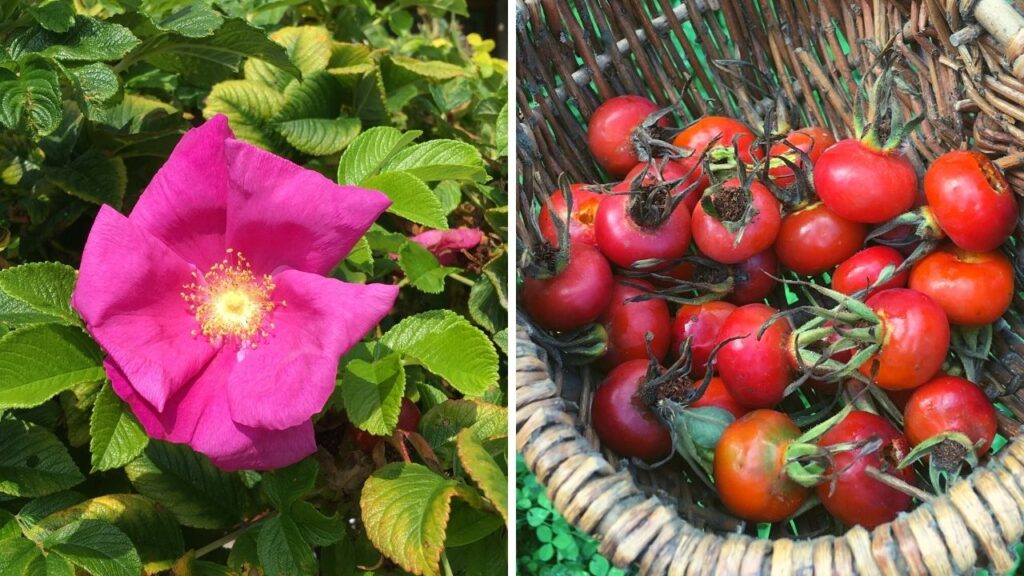
This is a fair question, so let’s look into it. As far as I have researched, all roses are edible. You might well be familiar with the Japanese Rose (Rosa rugosa) which is a common sight in suburban areas and retail centre car parks. The rosehips on this plant are much larger, being more rounded. They also ripen earlier than our native roses. The summer petals on this plant are a beautiful cerise pink colour. Both the petals and hips are edible, as with our wild roses. However I have found that these hips, being larger, are more susceptible to harbouring maggots, especially when they start to soften. So, I would recommend halving them to have a good look inside before using them for any cooking.

Something else you need to be aware of with foraging garden roses, including the Japanese Rose, is that they may have been sprayed with pesticide or plant food, not something you want to add to your diet. So, unless you know the garden or gardener well, it’s best to avoid Mr Jones’ prize roses from across the road. With any foraging it’s important to take a wider view and think about where you’re picking from and what forces those plants are subjected to. As always; if in doubt, leave it out.

foraging for japanese rosehips

Above: Japanese Rose (Rosa rugosa) with striking pink flowers in summer and hips as large as cherry tomatoes.

Discover More Wild Foods

If this has got your appetite for wild foods whetted then you should check out our online foraging course. It’s called Your Wild Food Year, and it covers over 80 wild food species over 12 months. You can find out more about the course here or sign up to a free taster.

Along with my partner, James, I host foraging and wild food walks and courses in North-East Wales at two beautiful National Trust estate grounds. Coming on a course is a great way to learn a variety of commonly growing plants and fungi we can use in our own cooking and also for hedgerow medicine. If you’d like to see what courses we have coming up, then head to our Events page.

I hope this blog has inspired you to try foraging rosehips yourself.

Lea

Social Share Buttons and Icons powered by Ultimatelysocial