Call us on: 07876 794098

Author - James Kendall

identifying trees in winter UK & Ireland

Identifying Trees in Winter: A Beginner’s Guide to Spotting Trees Without Leaves

Yes, You Can Identify Trees in Winter!

I’ll be honest, when I first started learning to identify trees, winter felt like the hardest season to do it. Without leaves on the branches, trees can look like lifeless skeletons, and it’s easy to think that identifying them by species is impossible. But over time, as an outdoor educator, I’ve discovered that winter is actually one of the most rewarding times to develop tree ID skills. It really gets you looking closer at the details, and once you nail winter, identifying trees in summer becomes a breeze.

In this post, I’m going to share with you how I identify trees in winter, focusing on key seasonal features like bark, buds, leaf litter and tree form. I’ll also give you three practical examples to show how these techniques work in the field. And if you’re feeling inspired to learn more, I’ll invite you to join my free online course, Kickstart Your Tree ID Skills.


My Process for Identifying Trees in Winter

When I head outdoors in winter, I focus on four key features that trees display even when their leaves are long gone. Let me walk you through my approach:

1. Buds

Once I learned to recognise buds, a whole new world opened up. They’re like the fingerprints of trees—each species has a unique  combination of shape, colour, and size. It’s important to not look at the bud in isolation though but to consider the twig and most importantly, the arrangement of the buds on that twig. More on that later. Here’s some examples of buds that stand out:

  • Ash (Fraxinus excelsior) trees are easy to identify in winter with their striking large black buds, arranged in opposite pairs. The young twigs of ash are a grey/green colour. The terminal bud resembles a Phillips screwdriver head. Once you see it, you can’t un-see it.


  • Beech (Fagus sylvatica) buds are long, slender (more so than any other common tree bud), and pointed—almost like little cigars waiting to unfurl. The twig of beech is typically slender, with a grey bark.


  • Horse Chestnut (Aesculus hippocastanum) buds are huge! Noticeably larger than other common tree buds. They are arranged in opposite pairs and are sticky to the touch. Look below the buds on the twig and you’ll see what looks like a horseshoe. This is the leaf scar, left over when the leaf fell in autumn. It’s one way this tree got its name.

identifying trees in winter using buds2. Bark

Bark can be one of the easiest and most reliable clues in winter. I love the variety you can find—some bark is smooth, some deeply furrowed, and some even peels away. Not all trees have bark that stands out from the crowd though, there’s a lot of grey/brown furrowed bark out there. But here’s some examples of a few which really ping out to the eye:

  • Birch (Betula spp.) is one of my favourites to spot because of its bright, white, papery bark. There’s nothing else like it.


  • Wild Cherry (Prunus avium), when it’s mature, has a rich brown bark with a high glossy shine to it. Across the trunk you’ll see distinctive horizontal lines called lenticels. The bark also has a peeling quality to it a bit like birch.


  • Beech (Fagus sylvatica) trees live to a grand old age and what is distinctive about their bark is that it typically remains smooth and unifssured even in it’s veteran years when every other tree species around it has long since cracked up. This feature makes the beech an easy spot in winter.

3. Leaf Litter

Even if there are no leaves on the branches, the ground can tell you a lot. I always look for fallen leaves and other debris at the base of a tree. But heed this warning, leaf litter is most reliable when the tree is isolated. If the tree is surrounded by many others, say in a woodland setting, then how can you be sure that the leaves you’re looking at belong to the tree above? So, if I’m not looking at an isolated tree, I tend to use leaf litter to re-enforce the conclusion I’m coming to from already having looked at the buds, twigs and bark. Saying that. here’s some distinctive leaf shapes to look out for on the ground:

  • Oak (Quercus spp.) leaves, with their lobed edges, are usually unmistakable. It’s a shape that appears in so much iconography that most of us know it inside out. The good news is that oak leaves have a high tannin content in them so they are well preserved through the winter for you to find.


  • Scots Pine (Pinus sylvestris) needles can be found anytime of the year below the tree. They will have browned off form their deep green colour, but what you’re looking for are needles which are joined at their base in pairs. Remember “Is it’s a pair, it’s a pine.” Needle length around 5-7cm is typical. This is a great way to spot our only native pine species without having to climb those tricky limbs.


  • Wild Service Tree (Sorbus torminalis) is a native species that most people haven’t heard of. It’s fairly rare, preferring ancient woodland sites. But it’s leaf litter is highly distinctive as it doesn’t look like anything else out there. Imagine a maple leaf (think of the Canadian flag) with 5 pointed lobes, but then it’s been put on a rack and stretched out, elongated. In Autumn time they can be a bright firey red colour.


identifying trees in winter using leaf litter4. Tree Form

I always take a step back and look at the overall shape of the tree, its “posture,” if you will. In winter, there are some trees which have a very distinctive outline and it’s worth knowing these:

  • Look at the outer branches of an ash (Fraxinus excelsior) tree and you’ll see they are smooth, upswept and with distinctive buds and twigs in opposite pairs. To me, the tips of the branches resemble a devil’s pitchfork. Look out for this.


  • Silver Birch (Betula pendula) trees have a habit of being pendulous toward their branch tips. You’ll notice that the end of the branches droop down, sometimes dramatically so, toward the ground and ending in very fine twigs, looking almost like hair swaying in the breeze. This is also a good feature to know as it helps you distinguish this species from other birch trees.


  • Hazel (Corylus avellana) is never a big tall tree. It’s a short shrubby tree that typically grows many stems from it’s base, shooting straight, long and upward to the sky. These multiple stems are often densely packed and made up of thicker and thinner shoots from several years of growth.

identifying trees in winter using form and shape


The Three Steps I Use to Identify Any Tree

Over the years, I’ve developed a simple three-step process that helps me identify trees, no matter the season:

STEP 1: Look at the Tree in Context
Take a moment to tune into your surroundings. I always consider where the tree is growing. Is it in a hedgerow, woodland, or near water? For example, alder and willow trees love wet habitats, while rowan is more common in upland areas. The more you practise your tree identification, the more this habit becomes useful as you ask “what do I expect to see in this environment?”

STEP 2: Begin With A Branch

Rather than getting overwhelmed, break the tree down into parts. I focus on one feature at a time starting with the a young healthy branch. Everything you need to know to identify the species is here in the buds, the twig and any withered fruits that be still hanging on. Once you’ve had a good look here, look closer at the other features such as bark, leaf litter or the overall form. Winter is perfect for this, as these features are more prominent without the distraction of leaves.

STEP 3: Ask A Question, Are The Buds Opposite or Alternate?
You might have noticed I’ve mentioned a few times whether the buds are arranged in opposite pairs or alternately along the twig. This is so important, because trees (for the most part) show one or the other. For instance, if a tree (in our British countryside) has opposite buds, it’s likely to be one of a select few; ash, elder, horse chestnut, sycamore, field maple, spindle, wayfaring tree or guelder-rose. I appreciate at this stage you might be thinking, “I can’t remember all those.” Well you don’t have to, that will come with practise,. Right now, it’s important to just look closer and start to recognise these patterns.


Example of Winter Tree ID in Action

Let’s put it into practise and I’ll share a real-life example where these techniques come into play.

Elder is a very common native tree found in all sorts of woodland and hedgerow. Here’s what i would look out for when identifying this tree in winter…

Bud & Twig – purple buds in opposite pairs on a thin grey twig.

Bark – mature bark is grey, knobbly and corky to the touch, try digging your thumbnail into it.

Leaf Litter – not usually found in late winter as it rots away, so not to be relied upon. If found, it is a composite leaf, made up of typically 5-7 smaller leaflets.

Tree Form – a small, shrubby tree, typically not taller than 6m. Often with multiple stems growing from the base or someway up.

Want to see these identifying features out in the field? You can watch my short video where I investigate the Elder in winter. It’s a snippet from my online tree ID course.


Take Your Tree ID Skills to the Next Level

If you’re excited to learn more about identifying trees, why not join me for my FREE online course, Kickstart Your Tree ID Skills? In this course, I walk you through everything you need to know to identify native UK and Ireland trees, with videos, quizzes, cheat sheets, photos and practical tips to help you grow your confidence.

👉 Sign up here for free and take the first step on your tree ID journey!


Conclusion: Why Winter Tree ID is Worth It

Remember, winter tree identification isn’t as hard as it looks—it just takes practice and a little know-how. By focusing on bark, buds, leaf litter, and tree form, you’ll soon find yourself confidently identifying species even on the coldest days.

I hope these tips and examples have inspired you to get outside and give it a go. And if you want to learn more, I’d love to see you in my free online course.

Happy tree hunting,

James
Head Instructor at Woodland Classroom

Creator of The Complete Tree ID Course

woodland activity leader training in wales

WALT: Accredited Outdoor Leader Training Arrives in Wales

Step into nature with the confidence to lead others. Join Our Woodland Activity Leader Training.

We are thrilled to announce the launch of our new accredited training course Woodland Activity Leader Training (WALT). This program is designed for anyone passionate about leading outdoor education sessions but who may lack the confidence or formal training to do so. Whether you’re a school teacher, park ranger, social worker or health professional, WALT provides the skills and knowledge needed to lead engaging and educational woodland-based activities.

James Kendall, co-director of Woodland Classroom shared his excitement, “Over the years we’ve been asked time and again by so many people whether we offer any accredited training in how to do what we do, hosting woodland based activity sessions. And now we can finally say yes. We’re looking forward to sharing our knowledge, enthusiasm and passion for outdoor education with others so they can take their first steps into this world.”

WALT is the brainchild of Scottish environmental education charity Wild Things! where a need was recognised for a course which empowered and qualified teachers to take their lessons out to nature with a good balance of outdoor learning theory, naturalist knowledge and practical bushcraft skills. Luke Strachan, CEO of Wild Things!, shares, “Wild Things is excited to partner with Woodland Classroom to bring our professionally recognised and much-loved Woodland Activity Leader Training course to Wales! As an environmental education charity, providing ways to empower others to deliver life-enriching experiences in the great outdoors is a core part of our mission.”

Want to know more about WALT? Watch this promotional video from the course creators Wild Things!

Why Choose WALT?

  • Accredited Alternative: WALT offers an accredited alternative to formal Forest School Leader training, making it a credible option for professional development.
  • First in Wales: This is the first time the course is available in Wales, providing a unique opportunity for local educators and professionals.
  • Comprehensive Training: Learn to lead groups of all ages in a variety of outdoor settings, enhancing your ability to teach and inspire through nature.
  • Established Success: WALT training is proven, having already trained hundreds of outdoor educators successfully for 10 years.

What You Will Learn

Participants will gain a wide range of skills and knowledge including:

  • Understanding woodland ecosystems and how to use them as an educational resource.
  • Practical skills such as safe tool use, fire lighting, shelter building, and rope work.
  • Activity planning and risk management to ensure safe and enjoyable sessions.
  • Techniques for engaging groups and fostering a connection with nature.
  • Approaches to inclusivity and accommodating diverse groups.

A Viable Alternative to Forest School Leader Training

One of the significant attractions of WALT is that it serves as a less intensive alternative to Forest School Leader Level 3 training. The course demands a smaller time commitment, incurs lower costs, requires less written paperwork, and qualifies you to start running sessions immediately after passing your assessment. With 10 years of successful training since its inception in 2014, WALT is a proven pathway to becoming a confident and effective outdoor leader.

James explains, “As an experienced Forest School Leader myself, I’m very much a champion for the Forest School way of learning. However, I also see that there are many people wanting to take groups into nature that are put off by the time and financial commitment required to achieve the Forest School Leader Level 3 award. Having worked with schools for years, I’ve seen that the reality is that not many school settings can host Forest School programmes in their purest form, as there are often clashes with the school curriculum and a restrictive timetable. The skills learned in WALT take participants through those essential steps and skills to where they need to be in order to take their own groups out into nature whilst being realistic with how those sessions will fit into the structure they are already working in, such as integrating outdoor learning into the curriculum.”

WALT is accredited through the NCFE for a Level 2 award. The course is delivered through a combination of online learning, for the theory modules, and outdoor face-to-face sessions for the practical elements. Previous participants have told us that they really like this more flexible format to training, which allows them to fit the course around their work commitments.

On completing the course, participants can join an online community of graduates where they can ask questions, share successes and connect with other outdoor educators.

woodland activity leader training in wales

Not Just for School Teachers

WALT is the perfect first step in training for school teachers seeking to include more outdoor learning in their sessions for children. However, this training is also suitable for anyone wanting to take groups of adults into natural settings such as for a socially prescribed programme with a focus on mental health and wellbeing through nature connection.

“Before the course, I lacked the confidence and didn’t know where to start with practically running outdoor-based sessions for adults. The course was enjoyable and informative, providing me with the skills and confidence to effectively lead my sessions. I am excited to take what I’ve learned and apply it to my work, helping others benefit from quality time in nature.” WALT Course Participant

WALT equips educators with the practical skills and confidence needed to enhance their teaching through engaging outdoor activities.

“Excellent, a fully immersive experience, so I gained very useful knowledge and skills to take away. Very informative and relevant information and activities I can take away and teach to any level of primary aged children.” WALT Course Participant

Course Availability and Custom Options

We will be hosting WALT courses twice a year, in the spring and autumn. Additionally, we offer the flexibility to host private group sessions and can potentially travel to your own outdoor venue to run the course.

Check our upcoming course dates and get in touch if you want to know more!

walt brochure previewDownload Our Course Brochure

To find out more about WALT, you can download our comprehensive course brochure.

Download the brochure here and discover how WALT can benefit you!

“The course was excellent. It met all my expectations. I came with almost zero knowledge, especially in the practical areas and I feel much more confident now in trying to develop these areas. It has also ignited my passion for learning more.” WALT Course Participant

Our Partnership with Wild Things!

We’re proud to partner with Wild Things!, an award-winning environmental education charity based in Scotland. Since 2003, Wild Things! has been fostering a deep connection between people and nature through transformative experiences. Their expertise and dedication to environmental education make them the perfect collaborator for this exciting new course.

Luke Strachan, CEO of Wild Things! adds, “There are few other outdoor courses that pack so much into such a short space of time, but our aim has always been to provide people with an affordable and exciting way to facilitate outdoor experiences, whatever their reasons may be. At Wild Things, we have been impressed by the quality, ethos, and heart of the Woodland Classroom team and we’re excited to work with them to bring our most popular training courses to new audiences across the country!”

Join us in making outdoor education more accessible and inspiring. Sign up for the Woodland Activity Leader Training (WALT) course today and become a confident leader in outdoor learning.

For more details, visit this page.

Get in touch today to learn more about this exciting opportunity!

woodland activity leader training in wales

best wild foods of summer - blog

A Foraging Ramble Through Summer’s Bounty

As summer arrives, the countryside becomes a treasure trove of seasonal wild foods waiting to be discovered. Imagine setting out on a warm, sunny day, the air filled with the sweet scent of blooming flowers and the hum of bees. With each step, the land around you reveals its hidden gems, inviting you to explore and taste the season’s best offerings.

Whether you’re a novice forager eager to dip your toes into this delightful pastime or a seasoned wild foodie looking to expand your pantry, summer is the perfect time to immerse yourself in nature’s bounty. Join us on a foraging ramble through the countryside as we highlight some of our favourite wild foods found from June to September, complete with tips for identification and delicious recipe ideas.

Safety is paramount when foraging, especially with wild food and medicine, as the old saying goes; “If in doubt, leave it out.” We always recommend bringing at least two guidebooks on your foraging adventures: one with photographs and one with diagrams, to give you a more rounded picture and accurate identification.  The following selections are drawn from Your Wild Food Year, our popular online foraging course, where we explore monthly foraging opportunities, share recipes, and feature guest speakers. If you’re keen to develop your foraging skills, check out the FREE course content here.

Now, let’s delve into six of our favourite wild foods of summer. We hope you’ll enjoy discovering and savouring them as much as we do.


ELDERFLOWER

Picture strolling along a sun-dappled hedgerow, the air fragrant with the sweet scent of elderflowers. Elderflower, with its clusters of tiny, creamy-white flowers, is one of the most accessible wild foods to forage. You’ll often find it in along sunny hedgerows, open scrub and woodland edges. The flowers bloom from late May through early July, creating a striking contrast against the green foliage.

wild food foraging - elderflower

Left: Elderflowers in full bloom. Centre: leaves typically have 5 leaflets. Right: A small tree in the hedgerow

To identify elderflower, look for its distinctive clusters (umbels) of small, star-shaped flowers that point upwards, accompanied by leaf made up of (typically) 5 smaller leaflets, each with a serrated edge. Harvest the entire flower head on a dry, sunny day for the best flavour.

Elderflower is incredibly versatile. Use it to make a refreshing tea or cordial, or try your hand at brewing elderflower champagne or cider. For a sweet treat, transform the flowers into sorbet or batter and fry them. Remember to leave some flowers on the tree to enjoy the rich, dark berries in autumn, perfect for syrups and natural remedies.

wild food foraging - elderflower

Left: Elderflower cordial, a classic recipe, Centre: Elderflower cheesecake with wild rose syrup, Right: Elderflower sorbet with wild strawberries

WINBERRIES

Winberries (Vaccinium myrtillus) are what we call them here in Wales. You might know them as bilberries. They are a delightful find, often hidden in the heathland’s low-growing foliage. These small, dark berries are packed with flavour, surpassing their larger, commercially grown relative, the blueberry. They thrive in acidic soil, often sharing space with heather, sitting under birch or oak in upland areas.

wild food foraging - winberry

Left: Tiny berries bursting with flavour. Centre: the leaf of winberry. Right: Berries on the low-lying bush

The leaves of the winberry plant are small, oval, and bright green with a finely serrated edge. The berries appear from July through September, so they have a long season for gathering. Foraging for winberries can be a bit of a treasure hunt, as they tend to hide beneath the foliage, but the reward is well worth the effort.

Our top tip is to invest in a berry picker (see the picture), which speeds up your harvesting no end.

These berries make an excellent trail snack, or you can gather enough to use in summer puddings, pancakes, or boil them down into a coulis or syrup for cheesecake.

wild food foraging - winberry

Left: A mixed berry salad in syrup. Centre: Summer pudding, a highlight of the year. Right: Winberry syrup


FAT HEN

Fat hen (Chenopodium album) is a real opportunist, sprouting up in bare soil. So, look for it as you wander through disturbed ground such as compost heaps, neglected garden borders, allotments, farmyards, and ploughed field edges. It’s a plant often dismissed as a weed by gardeners and allotment owners. Yet, it offers a delicious, spinach-like taste that’s less bitter and more versatile in the kitchen.

wild food foraging - fat hen

Left: Leaf shape is changeable, sometimes spade-like as seen. Centre: Growing in disturbed ground. Right: Always go for the most tender leaves and stems when picking.

Fat hen leaves can be variable in shape, but they are typically roughly diamond-shaped and with a large serrated edge. A coating of dusty white meal on the top leaves makes them easy to identify. This “frost” distinguishes it from other plants with similar leaves. Although there aren’t many poisonous lookalikes it is worth mentioning that there are some members of the potato family that have similar leaves, most dangerous being Black Nightshade, so be sure to get to know this plant too before setting out with your basket.

Use fat hen as you would spinach—add it to curries, steam it, or toss it into pasta or stir-fries. It doesn’t take a lot of cooking so throw it in the pan at the end. Be cautious of potential lookalikes like black nightshade, and stick to the frosted leaves for safety.

wild food foraging - fat hen

Left: Look for the white “frosting” on the top leaves. Centre: Fat hen & orache tart. Left: Steamed as a side vegetable – delicious.


WILD CHERRY

Wild cherries (Prunus avium) are a true summer delight. The trick is in getting to them before the birds do. The sweet fruits can seem to be here one day and stripped to almost nothing the next. So, pick out your tree earlier in the season and visit it regularly as the ripening time approaches.

wild food foraging - wild cherry

Left: Ripe cherries on the branch in late June. Centre: The distinctive bark of Wild Cherry. Right: Glossy leaves with a finely serrated edge and also unripe cherries.

We’ve had some great cherry harvests from urban trees, but trees planted as ornamentals are often cultivars favoured for their blossom rather than fruit. So as well as seeking them in town parks and village greens look for them standing above hedgerows also. The bark of the wild cherry tree is unmistakable, with shiny horizontal stripes called lenticels. The oval, serrated leaves are accompanied by clusters of cherries that transition from green to yellow and red as they ripen.

Harvest wild cherries in mid-late June and early July, but taste a few before collecting a large batch to ensure they’re not bitter. These cherries are perfect for summer puddings, dessert sauces, or sprinkled on breakfast dishes. If picked slightly underripe, cooking can soften them up nicely.

wild food foraging - wild cherry

Left: Cherries can be eaten right off the tree. Centre: Halved, stoned & ready to be used for cooking. Right: Cherry pie, always a favourite.

PARASOL MUSHROOMS

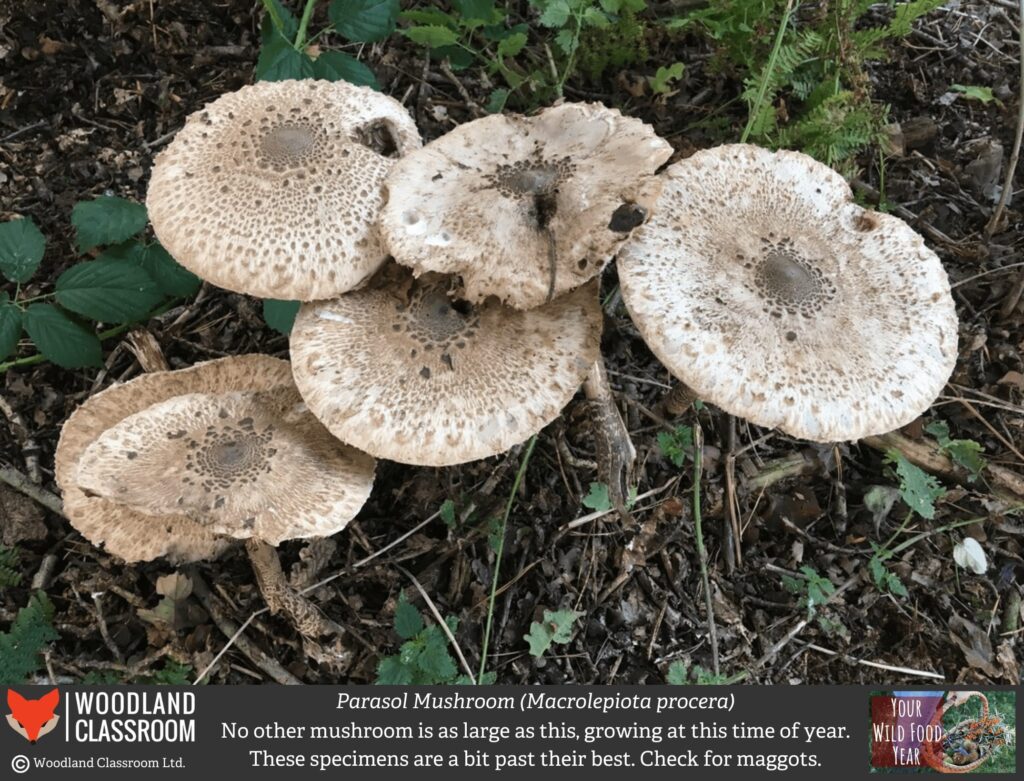
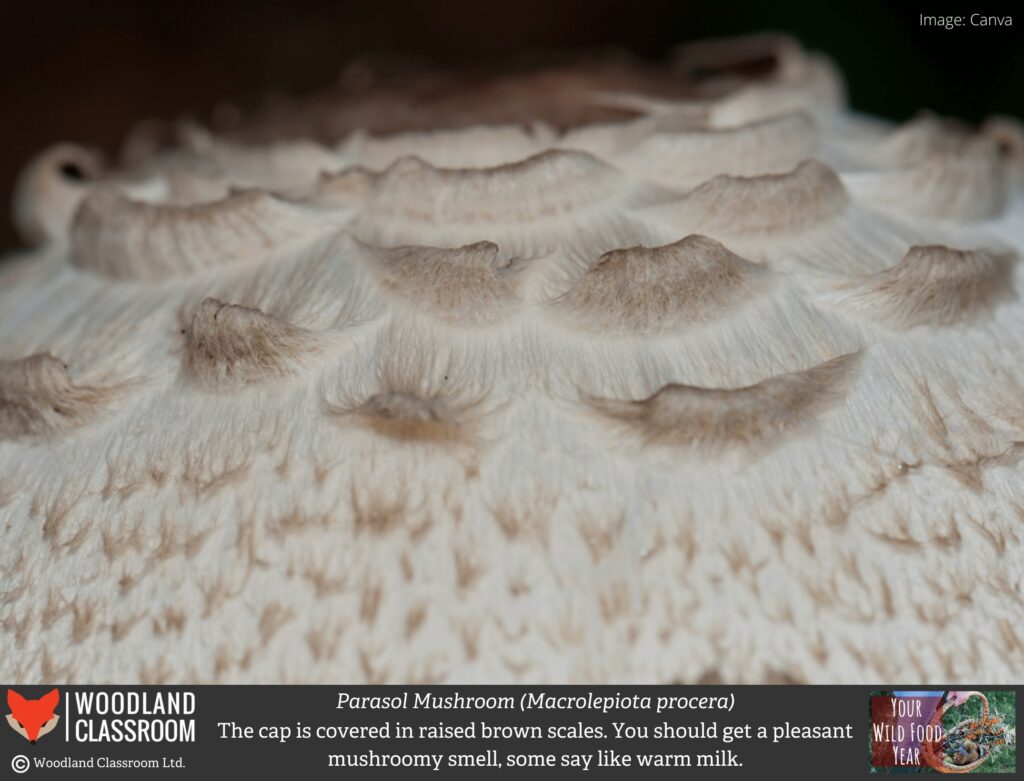
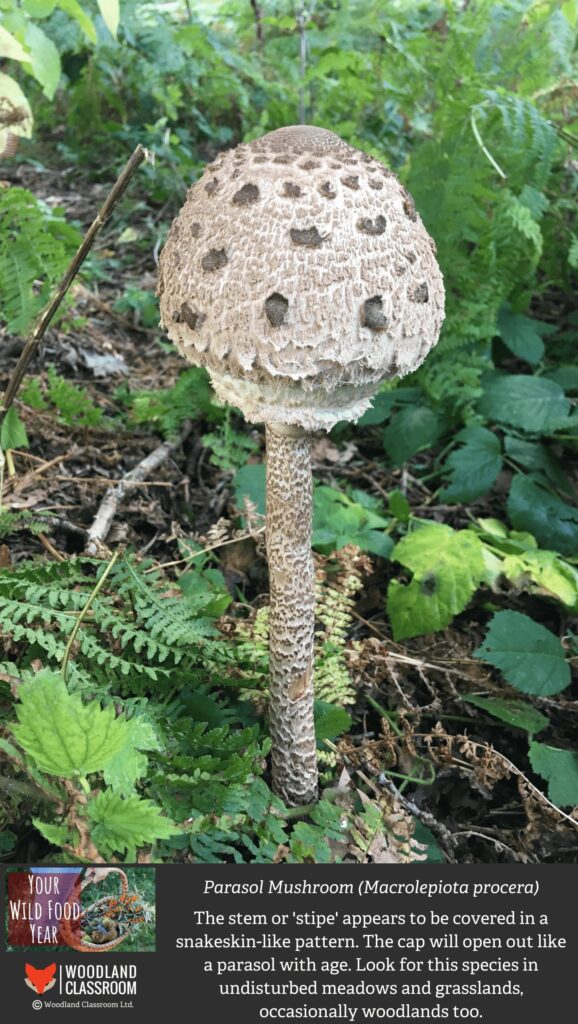
Imagine walking through a meadow and spotting the large, umbrella-shaped parasol mushrooms (Macrolepiota procera). These distinctive mushrooms are easy to identify by their snakeskin-patterned stem and raised brown scales on the cap. As they mature, the cap unfurls, leaving a white collar around the stem. This white collar can be gently detached to then run up and down the stem, a handy identifying feature.

When young they can resemble an old-fashioned microphone, but as the cap opens they take on the form which gives them their name and recognisable profile. They can get large too, up to the size of a dinner plate.

wild food foraging - parasol mushrooms

Left: A young mushroom, before the cap has opened. Centre: Under the gap are creamy white gills. Right: The shape that gives this mushroom its common name, like an umbrella.

The place it’s most common to see these mushrooms is in undisturbed meadows and grassland but you do occasionally see them in open broadleaf woodland as well. The main lookalike to this distinguished mushroom is the Shaggy Parasol (Macrolepiota rhacodes) which is edible but has been known to give some people a mild upset stomach. So, get to know this species too. Our advice to beginners would be to try a little bit of your parasol and see if it leads to any upset. If nothing happens by the following day then you’ve got yourself a very good wild food, one of the best.

Parasol mushrooms are delicious and versatile, suitable for pies, stir-fries, or pasta sauces. They also dry very well for long-term storage, retaining their fragrance and flavour.

wild food foraging - parasol mushrooms

Left: Parasol and partridge stir fry. Centre: A bumper harvest of parasols. Right: This fungi dries and stores well.

NETTLE SEEDS

Stinging Nettle (Urtica dioica) has a bad reputation, it’s probably not your favourite plant. But we’d like to try and change your mind. Nettles are possibly one of the most nutritious plants you can find, and they grow absolutely everywhere.

The most known foraging season is spring when the leaves are at their best – we love them. But nettle is a hidden gem for the summer forager also.  The seeds the nettle produces in July to August, are flavourless but are particularly jam packed with nutrients well worth getting into your diet.

nettle seeds - wild food & foraging

Left: The mature seeds on the female plant. Centre: The dense clusters of seeds are attached to a pendulous stalk. Right: The flowers found on a male plant, not for harvesting.

Nettle seeds are a hidden gem of the foraging world. Female nettles (there are separate male and female plants) produce large, drooping clusters of tiny seeds. Harvest these seeds by cutting the clusters off with scissors and pushing them through a sieve with a spoon to separate the unwanted stalks. This process also removes any remains of those troublesome stings.

Use nettle seeds as a nutrient-rich addition to salads, pasta dishes, yogurt, or breakfast cereals. They are virtually flavourless, making them a versatile superfood that can be sprinkled on almost anything. One of our favourite recipes is Lea’s raw chocolate energy balls which are packed with the seeds to give you a much needed boost to your day.

nettle seeds - wild food & foraging

Left: Seeds ready to be processed. Centre: Italian pasta with ash key capers and nettle seed sprinkles. Right: Chocolate energy balls, packed with nettle seeds.

DISCOVER MORE WILD FOOD

If the idea of foraging for wild food excites you, consider enrolling in our online course, “Your Wild Food Year.” This course offers a wealth of resources to help you become a confident forager, with monthly guides, recipes, videos, and expert advice. You can find out more right here.

“The course is so engaging and fun, I’ve learnt so much. Really awesome and would certainly recommend.” – Claire Roumph

Discover the joy of finding, harvesting and cooking with wild food with the very best each month has to offer. You will learn what to look for, where to look, and what to do with it in the kitchen. You will have videos, photo galleries, recipes and more at your fingertips, all taught by experienced foragers.

There’s also a FREE introductory version of the course to get you started. Begin your journey to discovering, harvesting, and cooking with wild food today. Register for the free wild food course here.

Check out our short video to learn all about our online foraging course Your Wild Food Year.

Happy foraging folks.

Lea & James

Park in the Past - the new home of Woodland Classroom

An Exciting New Venue For Our Future

The BIG news we’ve been sitting on for the past few months can finally be announced! Woodland Classroom are moving, to a new venue. It’s a home which is somewhere quite unlike anywhere else.

Just north of Wrexham lies an ambitious project like no other, Park In The Past. It’s a place where not only can you explore woodlands or try your hand at water-sports, but you could also stumble across a full-size Roman fortress! As we said, this place is special.

Set in the ancient Welsh landscape, the park comprises 120 acres of outstanding natural beauty offering woodlands, wetlands, meadows, footpaths a magnificent 35-acre lake and the gorgeous River Alyn winding through it. To find out more about the venue, visit their website here.

The aim of Park In The Past is to create a totally unique visitor attraction. There is the country park itself which local people are encouraged to explore and enjoy the nature trails. Then there is the historic aspect where the project seeks to recreate an ancient landscape, winding the clock back to the Roman invasion of Britain. This is where the Roman Fort Build comes in. Visitors can walk amongst the construction site of a full-size timber and earthwork fort recreated using traditional techniques wherever possible. It’s pretty impressive!

park in the past collage history

Above: It’s not uncommon to see a Roman soldier wandering the pathways. Visitors can explore the fort build and seek out the ‘neolithic’ stone chamber.

Our blend of bushcraft, woodland skills and outdoor education marries well with what the team on site are trying to achieve here, complimenting what is already on offer.

Phil Hirst, one of the Park Directors told us; “All of the team at Park in the Past are really delighted to welcome James and Lea Kendall from Woodland Classroom to our heritage and conservation attraction in January 2023. Our new partnership will extend the range and quality of inspiring experiences for visitors. James and Lea’s unique approach to engaging with Mother Nature and forgotten country crafts will greatly enhance our ability to improve the mental health and wellbeing of our communities. We can’t wait to get started!”

James Kendall, Head Bushcraft Instructor at Woodland Classroom shared his enthusiasm; “We are extremely excited to be working with Park in the Past and can’t wait to be able to offer our courses and events at this fantastic venue. We will be bringing our established programme of bushcraft, wild food foraging, forest school and nature-based wellbeing to this site as well as a whole host of new courses for people who want to develop their outdoor skills or deepen their connection with nature.”

If you want to check out our upcoming courses and events, you can do that right here.

“Park in the Past brings so many new opportunities for us with a huge space offering woodland, meadows and scrubland, not to mention the lake which could enable us to offer bushcraft combined with canoeing in the future – two things that go so well together. Where else can you be exploring woodland one minute and then stumble over a Roman fort? The ongoing experimental archaeology projects here are great opportunities to link in our traditional woodland skills and greenwood crafts also. We are also looking forward to lending our experience of sustainable woodland management and working toward improving biodiversity on site as part of our ongoing activities.”

park in the past collage - watersports

Above: The site features a 35 acre which hosts a range of water sports. There is also opportunity for pond dipping and river studies with our groups.

Park in The Past is managed by a Community Interest Company which has been set up to restore and manage the former Fagl Lane Quarry. The project aims to establish a balance between the sustainable management of habitats reserved exclusively for wildlife, and the sensitive utilisation of the site for commercial, educational and interpretative purposes. Park In The Past aims to create a balanced mixture of safe wildlife havens as well as areas for people to safely enjoy the site.

Park In The Past is easily accessible from the A55 North Wales Expressway. Chester City Centre is only 20 minutes drive away. Central Wrexham is just 15 mins drive away. The site is also within walking distance of Hope railway station.

The venue has lots of exciting plans for the future including the construction of a Celtic village and farm, a state-of-the-art visitor centre and a growing educational programme for schools focusing on ancient British history. As time goes on this venue is going to get better and better.

park in the past collage - park & wildlife

Above: The park is haven for wildlife and the woodlands are being managed with a view to improving biodiversity for the future.


Some people have asked us what this all means for Woodland Classroom offering courses and hosting groups at both Erddig and Chirk Castle. We’ve had a strong relationship with the National Trust, having hosted our courses at these venues since 2016 and we will continue to offer Felin Puleston Outdoor Centre at Erddig as a venue for outdoor education. In addition, a number of our bushcraft and foraging courses will still be hosted at Chirk Castle as it is a site which offers a completely different set of flora and fungi to Park In The Past. This way we can demonstrate the diversity that different sites can offer to the bushcrafter or forager. However, Park In The Past will become our principle home going forward.

Look out for more announcements over the coming months for our new course programme, venue launch event and the development of our new Bushcraft Basecamp and Forest School activity areas at Park In The Past. Our sincerest thanks go out to Paul and the rest of the Park In the Past team for letting us come and play in their sandbox.

If you are interested in bringing your school class, group or family along to a session with us at Park In The Past for a session with us then do get in touch.

We’re excited for the future and can’t wait to share this new venue with you all.

James & Lea

The Perfect Wild Mushroom For Beginner Foragers: Parasols

There is something magical about the idea of going out to the countryside and finding wild mushrooms to cook with. It scratches an ancient itch in our hunter-gather brains. If you’re looking to get into this addictive hobby then the Parasol Mushroom (Macrolepiota procera) is a great beginners fungi for anyone wanting to start wild mushroom foraging.

My name is James, I teach Bushcraft and Foraging in North Wales. I am the co-creator of Your Wild Food Year, an online course for anyone wanting to gain confidence in identifying, harvesting and cooking with wild foods. In this article I will introduce you to this commonly found edible fungi. You will learn how to identify it, where and when to find it, how to cook with it and what poisonous lookalikes you will need to avoid. Let’s dive in.

how to identify parasol mushrooms - wild food & foraging

Where & When Can you Find Them

We have found good specimens as early as late July but it’s most often seen from late August and through September.

You’re most likely to find it in meadows and unimproved grassland. I’ve also found it at the edges of ancient woodland. The three locations I see it often are all National Trust estates, so that points to land that has been consistently managed over a long period.

At what growth stage should you harvest them? Well you can pick them when they’re not yet fully opened. But if doing this be sure you’re not confusing them for the Shaggy Parasol (more on that below). Basically if the specimen looks like it’s in good condition you’re good to go. Ensure you fungi is free of mold, sliminess on the gills and the cap is not starting to wilt. One word of caution, you do often get the odd maggot or two inside the cap, which you only find when you’ve taken them home and started to chop them up. These are more typically found in older specimens. If there’s just one or two, I pick them out and use the mushroom anyway. What you do is down to personal preference.

how to identify parasol mushrooms - wild food & foraging

how to identify parasol mushrooms - wild food & foraging

How To Identify Parasol Mushrooms

Well, true to its name it resembles a parasol umbrella. You’ll find a distinctive brown ‘nipple’ raised in the centre of the cap. The cream-white cap meanwhile is also patterned with light brown scales. Something that is important (you’ll see why later) is the typical size of the cap. When fully open they can grow to 15-35cm across diameter, so they get seriously big! You’re getting a lot of food from your forage here.

Looking underneath the cap you will find gills rather than pores. These are cream-white in colour. The flesh of the mushroom doesn’t discolour when bruised, it stays cream-white.

The stem (otherwise known as a stipe) is again cream-white in colour and looks like it’s covered in a snakeskin pattern. It can grow quite tall, reaching up to 25cm in height. You will also typically find a ring surrounding the stem. If handled carefully this can be separated from the stem and then it runs up and down freely. Another good way to identify this fungi.

You shouldn’t forget to use your nose when learning to identify wild mushrooms. Some fungi have really distinctive aromas, like Dryad’s Saddle which smells surprisingly like melon. Parasols have a pleasant mushroom-like smell which some say reminds them of warm milk.

how to identify parasol mushrooms - wild food & foraging

how to identify parasol mushrooms - wild food & foraging

How To Use Parasol Mushrooms In Cooking

Parasols have a nice, firm texture and a pleasant mushroom flavour. They do dry well, retaining their smell and flavour. So, we often slice up any excess mushrooms and pop them in our dehydrator. This means you can enjoy them right through the winter in your cooking.

Some people prefer just eating the caps but you can eat the stem, in fact some experts say there’s more goodness to be found in the stem of fungi than the cap. The flesh is not as soft as the cap though, so some folks use these for making a mushroom stock.

Like most mushrooms they go great in an omelette, in a quiche, stir fry or added to a stew. Try deep-frying them in breadcrumbs and serving with lemon and garlic mayo. The sheer size of the cap makes them an excellent replacement for the a large field mushroom in your cooked breakfast. Lovely stuff all round!

wild mushroom and nettle tart

We made this tasty wild mushroom and nettle tart, cooked in our dutch oven over the campfire.


Caution: Beware The Shaggy Parasol

As with any foraging of wild mushrooms, you need to widen your knowledge beyond just the species you’re looking for, or think you’re looking at. As the old saying goes; “There are old foragers and bold foragers, but there are no old, bold foragers.” Heed these wise words folks.

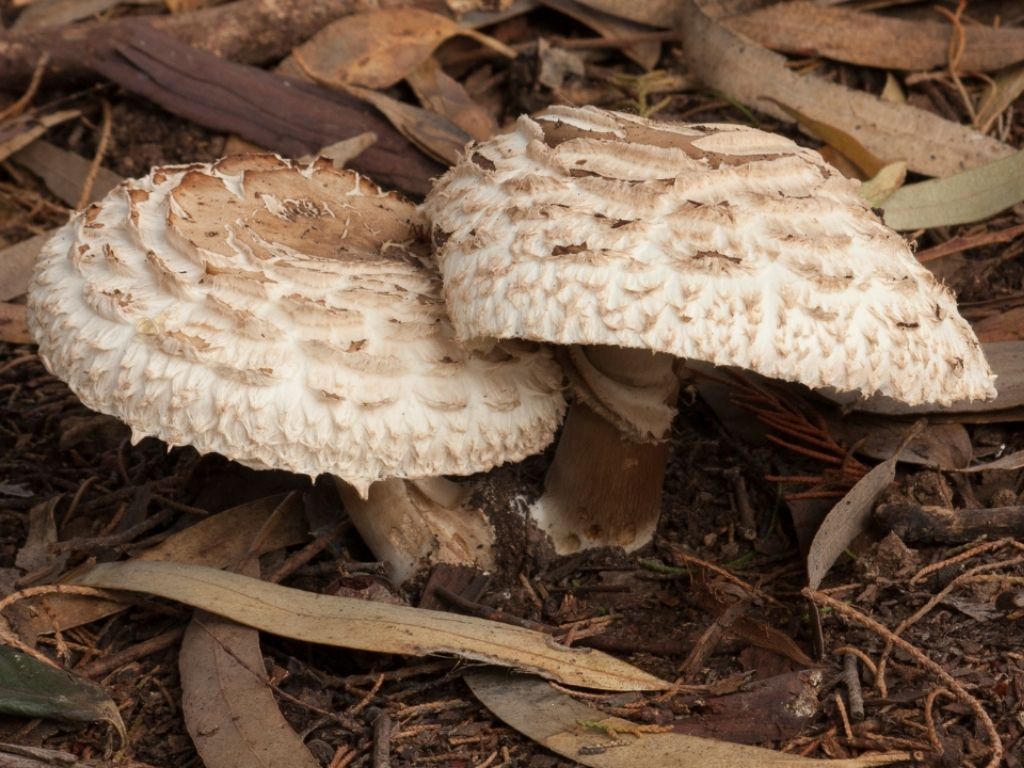
If you’re going out looking for Parasols then you need to be aware of the closely related and similar looking Shaggy Parasol (Macrolepiota rhacodes). This is not a poisonous species, however with around 20% of people it’s been known to give them a bit of an upset stomach.  It’s found in similar habitats and at the same time of year. Let’s learn more about the differences between the two fungi.

As the name suggests it is shaggier in appearance. Also the base of the stem is typically more bulbous than with the Parasol. It also doesn’t grow as large as the Parasol, the cap only getting to around 8-15cm in diameter and the stem reaching 12-18cm height. So a good way to avoid Shaggy Parasols would be to only pick fungi that are larger than this.

Remember that the flesh of the Parasol doesn’t bruise when handled? With the Shaggy Parasol this isn’t the case. The gills will bruise red and the flesh will turn an orange/red when you cut it.

This fungi also has a ring around the stem, but unlike the Parasol, this ring will not separate from the stem. So there’s another method of differentiating between the two.

shaggy parasol - wild mushroom foraging

Shaggy Parasol (Macrolepiota rhacodes). It can give some people an upset stomach. Image by Canva.

So, can you eat this mushroom? Well yes, but as I’ve said it can disagree with some people. So good practise is to try just a little bit and leave it 48 hrs to see if your stomach is happy. If so, tuck in. Be aware though if you are going to eat the Shaggy Parasol, it must be cooked first.

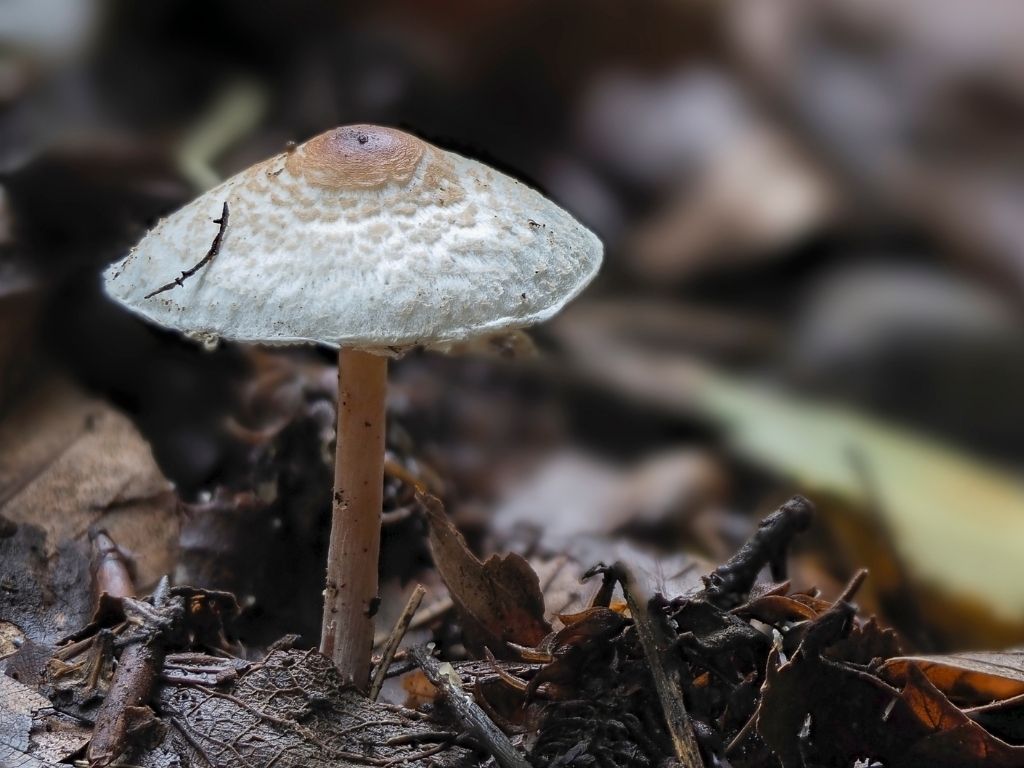
One last fungi to mention here are the Dapperlings (Lepiota spp.) They are poisonous so need to be avoided. How could they be confused with Parasols though? Well they have a distinctive brown spot in the centre of the cap too. However, the saving grace is that they do grow much smaller than the Parasols. As a general rule, avoid picking any Parasols whose cap is less than 12cm in diameter.

Hopefully this has not put you off heading out the door for your first Parasol mushroom. If anything I hope it will make the thrill of the hunt even more enjoyable and the reward of positively identifying your Parasol all the more satisfying.

dapperling - a poisonous wild mushroom

Stinking Dapperling (Lepiota cristata). A common member of this poisonous group. Note how much smaller it is than the Parasols when fully opened out. Get to know them. Image by Canva.


Discover More Wild Food

If all this talk of wild food and foraging has whetted your appetite then you can take your learning further with us either outdoors or online.

You can immerse yourself in the world of foraging through our outdoor courses hosted in beautiful National Trust estate woodlands in North-East Wales. Or if that’s too far afield for you we also host regular online workshops, live through Zoom where we focus on wild foods of the season and give you delicious recipe ideas, foraging tips and expertise from special guest speakers. If this all sounds interesting, check out what’s coming up on our Events page right here.

I think you’ll also be interested in our flagship online foraging course called Your Wild Food Year. When you enrol on this course you will go from clueless to confident on your journey to enjoying foraged plants, fungi, fruits and more with this detailed guide to identifying and cooking with the best wild edibles of Great Britain & Ireland.

Discover the joy of finding, harvesting and cooking with wild food with the very best each month has to offer. You will learn what to look for, where to look, and what to do with it in the kitchen. You will have videos, photo galleries, recipes and more at your fingertips, all taught by experienced foragers. Discover over 70 wild foods!

Crucially, you’ll also learn when to look. As each month we bring you the edible fungi, flowers, fruits and foliage which are in season from January to December.

There is even a FREE TASTER version of the course so you can try before you buy and see if the larger course is something that’s a good fit for you. So, start your journey to becoming a confident wild food forager today. Find out more right here.

“I’d always loved the idea of foraging for wild mushrooms but was too scared to try it. This course has shown me which species I can pick with confidence. The wild fungi hot spots I’ve discovered in my local area are now my closely guarded secret 😉 Thanks Lea and James.” Matt Corcoran

Your Wild Food Year - online foraging course

Until next time, stay safe and remember to always be 100% sure you have correctly identified a wild edible before consuming it. Good luck with your own foraging journey.

James

11 easy wild garlic recipes - blog

11 Easy Wild Garlic Recipes

Spring has sprung and with it comes one of the edible plants for the forager, wild garlic (Allium ursinum). Most people who have dabbled in foraging will know wild garlic (or ramsons) as a great plant to start with as it’s simple to recognise and use in cooking. It’s one of our absolute favourite wild foods. Not only because it tastes great but because it’s so versatile. So, it’s a shame that the main recipe you see online again and again is wild garlic pesto. There’s so much more to it than that, as you’ll see. We’ve done the trial and error, so you don’t have to and in this blog we have made a list of our top 11 recipes for you to try at home. And yes, pesto is included below too.

If you prefer to watch rather than read, you should have a look at our video 11 Easy Wild Garlic Recipes here, where we go into even more detail on ingredients, quantities and methods. We also put together a spicy Indian banquet bursting with wild garlic flavour. Check it out!

Every part of this plant is edible; leaves, stem, flower and bulb. So with that in mind there’s a bunch of ways we can use the plant. As a general rule, if you’re cooking wild garlic you want to treat it like spinach, don’t over cook it but throw it into a dish near the end so it doesn’t wilt too much and lose it’s flavour and goodness. Now, on with the recipes…


Recipe 1: Sandwich, Toastie or Wrap

Let’s start with something simple, if you haven’t got the time to make a whole meal why not incorporate the goodness of wild garlic into something as easy as a cheese sandwich, toastie or wrap. This way you get all of the benefits without any of the faff. Why not use it as a replacement for lettuce or spinach for a fresh garlicky addition. Don’t use too much – it’s pokey stuff!

wild garlic recipe - toastie

Recipe 2: Wild Green Mayonnaise

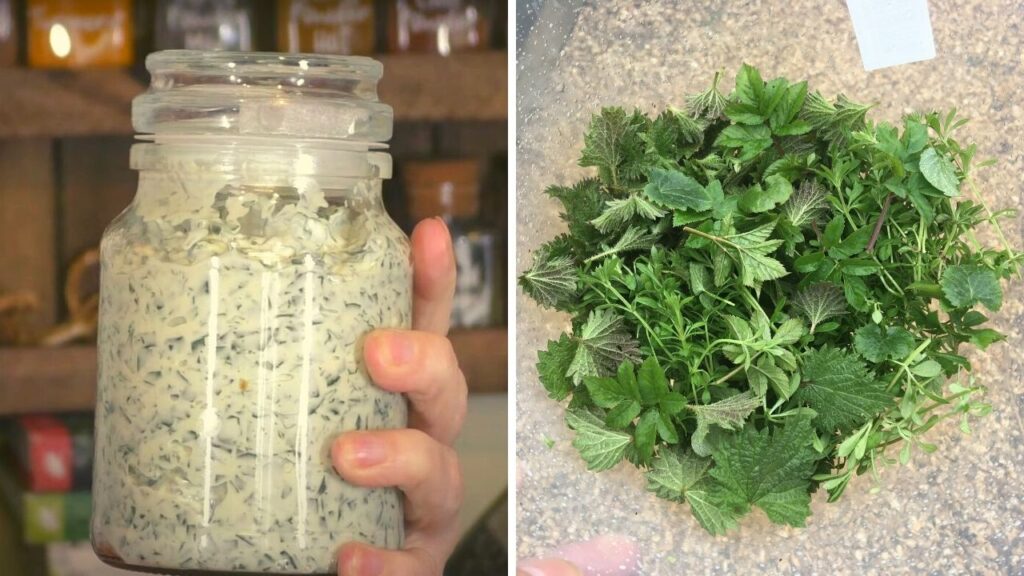
This is a super easy way to incorporate all your essential greens into your diet by adding them to a spread. Mayonnaise is a favourite, and I can then add it to sandwiches or use it as a healthy dip. Just shred the wild garlic and stir it into your dip of choice. If you want to push the boat out why not add a few more wild greens; garlic mustard, hairy bittercress, chickweed, nettle (blanch the leaves first) and cleavers are all in season now and are just as good for you! 


Recipe 3: Wild Spring Salad

This is another easy recipe to incorporate wild garlic into. If you’re a fan of salads and making them interesting and delicious, why not add some shredded wild garlic? I’ve found that all parts of the plant can be used in the salad to add some interesting flavours and textures. The stems have a real crunch to them and make a substitute for beansprouts. You could substitute lettuce with wild garlic leaves, but you might find you want to bulk it out a little with some shop-bought leaves, or later in the season why not use the wild garlic seeds (lightly toasted) to add a sharp pep of garlic to your salads. 

This is another great recipe to experiment with your wild greens, why not add some cleavers, nettle, ground elder or ground ivy. You could also add some fresh edible wildflowers like primrose, gorse or dog violet to give your salad a pop of colour. 

wild garlic recipe - mayonnaise & salad


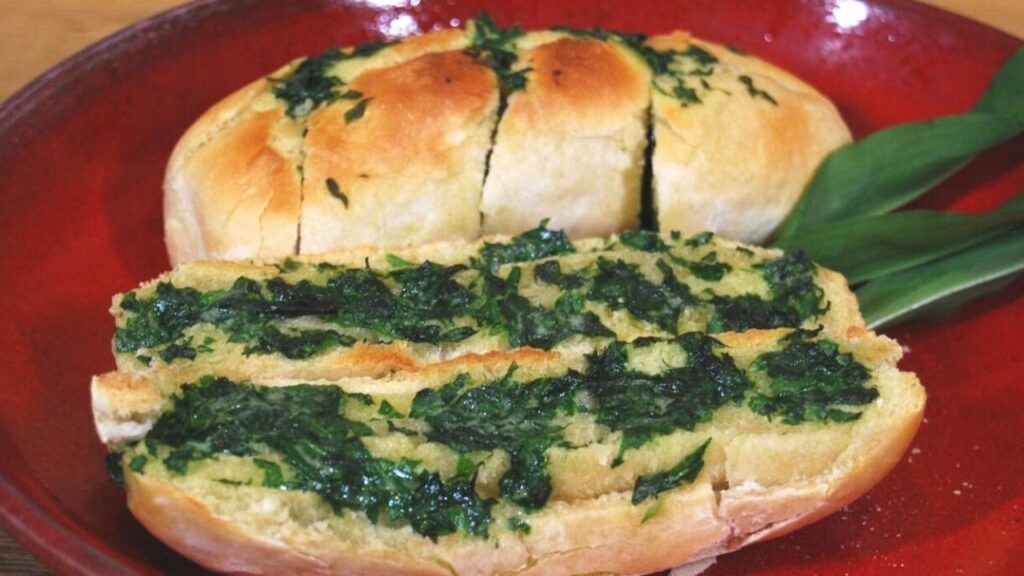
Recipe 4: Wild Garlic Bread

This is a great way to get some wild food into your kids. Most children love garlic bread and this is a classic recipe that is just so moreish it could quickly become your favourite wild garlic recipe. It’s also unbelievably easy; chop up the leaves fine and mix with butter. Next, simply cut some horizontal slices into a bake-at-home baguette and add a dollop of the garlic butter to each gap. Stick it in the oven as per the pack instructions and you’re done. This of course goes great with Italian food.

wild garlic recipe - garlic bread

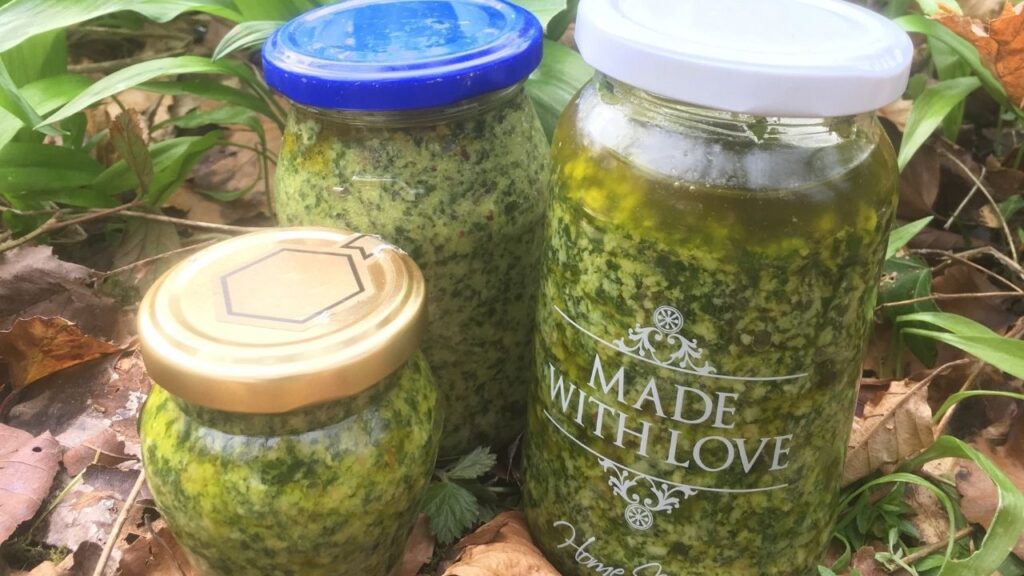
Recipe 5: Wild Garlic Pesto

This recipe needs the least description or introduction as you’ll find recipes for this all over the web. It’s such a classic and one of the easiest recipe there is. In a nutshell you replace the basil in your standard pesto recipe with wild garlic to make a subtle garlicky pesto that can be used in a range of ways. Mixed into pasta is the most obvious use but you could spread a little onto a cheese toastie, mix it into a rice dish or as a filling in a pastry. We’ve made our own pestos that bit more wild by replacing the pine nuts for chopped hazelnuts.

wild garlic recipe - pesto


Recipe 6: Wild Garlic Kimchi

We think this beats pesto hands down any day. This recipe is one of our favourites of the year, so much so that we even have a whole separate video on how to make this. You can check out that video below and also learn about the fantastic health benefits of eating kimchi. Kimchi is a Korean side dish, traditionally of fermented vegetables with ginger and chilli and is incredibly good for gut health. We’ve substituted the radish and cabbage for wild garlic leaves. 

Fermenting is a fantastic way of preserving and extending the season for wild foods into the whole year. Not only this but the process of preserving our foods is something our ancestors would have practised regularly in order to have the food they would’ve needed to survive winter, it’s an essential skill and connects us with our predecessors and their way of life. It’s often the case that we can put little thought into what we eat, but fermenting foods helps us foster a deeper connection with the earth and importantly, our food. I would highly recommend trying this if you want to enjoy wild garlic beyond spring. A jar of this stuff doesn’t last long in our household.

The reason kimchi is so good for us is that it creates live, healthy bacteria which goes into our gut and aids in digestion, boosting the immune system and overall health of the body. The bacteria encourages everything to function as it should. In order to ensure there is no harmful bacteria fermenting in the kimchi it’s important to sterilise your equipment before you start, this can be done in a hot wash in the dishwasher, but you’ll need a more thorough sterilisation of the jar you’ll be fermenting in.

For this dish you will need a generous helping of wild garlic as it will reduce down quite a lot. If you want the full recipe and step-by-step instructions on how to make this fantastic dish check out our video tutorial here.


Recipe 7: Pasta Sauce

This is another really easy way to incorporate healthy greens into your diet with minimal prep time. We’ve made a tomato based sauce, but you can incorporate wild garlic into any pasta dish you want, and with any combination of vegetables, there’s a lot of creative freedom with this recipe. We’ve also chosen to make a batch of this sauce and jar it for later use, which means we pre-cooked the vegetables we added, but you can make enough just for one portion of pasta and simply add it all to a pan. Once left in the fridge this sauce should last for a week or so.

We added fried onions, chopped basil and sun dried tomatoes alongside the garlic to a base of chopped tomatoes, stirred all together and jarred. Alternatively, you could make a pea pesto and stir in your garlic leaves, broccoli, peas and fennel for a vibrant green sauce, or mushroom and garlic leaves with a splash of cream for a warming mushroom sauce. Bear in mind that any dairy products used will mean the sauce won’t keep as long. 

If you pre-make your sauce and add it to the pasta once it has cooked, stir it in for only a couple of minutes, if the wild garlic leaves are cooked for too long they will lose all their structure and goodness. Similarly, if you’re cooking a sauce from scratch, add the garlic leaves last thing so they’ve just wilted.

Recipe 8: Baked Hummus

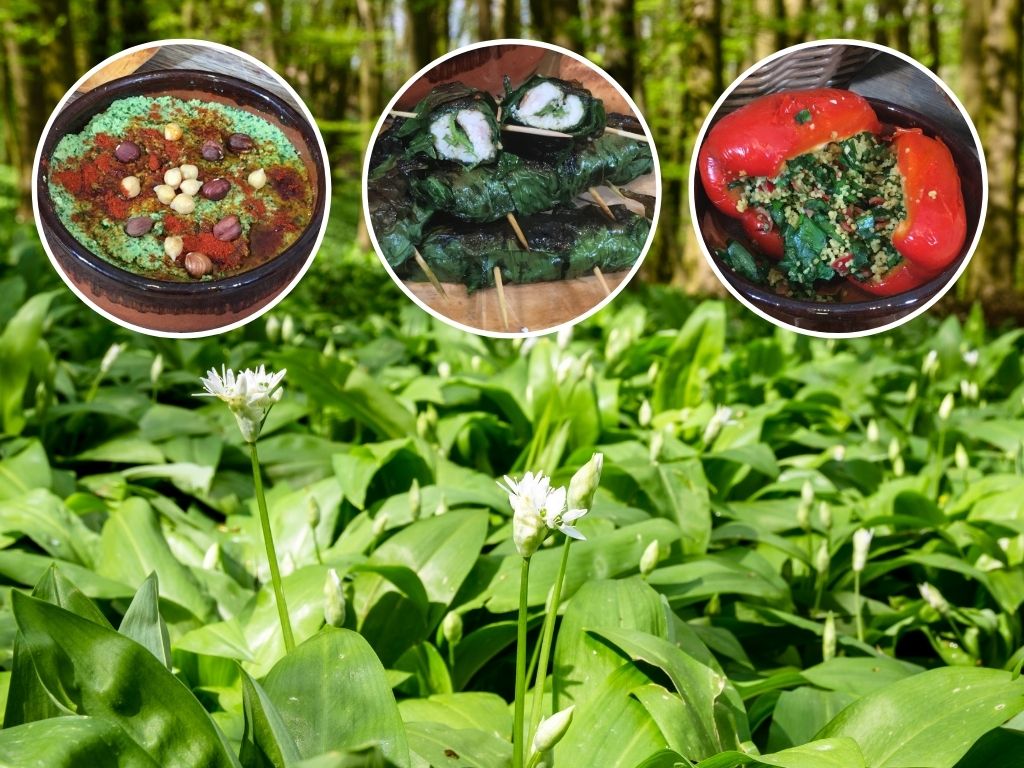
Just like regular shop bought hummus, this dip goes really well on toast or with some vegetable sticks, but this recipe adds the beautiful taste of wild garlic too. We bake this hummus to soften the sharpness of the raw wild garlic but if you don’t mind strong garlic flavours with your hummus why not give it a go without cooking it. Again, this recipe is very simple, just add some shredded wild garlic leaves into your favourite hummus recipe and bake. 

Baking it also gives the top layer a really lovely crust that adds some lovely texture. As well as adding wild garlic we’ve made this really unique by drizzling a little oil and adding some hazelnuts before baking to really make a showstopper of a dip. If you’re extremely organised you might have foraged and stored your own hazelnuts last autumn but if not (which is most of us) the shop bought ones will do instead. 


Recipe 9: Wild Garlic & Elf Cup Stuffed Pepper

These stuffed peppers can be eaten as a side but really they take centre stage, they’re visually very vibrant and beautiful. We use couscous as the main filling and as well as wild garlic we take advantage of another seasonal delight; the scarlet elf cap mushroom (Sarcoscypha austriaca). 

We pre-cooked the couscous and made a batch of the filling so we can make as many stuffed peppers as we want. Just remember when you’re cutting your pepper you want to remove a circle around the stalk and scrape out the seeds without damaging the structure, then simply add your filling and roast in a pan. 

You can switch the filling up as well, why not use rice instead of couscous, or add a little wild garlic pesto and mozzarella for a lovely cheesy filling. 

wild garlic recipe - stuffed pepper & saag aloo


Recipe 10: Wild Saag Aloo

This is one of our favourite additions to the Indian feast we prepared, its delicious and the wild garlic really enhances the flavour of all the spices. We swap out the spinach you would typically put in this dish for the wild garlic, so you do need quite a lot as it will reduce as it cooks. Equally this would work very well using nettle instead of spinach. You can get the full recipe and method by watching the video.

As a side dish this goes really well with our other Indian themed recipes; the chicken tikka parcels, stuffed peppers and pakoras. If you want this as more of a main attraction why not have this on some naan bread with mango chutney. Let us know how you get on with this dish.


Recipe 11: Chicken Tikka Parcels

This one is a little different, using the wild garlic in a new way. This is a really interesting way to incorporate wild garlic into a meal; wrap garlic leaves around strips of chicken to make a parcel that can be fried in a pan, cooked on a bbq or roasted directly on hot coals over an open fire.

Marinade diced chicken in tikka paste with a little oil. Next pick the largest wild garlic leaves you can find wrap several layers around a few chunks of chicken. The wrapped leaves can be pinned into place with cocktail sticks but if you want to be authentically wild you can whittle a pointed end onto foraged sticks as a makeshift skewer. Once cooked, any burnt outer leaves can be peeled away, leaving a succulent garlicky parcel which surrounds the juicy chicken. If you prefer you can substitute chicken breasts for a vegetarian alternative. 

The fantastic thing about this dish is that you can use any combination of spices to make it fit with a range of cuisines, the tikka curry powder we use in this recipe makes it a perfect addition to a foraged Indian feast. You could also try making a herb mix of rosemary, oregano, thyme and basil to make a side for an Italian dish or turmeric, cumin and nutmeg as part of a mezze platter.

For anyone who loves simple, outdoor cooking, using the leaves in this way eliminates the need for a pan or grill. The leaves and skewers used are all biodegradable of course and any waste can go back to the woods. This recipe really feels like a connection to our ancestors and how they would’ve cooked, it’s simple and connects us to our roots, so give it a go.


Discover More Wild Food

If all this talk of foraging has your mouth watering then you can find more inspiration from us with more good wild food stuff including; blogs, videos, outdoor courses and online courses too. If you haven’t checked out our YouTube channel already, be sure to do that here.

You can immerse yourself in the world of foraging through our outdoor courses hosted in beautiful National Trust estate woodlands in North-East Wales. Or if that’s too far afield for you we also host regular online workshops, live through Zoom where we focus on wild foods of the season and give you delicious recipe ideas, foraging tips, and expertise from special guest speakers. If this all sounds interesting, check out what’s coming up on our Events page right here.

Another way to get instant access to a whole backlog of wild food & foraging videos, recipes and pre-recorded workshops is to join our Tribe over on Patreon. In return for supporting our mission, our patrons get access to loads of exclusive resources. You can join the Tribe from as little as the price of a cup of dandelion coffee, just £3.60 per month. Find out about all the benefits right here.


Until next time, good luck with your own foraging journey.


James & Lea 

how to identify native conifers UK

Which Conifer Trees Are Native to Britain?

Are you confused by conifers and flummoxed by firs? In this article you’re going to get to know the native conifer trees of Britain & Ireland and learn the top five key features you need to look for so that you can easily recognise them in the countryside and tell them apart from the many non-native conifers you may find.

Conifers are not rare in this country, you can find them everywhere. As a general rule, they are also evergreen (though there is an exception, the Larch) so they hang on to their foliage right through our winter. With the majority of our native trees being broadleaves, losing their leaves in autumn, this makes a conifer easy to spot from a mile off.

But are you looking at one of our native conifer trees or is it one of the many non-native species which have been introduced to this country?

Before we get into this topic, you might be interested in my FREE Tree ID Course online, it’s called Kickstart Your Tree ID Skills and it includes videos, downloads, photo galleries and quizzes on trees in all four seasons of the year. If this sounds good to you then you can enrol for free right here.
 

What is a Conifer?

Conifers are a very old group of trees that includes firs, cedars, cypresses, junipers, kauri, larches, pines, hemlocks, redwoods, spruces and yews. As a rule, conifers bare cones, though some don’t look much like cones as we think of them. The other key feature they share is they have very small leaves in the form of needles or scales.

With the exception of some Scots Pine in Scotland and a few Yew woodlands, you will not comes across a natural forest of conifer trees in the UK and Ireland. They are most likely planted non-native species, usually for timber production or as a shelter-belt woodland.

When we picture a conifer, we usually have a Christmas tree in mind, which is typically a Spruce. But there’s more to conifers than simply this conical cone-baring form. Especially when it comes to our own natives.

how to identify conifers

Above: Conifers can come in a variety of weird and wonderful forms.


How Many Native Conifers Do We Have in the UK & Ireland?

Well the good news here is that we have only three native conifers. By native, we mean a species which have been naturally present on these isles since the last Ice Age and before we became disconnected from the continent. Our three native conifers are Scots Pine, Juniper and Yew.

Take a trip around the globe and you could be dealing with up to 800 conifer species. So, we’re quite lucky in the UK & Ireland that we only have three to tackle.

It’s not just the trees featured in this article that you could well see on your country walk though. There are several species and families of conifer trees that are very commonly planted here, either for forestry or in country estates and parks for their sheer beauty. You’d be forgiven for thinking that Larch, Spruce, Firs and Hemlock could be part of the natural make of our landscape but they are all guests from exotic lands.

So, let’s get to know our three natives and pick out the key identifying features you need to look for.


Scots Pine (Pinus sylvestris)

There are several pines which has been introduced to this country including the Corsican Pine (Pinus nigra var. maritima) and Lodgepole Pine (Pinus contora ssp. latifolia) to name a couple, but we have only one native and the clue is in the name, Scots Pine. However, don’t be fooled, this tree isn’t found only in Scotland, you could see it anywhere. In its natural range though it does favour uplands and poor soils. The oldest Scots Pine in the UK can be found in Scotland in the Caledonian Forest.

how to identify scots pine - pinus sylvestris

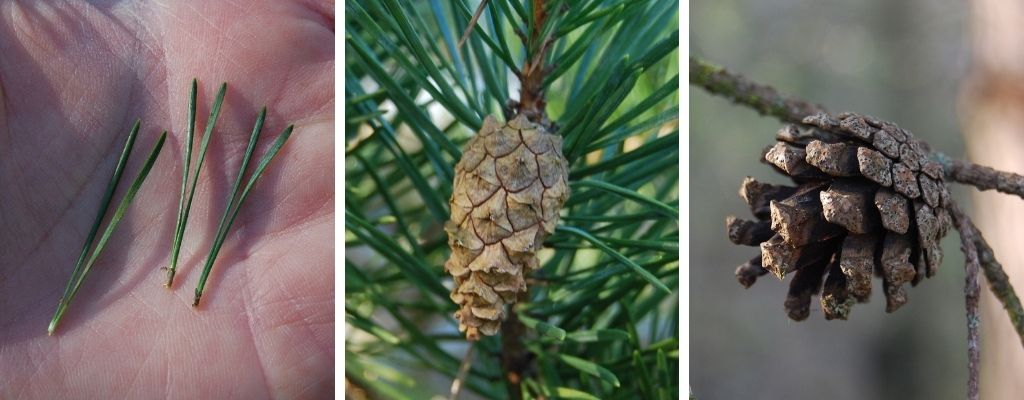
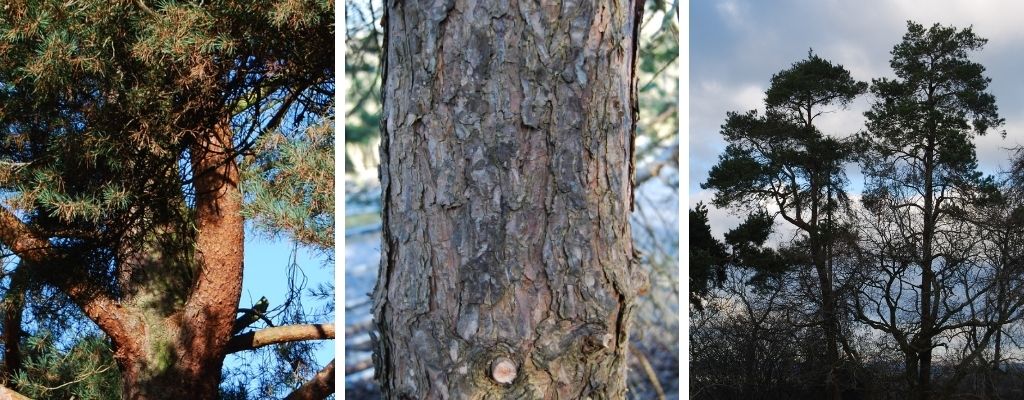
Left: Needles are in pairs, joined at their base. Middle: A ripe cone, still closed. Right: A mature cone having dropped its seeds.

Before we get into the specific details of Scots Pine, it’s worth mentioning a feature that is unique to pines. If you follow a single pine needle back to its base, where it joins the twig, you will discover it is joined to one or more other needles. Pine needles come in twos, threes or fives. This is important because conifers like spruce have needles which are attached singly to the twig.

I was told this handy little rhyme by Dave Watson of Woodland Survival Crafts to help me remember this rule; “If it’s a pair, it’s a pine, but not all pines are pairs.” By using this rhyme we can eliminate other families of conifers and know that we are looking at a pine. So, that leads to the question, how do we know it’s a Scots Pine?

To identify the Scots Pine there’s a few key features to look for:

  1. Needles come in pairs, joined at their base to the twig. Needles are approx 5 to 7.5cm in length. This is important as a commonly planted non-native, the Corsican Pine, also has needles in pairs, but they are significantly longer. Corsican Pine needles can grow to 15cm long.
  2. Needles often have a twist to them.
  3. Mature bark is a warm brown to orange colour with a craggy character. Also, look for a band of orange on the main trunk about a third to two-thirds up the tree. This is especially visible in clear sunlight.
  4. Pine cones. These are the typical cones used for Christmas decorations that you are probably familiar with. They take two years to mature. Cones are green and conical in their first year on the branch. In their second year they become more rounded and brown-grey in colour.
  5. Mature trees have a habit of spreading  and flattening out in their crown, so losing the “Christmas tree” conical shape we think of when picturing a conifer.


how to identify scots pine - pinus sylvestris

Left: Look for an orange band on the trunk some way up the tree. Middle: Bark is craggy and covered in plates. Right: The crown of mature trees flatten out.


Juniper (Juniperus communis)

You might know this tree best from its berries, or rather what’s its berries are used to flavour… gin.

This is by far the least common of our three native conifers. It is mostly a tree of upland areas, but you can find it formally planted in country estate gardens where it can be trimmed to shape. It’s worth noting though that Juniper is probably the most widespread tree species in the world, found from the Arctic to the Mediterranean.

how to identify juniper - juniperus communis

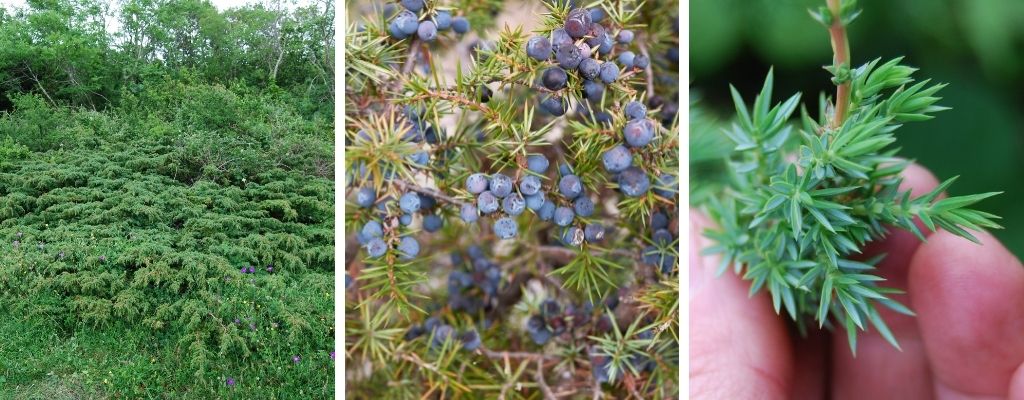
Left: Typically a low-growing and spreading tree. Middle: Ripe berries are blue to black in colour. Right: Needles grow in threes. They are very spiky.

In the UK, Juniper tends to favour chalk and limestone sites.

To identify Juniper you’re looking for the following things:

  1. Typically a low-growing, sprawling shrub of a tree. Though not always.
  2. Needles are small (up to 2cm long), very spiky to touch and they grow in threes.
  3. The mature bark is a reddish-brown colour which has a peeling habit.
  4. Berries. When mature they are dark blue/black. They are small and spherical. When young they are green in colour. You will only find them on the female trees. So, this feature can be a little unreliable.
  5. Crush a berry between you fingers, it will smell of gin. This also works with the twigs & foliage, but be careful, it’s spiky!

The ripe fruit of the female Juniper are generally called berries, but they are actually classed as cones.

There are several cultivated varieties of Juniper which you can pick up in your local garden centre.

how to identify juniper - juniperus communis

Left: Bark is reddish-brown and peeling. Middle: Young berries are blue/green. Right: Juniper can be an upright, single-trunked tree, but this is less common.


Yew (Taxus baccata)

We can lay claim to some of the most spectacular Yew trees in the world, as they are the oldest living organisms in the UK. It’s thought that some are as old as five thousand years! There is hot debate as to which is the oldest living Yew, but the most likely candidates, in my opinion, are in Wales.

how to identify yew - taxus baccata

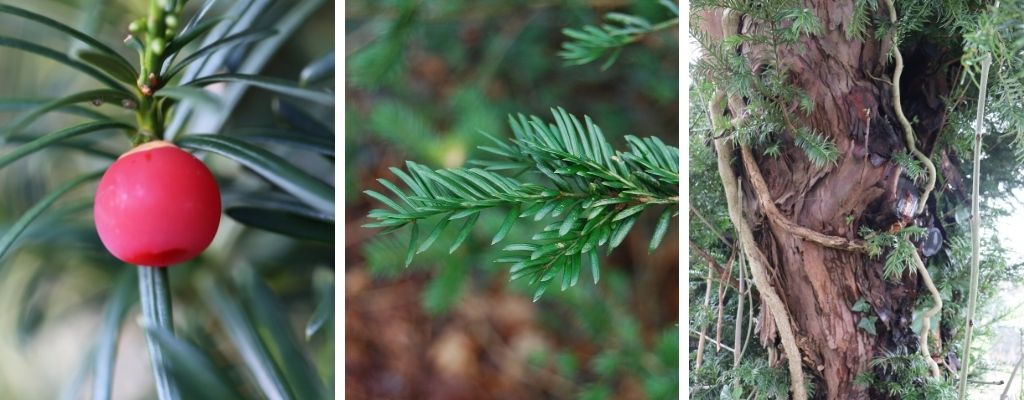
Left: Yews are often found in churchayrds. Middle: Needles are soft to touch. Right: Bark is patchy with reds, browns & purples.

You are most likely to find a Yew in your local churchyard, looming over the gravestones. Many of these trees predate the church they are paired with.

To identify the Yew tree you’re looking for a few key things:

  1. Glossy needles are up to 4cm long. They are arranged flat, along green twigs.
  2. The needles are soft to the touch, unlike spikier spruce trees.
  3. The mature bark of Yew is quite beautiful. Look for red-brown bark with a peeling habit that can show patches of oranges, purples and blood red. When wet, patches of the bark can look like they’re bleeding.
  4. The bright pink/red oval berries of the Yew are very different from anything else you’ll find on a conifer. You will only find these on female trees, so don’t rely on this alone.
  5. Mature trees will typically have more than one stem, growing from the base.

Yew trees don’t have cones. This makes them easy to distinguish from pine, spruce and fir.

how to identify yew - taxus baccata

Left: Pink/red berries are unmistakable. Middle: Needles arranged flat, on green twigs. Right: Bark is peeling and full of character.


Discover More About Trees

It can be so interesting to really look in to the details of our native trees and notice the changes that they undergo throughout the four seasons. That’s just what I’ve created for my FREE introductory online course called Kickstart Your Tree ID Skills. Here you will find a whole host of resources to take you from clueless to confident on your way to really knowing your trees.

REGISTER FOR THE FREE COURSE HERE

kickstart your tree id skills, free online course

When you sign up to this free mini-course you’ll be identifying common trees with video tutorials and photo galleries at your fingertips. Start your journey to becoming a fully fledged Tree Expert today. The course includes Tree ID Cheat Sheets which you can download and take outdoors with you.

“I’ve been frustrated for so long trying to learn my trees myself and haven’t gotten far. This course answered everything and has seriously upped my game.” Dr. Patrick Alexander


Happy tree hunting folks.

James

free winter tree id guide to UK & Ireland

FREE Winter Tree ID Guide

Many of us might well be able to spot an oak in winter by looking for fallen acorns or the familiar leaves, but could you tell me the difference between blackthorn and hawthorn in winter just by looking at the buds? Or do you know which trees give themselves away in winter by their bark? We might be able to identify trees in summer when their leaves are on but winter is a whole different ball game.

For anyone looking to improve their tree identification skills winter provides us with many distinctive signs such as buds, bark, twigs and fallen leaf litter that we can use to recognise our native and common tree species. The clues are all there if you know how to look.

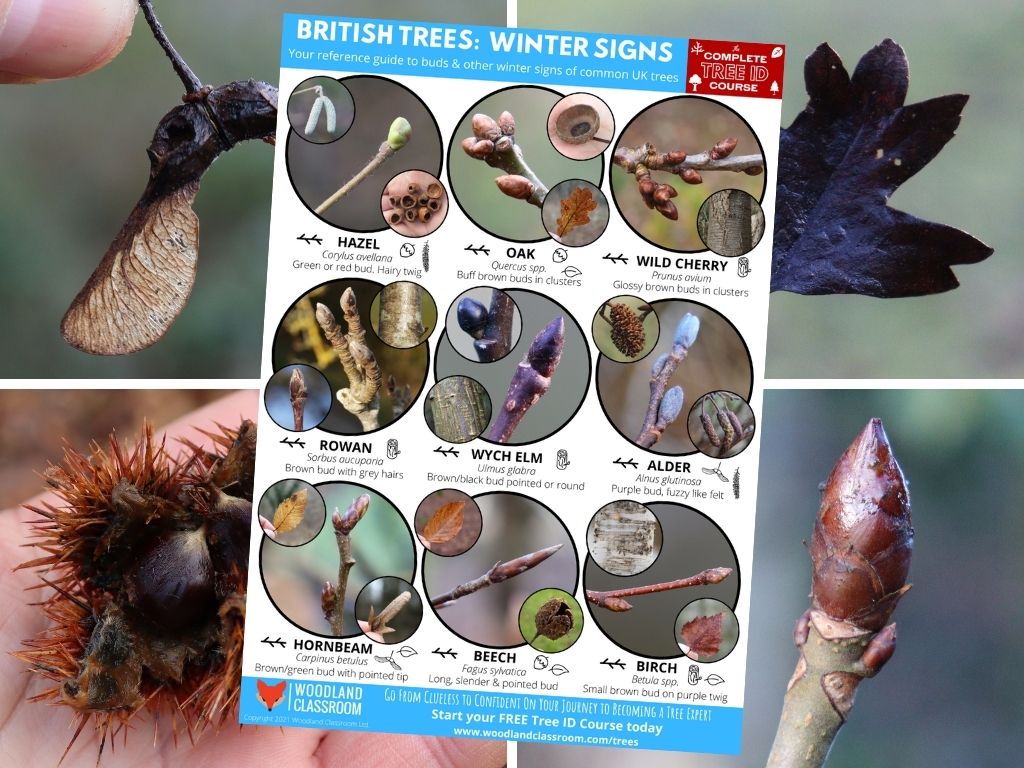
In this blog I’ll introduce you to some of clues to look out for in winter and break down the differences between common trees which often get confused. You can get outdoors and spot these clues for yourself with a free download I’ve created; Winter Trees Guide, which you can get your hands on just below.

free winter tree id guide to download

By the way, if you love trees, but struggle to tell one species from another, then you could enrol in my FREE Tree Identification Course online. More details can be found at the end of the article.


Bud Arrangement: The BIG Giveaway

One of the first things you can ask a tree when you are trying to identify it in winter is this; “Are the buds arranged alternately or in opposite pairs?”

This is absolutely key to nailing the species of tree as once you’ve answered that question it allows you to eliminate a whole bunch of species from your enquiry.

The majority of native tree species in Britain have their buds arranged alternately along the branch.

One last thing to remember; it’s important to select a young healthy twig to answer this question because as a branch matures it will often self-select the healthiest of the twigs to grow on and will drop it’s near partner. So, you can be looking at an older branch and thinking that they definitely don’t grow in opposite pairs, but then on closer inspection you might well notice the old scar left over from where it’s opposite equivalent was self-selected to be dropped by the tree in favour of it’s partner.

When you become practised at this you will begin to start noticing the bud arrangement from a distance, as you look at the form of tree. This is when tree identification can become very satisfying and you can really start showing off.

In the Free Winter Tree ID Guide I’ve grouped alternate budding trees separate from opposite budding trees for easy reference.


Blackthorn vs. Hawthorn

Let’s take two very common trees which often get confused. Not only are their names similar, but they also are thorny, shrubby trees which populate our hedgerows, often growing side by side.

To help confuse matters both these species have alternate buds and the buds are very small and grow in cluster at the end of the twig. So, we need to look at other clues to help us out.

hawthorn and blackthorn winter tree identification

Above: Blackthorn (Prunus spinosa) on the left, Hawthorn (Crataegus monogyna) on the right. The difference is clear.

The first thing to look for is leaf litter below the tree. As you can see from the picture, the leaves shapes are very different. However, this method is unreliable when you’re looking at a dense hedgerow and the two species are intertwined. How can you tell which tree the leaf has fallen from? Luckily, there are other signs we can go to also.

identifying blackthorn and hawthorn in winter

Above: Blackthorn on the left, Hawthorn on the right. Bark is a feature you can use year round to identify a tree.

Looking at the bark is going to be useful here as, like the leaf litter, they are very different. The bark of blackthorn, as its name suggests, is very dark and seems to soak up the light. It is also generally quite smooth. The bark of hawthorn is much more grey to brown and fissures readily, being much more craggy.

As well as the bark you can look at the thorns, which typically you will see a lot more of on blackthorn than you will compared to hawthorn. The last sign to help us here is the autumn fruits, which can often be found still hanging on in winter.

comparing blackthorn and hawthorn in winter

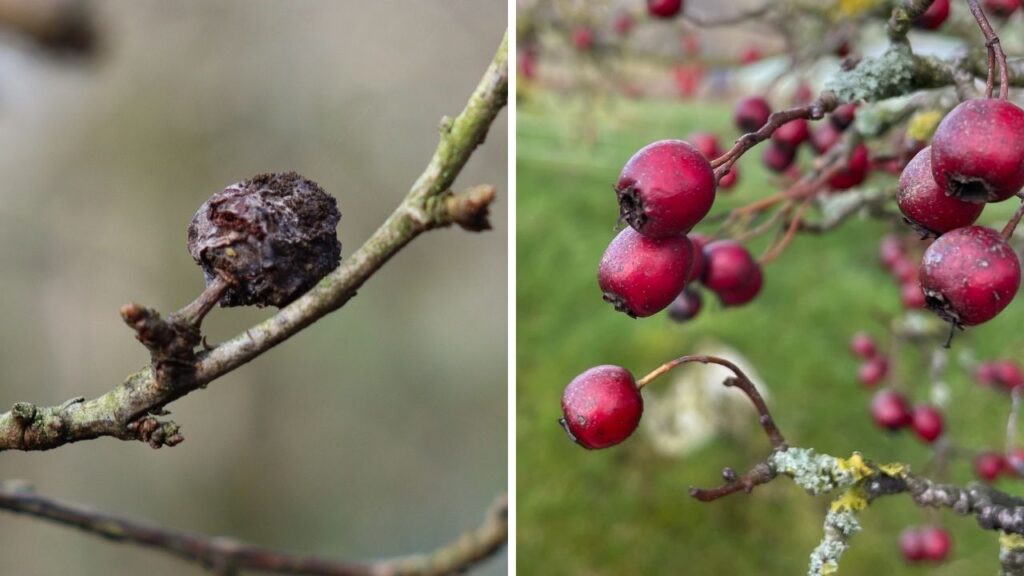
Above: On the left, Blackthorn can hang on to a few withered & dried sloes in winter. On the right, hawthorns often has smaller, deep red berries on show in winter.

The autumn fruit of blackthorn is the sloe. A good size fruit, around 1.5cm diameter and purple to black in colour. In winter though they are shrivelled and looking much worse for wear, with most of them having fallen already. Hawthorn in comparison holds onto it’s berries better in winter. Look for smaller, dark red berries, with an ovoid shape, growing in sparse clusters. As they dry out they darken in colour.


Looking Under The Tree

Have a good kick about in the leaf litter under a tree and you might find another big hint to what species you’re looking at. The old saying goes “the apple never falls far from the tree” and that’s good news for us in this case. I’m talking about fallen fruits and nut cases, many of which can still be found in the depths of winter, if not in the best condition.

winter tree identification: fallen fruits and nuts

Top Left: Crab Apples. Mid Top: Sweet Chestnut. Top Right: Hazelnuts, nibbled by wildlife. Bottom Left: Conkers from Horse Chestnut. Mid Bottom: Beech mast and leaf litter. Bottom Right: A bract from a Lime tree.

Some trees, like the Crab Apple, have a dead giveaway with the fallen, rotting fruits. Look under an established hazelnut and you’ll most likely find empty nut shells, nibbled away by rodents and birds. Then there’s tree like out three native Limes which have special leaves called bracts, which look like nothing else you’ll find on the woodland floor and can only belong to a Lime tree. Beech mast is very reliable under mature trees and you’ll find yourself crunching in underfoot as it carpets the woodland floor. There’s much to be gained by looking down.

Now this only works if there’s something to find and also you should be wary of relying on this too heavily where the tree is crowded with others as  what you’re looking at may have fallen from it’s neighbour.

By the far the most reliable method of winter tree identification is to begin with a branch and study a healthy twig and it’s buds. That way we can be sure we’re investigating the right tree and the knowledge of bud and twig is transferable no matter whether the ground below is humous or concrete.


Get Your FREE Winter Tree Guide

I’ve created a handy guide you can use when you’re out and about looking at trees during winter. The guide features 18 native and common British trees which have buds, twigs and leaf litter that you might already be familiar with but also there’s other signs here that you’ve probably never noticed before. I’ve laid out similar looking species side by side so that you can easily distinguish between them.

The guide puts the focus firmly on the winter buds but you’ll also see smaller images featuring other clues you can look for in each species such as old fruits, leaf litter, nut cases, bark and catkins. Where I’ve included these they act as dead giveaways to which tree species you’re looking at.

I hope you find it useful on your journey to understanding the trees around us.

DOWNLOAD YOUR GUIDE HERE


Discover more About Trees

It can be so interesting to really look in to the details of our native trees and notice the changes that they undergo throughout the four seasons. That’s just what I’ve created for my FREE introductory online course called Kickstart Your Tree ID Skills. Here you will find a whole host of resources to take you from clueless to confident on your way to really knowing your trees.
REGISTER FOR THE FREE COURSE HERE

kickstart your tree id skills, free online course
When you sign up to this free mini-course you’ll be identifying common trees with video tutorials and photo galleries at your fingertips. Start your journey to becoming a fully fledged Tree Expert today. The course includes Tree ID Cheat Sheets which you can download and take outdoors with you.

“I’ve been frustrated for so long trying to learn my trees myself and haven’t gotten far. This course answered everything and has seriously upped my game.” Dr. Patrick Alexander


Happy tree hunting folks.

James

make boozy berry chocolates for christmas

Wild Boozy Berry Chocolates

So, you’ve made your sloe gin and your blackberry brandy back in the autumn and you’re now ready to bottle up the drinks to give as gifts for Christmas. But wait! Don’t throw away those berries. You could make divine festive chocolates that will leave you wanting more.

In this article we will show you two easy-to-make and indulgent recipes for our Wild Boozy Berry Chocolates which make great use of your spirit-soaked hedgerow fruits. This is one of our favourite recipes of the whole year.

These chocolates will be the talk of any Christmas gathering with friends or will make a perfect surprise flourish to round off Christmas dinner. You could even wash them down with a tot of blackberry brandy or elderberry vodka. Just remember, they’re not for kids 😉

make your own christmas chocolates wild food & foraging

Above: The brandy-soaked berries in these chocolates are complimented by the orange zest and cinnamon. We added some edible gold spray for a final flourish.

Making Hedgerow Spirits

As outdoor educators, 2020 saw us locked down, unable to run many of our woodland courses and forced to stay close to home for the majority of the year, consequently we have been exploring our local green spaces and (like so many people) really getting further into the fascinating world of wild food and foraging. We have been preserving wild greens, cooking up foraged meals and discovering so many edible plants all around us like never before.

In the spring we were enjoying wild garlic pesto and nettle soup, in the summer it was dandelion honey and elderflower cordial. Autumn has bought us an abundance of berries and one wild food recipe that most people have heard of is sloe gin. It’s a foragers classic and if you’ve never made it for yourself, do give it a go. It’s so simple. If you want a recommend method for making this yourself, head over to the River Cottage website for a simple how-to.

The possibilities of hedgerow spirits go way beyond simply sloe gin though. We have made all sorts of recipes, using vodka, brandy, gin and whiskey. Any of the autumn berries can be used, and any mix, depending on what you have available or an experiment of different flavours together. All of these autumn foraged fruits work well; sloe, bullace, damson, haws, blackberries, rosehips and elderberries. 

making hedgerow spirits - wild food & foraging

Above: The sloe gin and blackberry brandy is all bottled up, but we have some boozy berries left over. Don’t get rid of them just yet.

Waste Not, Want Not

Many people would chuck the alcohol-soaked fruits away once it’s time to strain out their hedgerow spirits, but this would be a BIG mistake. We used a whole host of hedgerow berries in our chocolates which has been gathered since summer; wild cherries, blackberries, wild raspberries, wild strawberry, sloe, bilberries, redcurrant and bullace. But you can use whatever fruits you have soaked in alcohol already.

Don’t use elderberries in your chocolates as the seeds can give you an upset stomach if eaten without cooking first. Be sure also to remove any large stones from fruits such as sloe, bullace and cherry too.

Any of the spirits will work for this recipe, but we love brandy-soaked fruit the best with chocolate. Rum would also be a good option.

wild food & foraging: autumn fruits

Above: Use any of these autumn fruits in your hedgerow spirits and chocolates. Sloe, elderberry, rosehip, blackberry, hawthorn and bilberry.

Recipe 1: Boozy Berry, Fruit & Nut Chocolates

Boozy fruit – stones removed from the flesh, as needed

Hazelnuts – Roughly chopped

70% Dark Chocolate – use good quality chocolate, you won’t regret it

Icing sugar – for decoration


Recipe 2: Boozy Berry, Orange & Cinnamon Chocolates

Boozy fruit – again, remove the stones where you need to

Grated orange zest

Cinnamon powder (to taste)

70% Dark Chocolate – use the good stuff

Edible Gold Glitter Spray – for decoration


Method

  1. Cut the flesh from your boozy fruit and discard any stones or inedible pips. Set the fruit aside in a bowl for now.
  2. Bring a small pan of water to the boil and rest another bowl over the pan to create a double-boiler. Break up the chocolate and slowly melt it in the dry pan.
  3. Take a clean ice-cube tray and fill each section halfway with the other ingredients; either fruit, orange zest and cinnamon or fruit and hazelnuts.
  4. Next, gently pour the melted chocolate into each section of the ice tray until the ingredients are well covered.
  5. Place the tray in the fridge for 1-2 hours to allow them to set.
  6. Push chocolates out of the tray and for a little sparkle you can either dust some icing sugar over them or give them a splash of edible gold spray.
  7. Lastly, eat them and be merry!
boozy berry chocolates

Above: These boozy chocolates contain not only brandy-soaked hedgerow berries but also hazelnuts, for an indulgent Christmas treat.

Discover More Wild Food

If all this talk of wild food and foraging has whetted your appetite then you can take your learning further with us through the range of courses we offer.

You can immerse yourself in the world of foraging through our outdoor courses hosted in beautiful National Trust estate woodlands in North-East Wales. Or if that’s too far afield for you we also host regular online workshops, live through Zoom where we focus on wild foods of the season and give you delicious recipe ideas, foraging tips and expertise from special guest speakers. If this all sounds interesting, check out what’s coming up on our Events page right here.

Another way to get instant access to a whole backlog of wild food & foraging videos, recipes and recorded workshops is to join our Tribe over on Patreon. In return for supporting our mission, our patrons get access loads of exclusive resources. You can join the Tribe from as little as £3.60 per month. Find out about all the benefits right here.

Until next time, good luck with your own foraging journey.

Lea

bushcraft skills course in north wales

My Weekend in the Woods

Have you ever wanted to learn skills that would help you thrive in the wild, from how to read the landscape to lighting a fire with natural materials? My name is Emily Fox and I was asked to write about my experience attending a Bushcraft Skills Weekend with Woodland Classroom.

Woodland Classroom host outdoor courses that cover everything from tree identification, foraging and outdoor survival skills, but in reality those lines often blur as there is so much cross-over in these subjects, so I was looking forward to a little of everything. In this blog I’ll be taking you along with me as I tell you what I got up to in my weekend in the woods. To check out what other outdoor courses we have coming up click here. 

I’m already a pretty outdoorsy person, I’m really into my climbing and love hiking, especially around Snowdonia and the Lake District.

I spend a lot of time hiking and running around in the woods wherever possible and have even managed a little wild camping, so I’m used to being outdoors. I saw the bushcraft weekend as an opportunity to really step up my skill level and become better at understanding the land around me and how to survive if I found myself short on anything on a wild camp or out in the woods. It was something I’d not really done before so I was excited to see what skills I could learn. Having arrived late on the Friday evening though I didn’t know it would be straight into the deep end!

I was offered the option to sleep out in what looked like the ultimate den of sticks… my answer was, of course, yes. My tent, stayed in the backpack.

natural lean-to survival shelter

Above: My home from home for the weekend. Notice the bed of fresh brush which kept me off the cold floor.

Waking Up In A House Made of Sticks

Waking up on Saturday morning after a full, busy week of fast-paced work and modern living to the sun filtering through the pine trees as I lay on a bed of bracken under the canopy of the lean-to shelter was the most relaxing start to the weekend I’ve ever had. It put me right in the zone. I’d jumped at the chance to come and help at a bushcraft weekend in Wales as it sounded like the perfect getaway, and I was even more excited when I was offered an outdoor shelter to sleep in for the night. My lean-to was made of just sticks, leaves and branches, not a plastic tarp in sight, but despite it having rained the whole day before this natural shelter was bone dry and I slept like a baby the whole night!

After introducing ourselves to the group James, our Head Instructor, took us into the woods and asked us to look at our surroundings and share what we could tell about the landscape around us. I was asked to read the landscape; what did I notice about the age of the trees, did I recognise any plant species, how might the land-use have changed over time and where could water possibly be found? This was all about waking up our inner-ancestor and looking at the land through ancient eyes, those people that relied on the land for their survival. We were then tasked with going and having a look to see what natural materials we could gather that could be useful to us. Spruce resin for fire building, blackberries for eating, flexible willow branches for weaving and spruce needles for natural medicine were all things students brought back.

making survival shelters

Above: Constructing a kennel shelter. The whole thing is held up by just 3 poles. No rope is used.

Sharp Tools & Shelters

The first activity was to whittle a tent peg from greenwood, something that would come in handy later. James showed us safe ways to use a knife, cutting techniques and knife grips to use in making the peg. I was pleased with my finished peg and tucked it into my backpack for tomorrow. Having shown we were safe with the knives we were allowed to keep them on us for the weekend. Next we were onto natural shelter building, similar to the one I’d slept in last night.

The group was split into two and each team was guided through making a different style of lean-to we split into two groups and got to work building different types of lean-to shelters. James showed us how to use bundles of bracken, like thatching, to make a layered waterproof covering to keep the shelters dry. Working in smaller groups let us be super involved in each activity and allowed us to get to know the people we were working with a lot better. Using these materials was time-consuming, compared to putting up a tent, but they were also surprisingly effective and I got a real sense of achievement from creating this structure. It’s an empowering experience and I can see why bushcraft skills can be addictive – the idea of being able to fend for yourself, accessing “secret” knowledge.

whittling skills on a bushcraft course

Above: Other folks on the course very happy with their brand new tent pegs.

Playing with Fire

After lunch at basecamp we went back into the woods to start on fire making. We began by looking at all the components we needed to actually light and sustain a fire. The three essential aspects of a fire are heat, fuel and oxygen. I would need all of these things in abundance to keep my fire healthy. I experimented with lighting fires using modern fire-steel and traditional flint & steel. I was given cotton wall and char-cloth (made my baking natural fabrics) and I soon saw that without any substantial fuel the flame only lasted for a few seconds before dying off.

I learned that by adding an accelerant, either something I could bring with me like vaseline or something gathered from the woods, such as spruce resin. My little fire lasted a lot longer, around thirty seconds instead. We then used this principle to find natural tinder, kindling and accelerants before building our own fires, gradually building our firewood thickness until we got from a small flame to our own roaring campfire that could sustain us through the night if needed.

It really is true that once you have a simple roof over your head and a fire going, you can feel at home anywhere. The cup of tea helped.


Identifying Trees in the Dark?!

Just as the sun was setting James ran a night-time tree identification walk. Now this sounds intriguing; how can we possible identify trees in the dark? We took a stroll in the darkening woods to see if we could hone our skills, with James teaching us how to recognise trees based on just the leaf shapes, texture of the bark and shape of the tree against the sky. There were some really interesting conversations about how we each recognised certain trees. For example, someone commented on the fact that the oak tree was easy to identify by its outline because it was often used on pub signs. James encouraged us to closely examine the trees we came across; see what the leaves felt like, how the branches were structured, all whilst encouraging us to draw on what knowledge we already had. I was also encouraged to engage my other senses. I discovered that I could recognise a mature beech with my eyes shut as I could hear the crunch of the thick layer of beech mast beneath my feet – result! James was giving out ‘bushcraft points’ to anyone with correct answers. I earned 5 bushcraft points for remembering that holly leaves further up the tree aren’t spiky because animals don’t graze on them, then lost another two for excessive gloating, oops!


Easy Like Sunday Morning

Another comfortable night in my stick home, with the tawny owls hoots for company. James had explained that by crafting a raised bed from, logs brash and bracken layered up that it raised my body off the cold ground and so added a lot of insulation. It’s said that layers below you are much more valuable than a layer on top when sleeping on the earth.

I started Sunday with a nature-awareness exercise, called the Sit Spot. James talked to us about connecting with nature by taking a moment to sit outside and quietly observe what was happening around us, without expectation or agenda. With that we each slunk off into the woods to find a quiet comfortable spot. I sat for 20 minutes to take in everything going on around me before coming back and reporting what we had seen, heard or felt. It was lovely to start the day by connecting deeply with our environment. Tis is a real contrast to the attitude I adopt when hiking where the purpose of being outdoors is to get from one place to another, rather than simply allowing myself and nature to be.

water filtering and billy can cooking

Above: Hanging out billy can above the fire using campcraft skills. Filtering dirty water using natural materials.

Making My Ultimate Woodland Getaway

The majority of today was all about putting together the skills we had learnt so far. The goal was to be able to set up our own shelters, start a fire and make a cup of tea in our camps. I would need to use my knife for cutting, shelter building skills, I’d need a way to hang my billy can over the fire and I’d need plenty of firewood. Lots to be getting on with.

The first activity was to filter water using natural materials we could find in the woods as well as artificial ones to. We would not be drinking the water we filtered aa this should only be done in a real situation, but it was good to see the principles at work. We then worked on making natural cordage using nettles and bramble. This cordage could be used for our shelters or for hanging our billy can. James showed us how to identify the most suitable bits of plant to use and how to dry and braid the strands to make a strong cord which could be used for years.

Since yesterday we all made a natural shelter, today we were given a one-person tarp (called a basha) to rig over our makeshift camps. James introduced me to a couple of knots for getting it all taught. Our group decided to combine the tarp alongside the lean-to I slept out in so we had a covered area for our outdoor fire – very cosy indeed. Our whittled tent pegs and natural cordage came in handy here and we saw how strong this natural fibre really was when put to the test of holding up our shelter.

Next we worked we turned to campcraft skills with the challenge of creating something that could be used to hang our billy can for boiling our brew over the fire. I worked with a couple of others, each of us made a different part of the frame from hazel wood before moving the various components over to our camp. Each group came up with a totally different way of solving the problem which was good to see. My trusty tent peg came in handy to anchor the pot pole. I used my wild cord to make the billy can adjustable so we could lower it down or back up depending on how intense we wanted the boil.

natural cordage and survival shelter

Above: We combined paracord with our bramble cord to tie off our shelter. Matt looking very content in his woodland home.

Making Fire… in Heavy Rain!

It was time for the big finish, practising ancient fire by friction skills. Something I had read about and seen on YouTube but not done myself yet. Now it’s very important that certain components of this traditional fire-starting kit be kept bone dry. We were all set, feeling somewhat confident… and then the heavens opened! We were to make our fires using bow drills and due to the rain coming down we decided to work in teams to increase our chances of success rather than everyone struggling individually in unideal conditions. I get the feeling this is how our ancestors would have pulled together in a real situation… so it’s not cheating.

Once James showed us the technique I was surprised how quickly we achieved smoke and the beginnings of an ember. James tressed how success comes not from powering through to eventual success but using good technique and communication with each other to ensure the best chance of making fire. Unfortunately, for a beginner like me, these were not ideal conditions. The rain was getting heavier and this made it hard for us to create any sparks or for a flame to catch in our tinder nest, but with a little help, we eventually managed to get a roaring fire going and enjoyed a well-earned hot cup of tea from our billy can. Job done! 

fire by friction skills course

Above: Me working with my group on fire-by-friction to get a good ember for our fire.

Home & Dry

At the end of the day, we had practiced the skills to go out into the woods and thrive on what we could find around us in a sustainable and nature-focused way.

There was something very rewarding about managing to make the bow drilling a success despite the elements being against us. We were shouting when we finally got it going it was an amazing feeling and even though we were all pretty tired at the end of the weekend I definitely felt like I had learnt so much. It was more than just learning skills to use outdoors, it was changing the way I thought about nature and being creative with how I solved any problems I might face if I was in the woods without certain tools. I’ve definitely caught the bushcraft bug.


Ready For Your Own Adventure?

I can highly recommend this course and I’m looking forward to attending more in the future, especially the Wild Food and Foraging Day. If you’re looking for a quality and fun experience like this then do check out our upcoming courses.

Woodland Classroom host outdoor courses on bushcraft skills, wild food & foraging, nature connection and tree identification all surrounded by the beautiful National Trust estate woodland of Erddig and Chirk Castle in North-East Wales. Courses are available for adult learners, families and private bookings. Get in touch if you’d like to know more.

SEE OUR UPCOMING COURSES HERE

Hope to see you in the woods,

Emily

Emily Fox is our Outdoor Activities Assistant, on placement to Woodland Classroom for 12 months. She hopes one day to run her own outdoor activity business where she can share her passion with others.

  • 1
  • 2
  • 7
Social Share Buttons and Icons powered by Ultimatelysocial