Call us on: 07876 794098

Tag - adult learners

which trees have catkins

Which Trees Have Catkins?

When out and about wandering the wilds have you noticed catkins on the trees? Depending on what time of year you’re looking they can be small and closed up or they could be large, mature, pendulous flowers, dangling like lambs tails in the breeze. They can be a very useful sign to help us identify what species of tree we are looking at.

In this blog I’ll explain what catkins are, when you can see them on different tree species and which trees have catkins. If you love trees, but struggle to tell one species from another, then you could enroll in my FREE Tree Identification Course online. More details can be found at the end of the article.

You can also get your hands on a free download; Spring Trees Catkin Guide which you can find below.


What Are Catkins?

Catkins are made up of a hanging spike of tiny flowers, which begin their lives all closed up but will mature and open as spring approaches. Catkins release pollen which is reliant on the wind to blow it over to a waiting flower. As a general rule, the catkins open up and mature before the leaves appear on the tree. The reason for this is so that the leaves don’t get in the way of the pollen travelling on the wind, so the chances of pollination are increased – nature’s pretty clever like that. Typically there are a lot more of the male catkins on the tree than the female flowers, again giving the tree the best chance at reproduction.

In the majority of tree species, catkins are usually male, but this is not always the case. With willow trees there are separate male and female catkins which only grow on separate trees. So they are reliant on there being the opposite sex tree within reach of the wind.

goat willow - male & female

Goat Willow (Salix caprea) has striking catkins in early Spring. The males (left) and the females (right) appear on separate trees.

When Do Catkins Appear?

On some native trees the new catkins can appear as early as the autumn, when they will be short, closed up and firm to the touch. These will hang around on the branch through winter as they slowly swell and mature. If you’re seeing these young catkins on a tree in winter then it’s most likely one of the following; alder (Alnus glutinosa), birch (Betula spp.) or hazel (Corylus avellana), these are the most common.

alder and birch catkins

Alder (Alnus glutinosa) on the left and birch (Betula spp.) on the right. Young catkins appearing in autumn.

In late winter the hazel tree’s catkins undergo a transformation as they swell in size, open up and release their pollen to the striking but tiny scarlet flowers. They are a beautiful but often overlooked splash of colour at this time of year, if you can find them. The catkins themselves are notable in late winter because they are maturing well ahead of any other native tree. Give the mature catkins a little tap and you might  well be rewarded with a cloud of pollen puffing from the flowers.
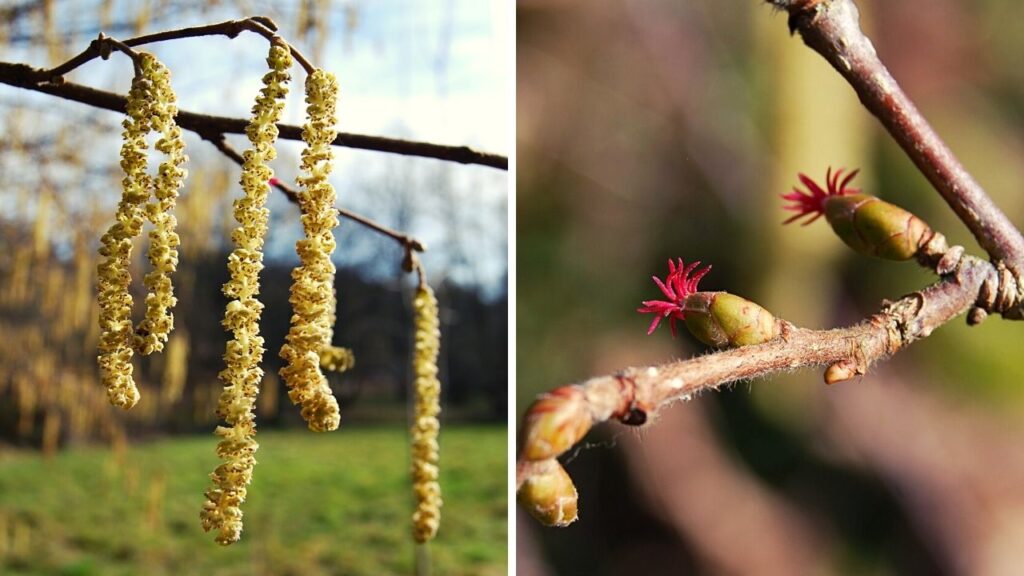
hazel catkins and flowers

Hazel (Corylus avellana) is the first native tree to give us a striking splash of colour in late winter, even if it is tiny. A country nickname for the catkins is “lambs tails”

In early spring it’s the turn of the willows and poplars to open up their catkins and this makes these species much easier to recognise than at any other time of the year. As we get to late spring, the female willow flowers have been pollinated and we get those distinctive white fluffy catkins of seeds which float on the wind and litter the pavement and curb-side, the bane of street-sweepers everywhere. I think they look quite nice though.
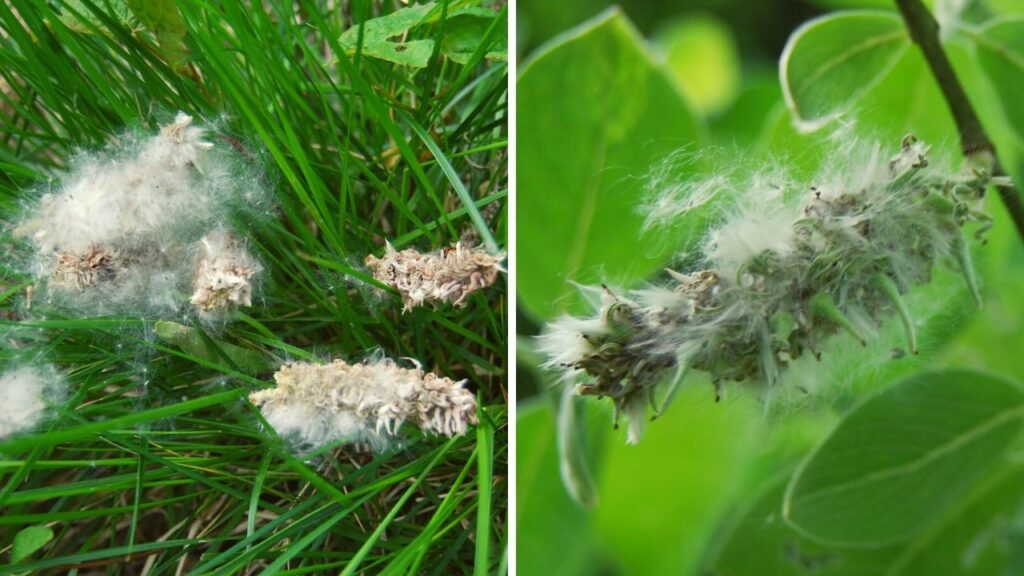
mature willow catkins in late spring

The fluffy pollinated seeds of the Goat Willow (Salix caprea) these are the mature female catkins. Seeds then spread by wind-dispersal.

Here’s a list of all our native tree species which have catkins, at one time of the year or another:

Alder, Aspen, Black Poplar, Birch, English Oak, Grey Poplar, Hazel, Hornbeam, Sessile Oak, Sweet Chestnut, Willows and White Poplar

Discover more About Trees

It can be so interesting to really look in to the details of our native trees and notice the changes that they undergo throughout the four seasons. That’s just what I’ve created for my FREE introductory online course called Kickstart Your Tree ID Skills. Here you will find a whole host of resources to take you from clueless to confident on your way to really knowing your trees.

REGISTER FOR THE FREE COURSE HERE

kickstart your tree id skills, free online course

When you sign up to this free mini-course you’ll be identifying common trees with video tutorials and photo galleries at your fingertips. Start your journey to becoming a fully fledged Tree Expert today. The course includes Tree ID Cheat Sheets which you can download and take outdoors with you.

“I’ve been frustrated for so long trying to learn my trees myself and haven’t gotten far. This course answered everything and has seriously upped my game.” Dr. Patrick Alexander


free spring tree catkin guide

FREE Spring Trees Catkins Guide

I’ve created a quick reference pictures guide to 9 of our native and common trees which produce catkins from late winter to early summer. I’ve arranged them in order of when their catkins appear too so you know not only what to look for but when to look for it. I hope you find it useful.

DOWNLOAD YOUR GUIDE HERE

Happy tree hunting folks.

James

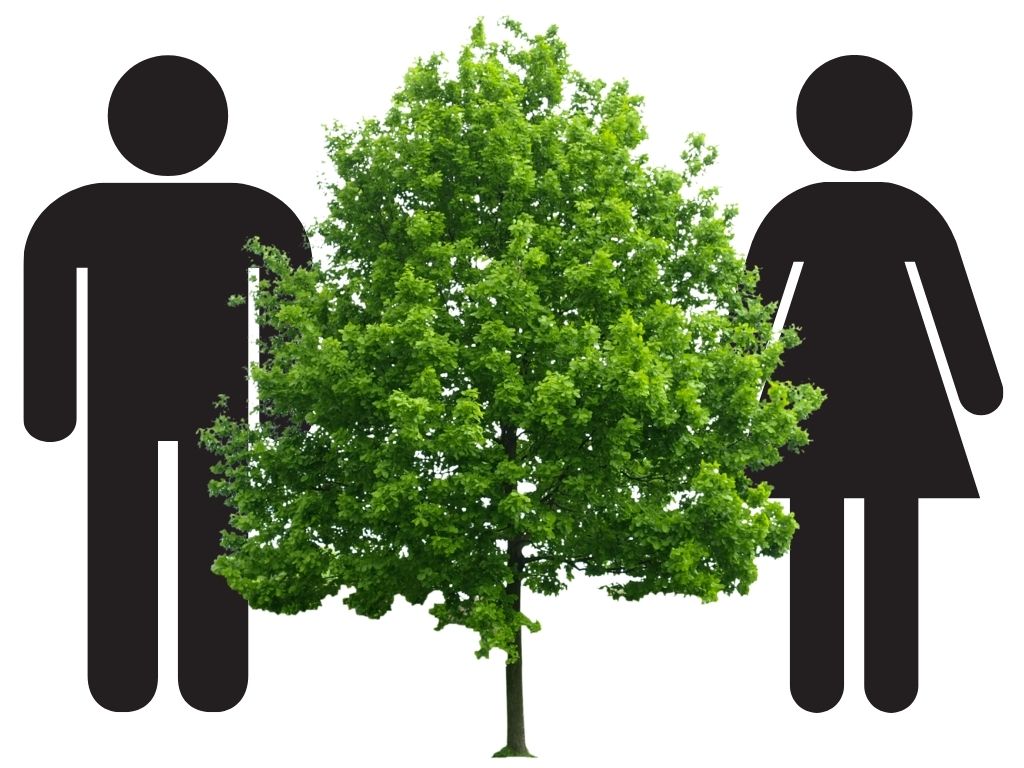
are trees male and female?

Are Trees Male & Female?

We all know how it works with animals, but can trees be either male or female? Or do they have their male and female reproductive parts on the same tree? In this article I’ll break down for you the answer to the question whether trees can be male or female and also give you some common examples you can see for yourself, out in the countryside.

The short answer to the question is… sometimes.

It’s a question I had to ask myself when doing research for creating my FREE Tree Identification Online Course. Having scoured the books and spent extensive time in the field looking at the evidence, I’ve discovered that here in the UK we have a number of native species which have separate male and female trees, although they are in the minority.


WORD OF THE DAY: DIOECIOUS

Trees which do have separate male and female individuals are referred to as being dioecious (pronounced dye-e-schuss), which is defined in the dictionary as “having the male and female reproductive organs, especially flowers, on different individuals.”

On the flip side, trees and plants that include the organs or flowers or both sexes on the same individual are called monoecious. The majority of native trees fall into this category, including trees like oak, birch, beech and hazel.

birch and hazel male and female flowers

Left: Birch with both male & female parts on the same branch. Right: Hazel with female flowers above and male catkins below.

In the image above you can see that the birch (Betula spp.) has female flowers (small, green and upright catkins) as well as male flowers (long pendulous and speckled catkins) on the same branch. Meanwhile hazel (Corylus avellana) has very different female and male parts on the same tree.

An easy way to remember which parts you’d expect to see on a dioecious tree is that with male trees they produce the seed (in this case pollen) which then fertilises the female trees which then grow the fruit, seed, nut or berry – sound familiar?


LOOKING AT EXAMPLES

So, where might you have seen a dioecious tree whilst out on your Sunday walk? Let’s talk about some examples.

Have you ever wondered why you don’t always see red berries on a holly (Ilex aquifolium) in winter? This is because only the female trees bear the fruit. It’s worth noting that there are other factors at play as well, such as whether a holly tree is getting too much shade (making it sterile) or it has no male nearby to pollinate it, so not every holly you see without berries will be a male, but EVERY holly you see with berries is a female.

holly with female berries and male flowers

Holly (Ilex aquifolium) with the familiar female berries on the left and on the right a separate tree with male flowers.

Both male and female holly trees have flowers, appearing in May, but there are subtle differences for which you might need a hand lens, so the easiest way to tell is in berry season.


WILLOWS & POPLARS

Once the early spring comes around there’s another two families of native trees which announce their gender, loud and proud, for all the world to see. These are the willows and the poplars. Both families of trees are closely related.

In late February and through March the willows explode with fluffy, dangling catkins. Think of the ‘pussy willow’ (Salix caprea) named after its young male catkins which look and feel like fluffy cats paws.

goat willow - male & female

Goat Willow (Salix caprea) also known as pussy willow. On the left we have the male catkins on one tree. One the right we see the female catkins on a separate tree.

Look at the yellow pollen, clearly visible on the male flowers on the left picture. Remember, this pollen is needed to fertilise the female flowers on another tree.

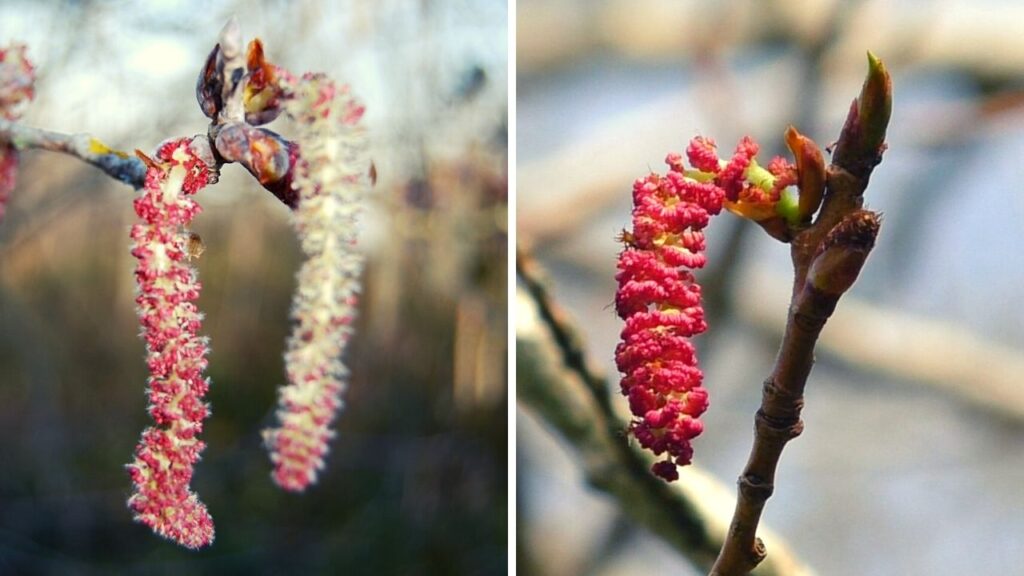
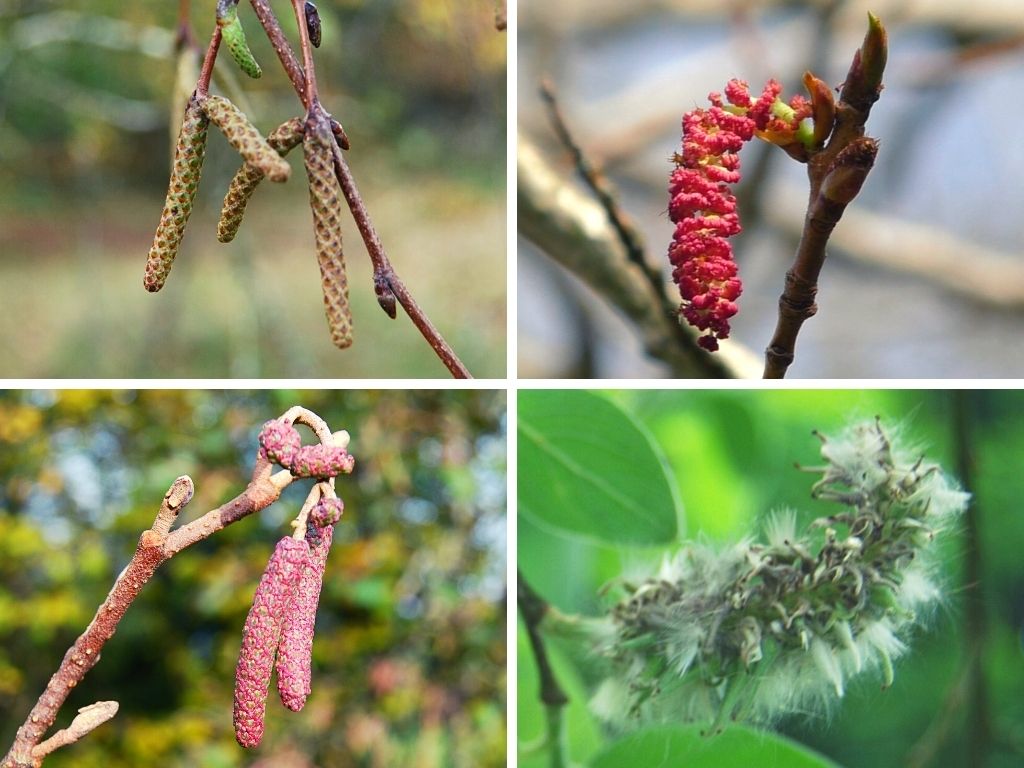
Meanwhile the poplars, follow suit with their own catkins. Like willows these catkins are easy to spot in early Spring as they are out before the trees come into leaf, so they really stand out. Look at the example in the picture below, we have both White Poplar (Populus alba) and Black Poplar (Populus nigra) with their striking crimson male flowers. In both cases the female flowers (also catkins) are green rather than red, so easy to tell apart once you know this.

white & black poplar - male flowers

White Poplar (Populus alba) on the left, Black Poplar (Populus nigra) on the right. Showing off in spring with their male flowers.


A TREE THAT BREAKS THE RULE

The ash (Fraxinus excelsior) is our third most common tree and it’s the rebel of the pack. Bending the rules – there’s always one. Look closer and in spring you could see both male and female flowers on the same tree (though on different branches) but you can also find ash trees which are exclusively male or female.

In winter, once the leaves have fallen you can often spot an ash a mile off, distinctive by its seeds, called “keys” hanging in dense bunches all in the crown. They really stand out in the overall silhouette of the tree, so look out for it. You’ll have to wait until spring though to answer the question of whether it’s male or female… or both! If you want to see pictures of both the male and female flowers of the ash, you can find these in the photo galleries of my Tree ID Course, it’s free to sign up.

So, if you’re planning some tree planting yourself and you want to include any of the species mentioned here you do need both a male and a female in order to let nature work its magic. However, if you are planting trees simply for ornament and you don’t want to encourage a young forest sprouting up around you (although personally that sounds quite nice to me) then it doesn’t matter, the tree will be perfectly healthy on it’s own.


BOYS & GIRLS – THE DEFINITIVE LIST

Here’s a complete list of all the native tree species which are dioecious (male or female)

Ash (sometimes), Aspen, Black Poplar, Buckthorn, Grey Poplar, Holly, Juniper, Sea Buckthorn, White Poplar, Willows and Yew

If you found this interesting and want to know more about the trees around you, then you can start building your tree ID skills right now by signing up to my FREE introductory online course Kickstart Your Tree ID Skills.

REGISTER FOR THE FREE COURSE HERE

kickstart your tree id skills, free online course

When you sign up to this free mini-course you’ll be identifying common trees with video tutorials and photo galleries at your fingertips. Start your journey to becoming a fully fledged Tree Expert today. The course includes Tree ID Cheat Sheets which you can download and take outdoors with you.

“I’ve been frustrated for so long trying to learn my trees myself and haven’t gotten far. This course answered everything and has seriously upped my game.” Dr. Patrick Alexander


Happy tree hunting folks.

James

top 3 easy ways to identify trees

3 TOP TRICKS TO IDENTIFY ANY TREE

Ever get frustrated that you don’t know what tree it is you’re looking at? Don’t sweat it, I’m going to share with you my top 3 techniques for identifying any tree out in the countryside.

I call these techniques, my 3 Key Principles of Tree Identification. Have a look at the video below and I’ll explain what they are and how you can use them yourself.


When practising tree identification (and this goes for wildflowers too) I like to play a game of elimination, whittling down what the tree isn’t to help me work out what it is. Using these techniques helps me do that. So, let’s elaborate some more on these 3 Key Principles…


TECHNIQUE 1:   TUNE IN

Think about your surroundings. Ask yourself, “where am I?” Are you in farmland, a town park, an old country estate or a retail centre car park?

This is important because the setting of where you’re looking at a tree can tell you a lot about which species you might expect or not expect to see.

For instance, if we’re out in farmland or a natural woodland then it’s most likely we shall see a range of our common native tree species; oak, hawthorn, ash, willow and so on. The trees that make up the majority of our countryside.

countryside

However, if we’re somewhere like a National Trust property, an old country estate, the likelihood of exotic tree species having been planted here becomes much greater. You could be seeing rhododendron, eucalyptus or even giant sequoia.

The same goes for looking at trees in somebody’s garden – they could have planted anything! There are hundreds of Acers (from the maple family) and a whole host of ornamental birches for a start, many of which are common place in gardens up and down the country.

This principle also applies to the wider environment. For instance you’re going to see a different variety of species down in Devon than you will up in the Highlands of Scotland. Certain tree species prefer certain soil types, or micro-climates, and some species will tolerate more extreme conditions, such as a mountain-side, more than others will.

So, a good habit to get into when you start practising tree identification, is when you arrive at a location to start tree hunting, take a moment to stop and ask yourself:

“Where am I?”

“What is the history of this environment?”

“Which species do I expect to see here?”

The more you practise tree identification, the more experience you will build up and the better you’ll be able to predict the range of species you could see when visiting a new place.


TECHNIQUE 2:  BEGIN WITH THE BRANCH

Study a young, healthy branch first.

With most tree species, you can find everything you need to know to identify it in any season simply by looking at a healthy, young branch from the tree.

Depending on the season, a young healthy twig is going to include one or more of the following distinctive features:

Buds, leaves, flowers, fruit, nuts and of course the young bark itself.

Think of a young healthy branch as the tree in microcosm. Often, everything you need to know is right here.

tree identification in winter

Everything you need to know to identify the tree can usually be found at the tip of a branch.

One word of warning, make sure that the branch you’re looking at is actually attached to the trunk of the tree you’re investigating. When you’re in a woodland or looking at a hedgerow branches tend to cross over from other trees in their race to reach sunlight and it can be easy to grab hold of a branch from the neighbouring tree.

This may sound obvious but I’ve seen it plenty of times on courses and even done it myself and it can cause a lot of confusion.

So, once you’ve selected your branch to study. Just take a moment to follow it back with your eye and check it’s attached to the right tree.


TECHNIQUE 3: IS IT ALTERNATE OR OPPOSITE?

Study the bud or leaf arrangement.

Depending on the time of year, the twig is either going to include buds or leaves. These features are going to be laid out in one of two forms:

1.   Alternately along the branch.

2.   Growing in opposite pairs.

This is absolutely key to nailing the species of tree as once you’ve answered that question it allows you to eliminate a whole bunch of species from your enquiry.

So I like to ask the tree this question when I first approach it. “Are your buds arranged alternately or in opposite pairs?”

The majority of native tree species in Britain have their buds or leaves arranged alternately along the branch.

One last thing to remember; it’s important to select a young healthy twig to answer this question because as a branch matures it will often self-select the healthiest of the twigs to grow on and will drop it’s near partner. So, you can be looking at an older branch and thinking that they definitely don’t grow in opposite pairs, but then on closer inspection you might well notice the old scar left over from where it’s opposite equivalent was self-selected to be dropped by the tree in favour of it’s partner.

When you become practised at this you will begin to start noticing the bud arrangement from a distance, as you look at the form of tree. This is when tree identification can become very satisfying and you can really start showing off.


IN CONCLUSION

In conclusion, keep these three principles in mind when you’re out and about looking at trees. They will give you a solid grounding from which to build your skills up from.

If you found this interesting and want to know more, you can start building your tree ID skills right now by signing up to my FREE introductory course Kickstart Your Tree ID Skills.

REGISTER FOR THE FREE COURSE HERE

Happy tree hunting folks.

James

how to identify trees in autumn

Identify Autumn Trees Like a Pro

Autumn is a beautiful time to be out in the woods, with all the fantastic colours our trees give us. But many people struggle to really know what they’re looking at. Can you tell your beech from your birch, or your alder from your elder? I’ve been on a mission over the past few years to build my tree ID skills and I’ve brought all that experience together in an online training course, which will take you from clueless to confident in your own tree knowledge. In this blog I want to share with you some of my top tips for really getting to know your trees in autumn.

Autumn is a season where many of the leaves we could be familiar with are changing, so we need to look closely at what’s going on and also start relying on some other features to make a positive ID.

I’ve made a video showing you how to recognise our native field maple (Acer campestre) in the season of autumn. Its a tree that many folks get confused with sycamore or the many other non-native maples which can be found across the UK.

If you liked this video and would like more good stuff then you can sign up to my new online training programme, The Complete Tree ID Course. It’s totally FREE to enroll on the introductory course Kickstart Your Tree ID Skills

ENROLL ON THE COURSE NOW

When you join the free course you will also get tree ID videos for ash and hazel in autumn.

tree id cheat sheets: ash in autumn

Join the online course and get seasonal Tree ID Cheat Sheets for many British tree species. Download them to your mobile device or print them off.

So, let’s talk about a few things to look out for at this time of year with my top tips for identifying trees in autumn…


Look for consistent colour when the leaves change.

Although many trees show a range of golds, yellows and reds at this time of year, some tree species give an even display of a dominant colour in autumn. Once you’re familiar with that, it can be recognised from a distance before you even get anywhere near the tree. In the video on field maple here you will have seen how that tree produces an even display of bright yellow across all the leaves. This is in contrast to sycamore which typically doesn’t give a show like this.

hornbeam in autumn

Let’s play ‘Spot the Hornbeam.’ The tree gives a reliably even display of yellow at this time of year.

Hornbeam (Carpinus betulus) is another native tree which gives an even display of yellow across the whole tree. This can be really useful when differentiating it from beech (Fagus sylvatica), which is a tree is shares a lot of similarities with. Lucky for us, beech leaves don’t turn a bright yellow anywhere as evenly. Look out for consistently yellow leaves on Birch trees also.

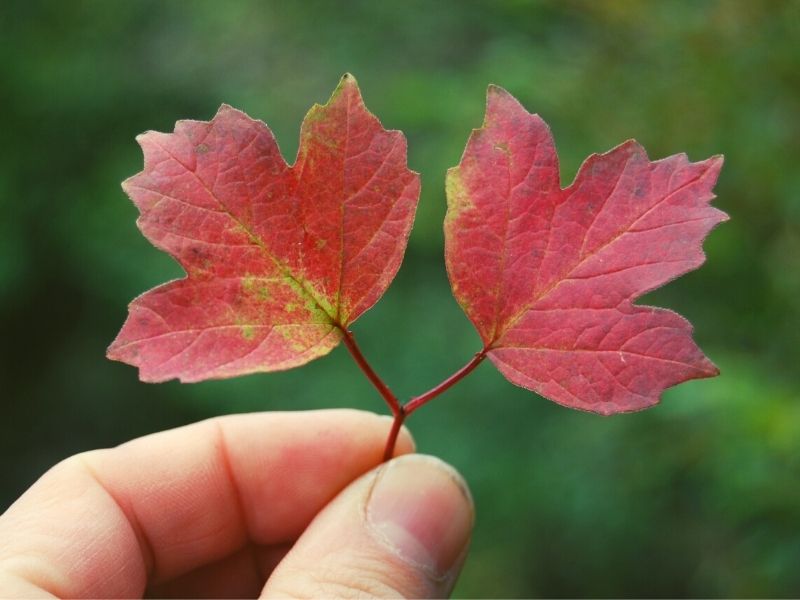
Red is a colour associated with leaves in autumn but in reality there are very few native tree species out in our countryside that give us a good show of red. So if you’re seeing this colour strongly across a tree or shrub it can only be one of a few species; Guelder-rose (Viburnum opulus), Dogwood (Cornus sanguinea) and Spindle (Euonymus europaeus).

guelder rose in autumn

There are few native trees in the UK which give a show of red, Guelder-rose is one of them.

Look at WHEN Leaves Fall

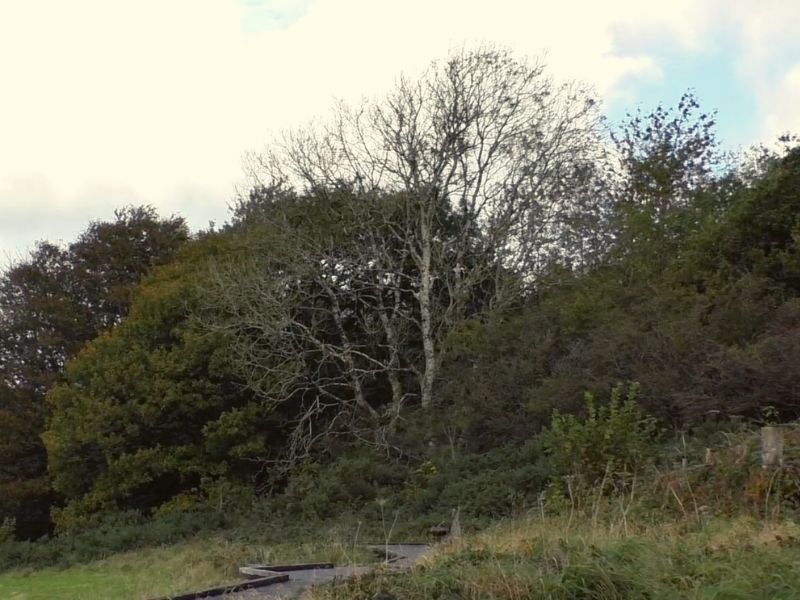
Certain tree species drop their leaves much earlier than others. Ash (Fraxinus excelsior) is a great example of this. Strangely, it’s also one of the last trees to come into leaf in late Spring, so they don’t hang about long. Once you look, you might notice ash looking pretty bare as early as late September. So, if we take that feature and use it when we’re looking at a bunch of trees from a distance in autumn, if you’re seeing a tree with bare branches when others around it are still well leaved then you could well be looking at an ash.

ash tree in autumn

The ash tree here clearly stands out from the crowd as most of its leaves have already fallen.

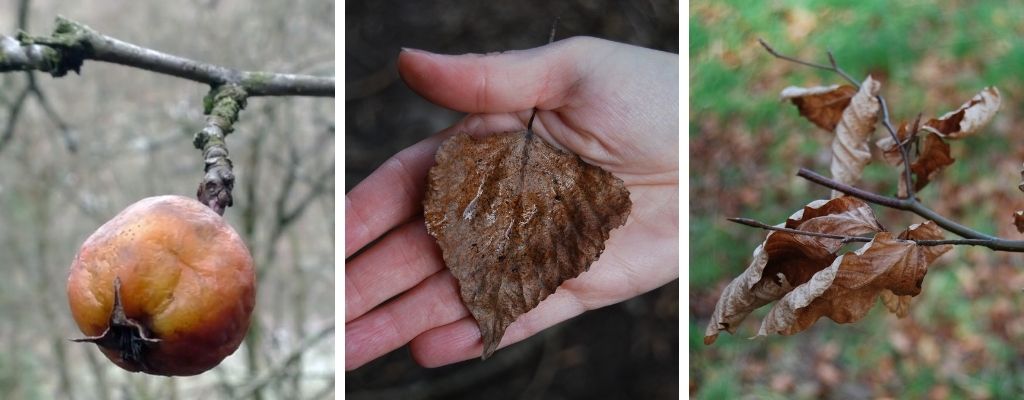
Also, it’s worth knowing that young beech and oak (Quercus spp.) trees often hold onto their brown leaves right through winter. So at the back end of autumn, if a broadleaf tree still has its leaves, it’s probably one of those two.


Know Your Fruits, Nuts , Seeds & Berries

Autumn is, of course, the time for an abundance of fruit and nuts in our hedgerows. For many of our natives this can be the season where they really shine and become visible to us, standing out from the crowd. A great show of berries or fruit can take centre stage, such as with the crab apple (Malus sylvestris) with it’s branches heavy with small, green/yellow apples.

When it comes to the hazel (Corylus avellana) you might think that the familiar hazelnut would be the thing to look out for in autumn, however these nuts can be pretty unreliable and by mid-autumn they’ve usually already all been snaffled by the squirrels, birds and mice. The good news is that there is another key feature you can look for on the hazel at this time of year which is much more reliable. But rather than tell you here, I’ll show you….

I’ve made a video all about Identifying Hazel in Autumn as part of the free course Kickstart Your Tree ID Skills, so if you want to check that out just follow the links in this blog. You’ll also see my top hazelnut foraging tips in that video too.

If you found this interesting and want to know more, you can learn my 3 Key Principles of Tree ID which you can apply to any tree, and lots more top tips and techniques by signing up to my FREE introductory course Kickstart Your Tree ID Skills.

REGISTER FOR THE FREE COURSE HERE

Happy tree hunting folks.


The Complete Tree ID Course

covid-19 method statement for bushcraft and forests school activities with woodland classroom

HOW WE’RE RETURNING TO THE WOODS WHILST MANAGING COVID-19

OUR COVID-19 METHOD STATEMENT by WOODLAND CLASSROOM LTD.

Statement updated 22rd Sept 2020

After a break from outdoor activities during lockdown we are now beginning to return to the woods with our exciting range of courses for adults and families, and looking further ahead, for children.

Below we have set out how we are going to do this so that our clients have confidence that we have considered the current situation and are acting responsibly. We will continue to monitor the Welsh Government guidance as and when it changes.

We would like to take this opportunity to thank our good friends at Woodland Ways Ltd. for their support in helping us prepare this method statement.


In Summary

Here’s the essentials of what our customers need to know about how we are currently operating within the government guidance:

  1. All organised children’s outdoor activity days including holiday clubs, birthday parties and outdoor education are currently on hold. We hope to be back with holiday clubs in the new year.
  2. Adult outdoor courses are going ahead with restricted group sizes and social distancing & increased hygiene in place. An additional risk assessment has been written to make us more COVID-19 secure.
  3. We will not be hosting events at National Trust properties until at least 1st September in accordance with the Trust’s own risk assessment. In the meantime, alternative venues are being arranged as appropriate.
  4. We are continuing to expand our offering of online learning covering wild food, tree identification, bushcraft and nature connection.
  5. Our monthly Home Education group, Pathfinders, is planned to start up again from October, but with certain restrictions in place. Contact us to find out more.
  6. We are taking bookings from schools, event organisers and groups for the future, please get in touch to discuss what we can offer you.

Customer Statement

All the precautions and measures put in place that we have listed below are subject to change according to the government guidance. If you have a question, please get in touch. Detailed below is what you can expect from us when undertaking courses and events in Wales.

The safety of our customers and our staff is a primary concern for us.

If you have made a booking for an upcoming course or event and you cannot attend as you are ill or shielding, then we will issue you with a 2 year voucher to use on any Woodland Classroom course, event or product to the equal value of your booking.

We have taken on the Welsh Government’s guidance given: “Sport, Recreation and Leisure; guidance for a phased return” and we have also consulted with our piers in the industry and the Institute for Outdoor Learning, for best practise, of which we are an active member.

You can read the government’s advice here: https://gov.wales/sport-recreation-and-leisure-guidance-phased-return-html

Upcoming Courses

As of 23rd July all our adults and family courses will operate with a maximum of 16 participants, using a ratio of 1 instructor to 8 students.

All courses and events will operate with government approved numbers.Note: The current advice in Wales is that groups of no more than 30 can meet for an organised outdoor activity.

Courses Specific COVID-19 Methodology Statement

Activity: Running of all education course activities and events at our established outdoor venues with adherence to Welsh Government specific advice.

Venues included:

Erddig estate, Wrexham

Chirk Castle estate, Wrexham

Aberduna Nature Reserve, Flintshire

Hawarden Estate Farm Shop, Flintshire


Attendance on the course

It is important for all clients that should you, or a member of your household, become or are already unwell with symptoms of coronavirus you should inform Woodland Classroom Ltd. immediately and should not travel to or attend your course. If you are at our venue already then you should cease activity immediately and alert a member of staff whilst taking steps to isolate and remove yourself.

If you are self-isolating as a result of Covid 19, Woodland Classroom Ltd. will forfeit its rights under our terms and conditions to deeming this a cancelation by the client and instead will provide you with a 2 year voucher to undertake that course, or a similar course, within that time frame from your original booking. We recognise these are unusual times, and we want you to book with the assurance that you will not lose your money.


What we expect of you, and what you can expect of us

Prior to the course

  1. Please ensure you have read the kit list and have all items with you. FAILURE TO BRING ANTI BAC HAND GEL AND A PERSONAL FIRST AID KIT WILL RESULT IN YOU NOT BE ABLE TO ATTEND THE COURSE. Clients will be informed of what makes up a Personal First Aid Kit in advance of attending.
  2. Your instructors will have changed into their uniform at the venue to minimise any risk of cross contamination, you may wish to consider doing the same if you are visiting shops/public spaces before the course
  3. Clients must complete a premedical questionnaire and registration form prior to arriving at the course and have this printed out to bring with them.


Meet and greet

  1. Effective from 23rd July until further notice all courses will have no more than 8 clients per 1 instructor, with a maximum of 16 customers in attendance. Ratios will be reviewed increase at the time the government guidance allows. 
  2. From the moment of stepping out of the car, we would request that all employees, sub-contractors, apprentices and clients at all times remain 2 metres apart (unless you are from the same household) there should be no hand shaking or other contact with people from outside your household.
  3. Clients will place their signed copy of their registration forms and premedical questionnaire into the plastic wallet provided at the meeting point, confirming to the instructor that you have answered no to all medical questions and understand your responsibilities. Employees will not handle this paperwork for at least 72 hours and therefore we are asking you to be open to the fact that you have read it and have signed the document.
  4. You will be welcomed by the instructor and will be expected to have read the following safety brief:


Safety Brief

  • The weekend is designed to be fun and no one will be forced to do anything they do not wish to do.
  • Please respect everyone’s wish to practise social distancing, beyond the recommended 2m guidance, and their choice to wear a mask if they wish to.
  • Any rubbish that can be burnt should be burnt. If the rubbish cannot be burnt, e.g. metal or glass and plastics, this will need to be taken home with you.
  • For small cuts you should have a simple first aid kit with you; containing at least plasters and antiseptic wipes. For more serious injuries we have a first aid kit in basecamp and an accident book to record injuries in. All Instructors are first aid qualified. Please note due to COVID-19 our instructors have been told NOT to provide mouth to mouth resuscitation in case of collapse, but to undertake chest compressions only unless directed otherwise by the emergency services, further first aid treatments will be at the discretion of the instructor but may involve them telling you and guiding you how to treat the wound yourself.
  • If any medical information has changed since making your booking could you please advise an Instructor, all information will be kept confidential and we are interested in where your medication may be.
  • If lifting heavy items tat require 2 people, please follow good manual handling practise and share your lifting only with some from your own household. If this is not an option, the item(s) cannot be moved.
  • Due to COVID-19 no activity should take place that involves exertion within a 5-metre space of anyone else (e.g. fire bow)
  • A pegged out display of 2 metres and 5 metres will be demonstrated

Once it has been agreed everyone is aware of the safety brief, you will then be directed to basecamp with the instructor.


On arrival in camp & for the remainder of your course

  • You will be provided with a demonstration on handwashing with no running/piped water, everyone will be requested to wash their hands.
  • For everyone there is a compulsory handwash every 2 hours (using your own anti-bac gel) during the teaching day, water is available for those who wish to handwash more. Handwashing must comply with our handwashing instructions which comply with UNICEF guidelines, a jug should be used to pour the water over the hands of the client into a collecting bowl underneath and then disposed of in a dedicated hole at the edge of camp.
  • Please note we have provided face guards for any member of staff who wishes to use them, please respect this if an instructor puts one on. This is in no detriment to how we view you; it is the instructor’s personal choice. We are however of the understanding that the outdoors is very low risk.
  • Each client will be issued with their own equipment (as appropriate) as well as a water supply for the duration of the course – these should not be handled by anyone else outside of your household. This equipment will have been left fallow for 72 hours prior to your course commencing, or if a course has been held within this time frame the equipment will have been disinfected thoroughly.
  • Any further tools and or equipment that are used through the course (e.g. fire bow kit) should be picked up from the unused pile and placed in the used pile when you have finished with them. These will then either be left fallow for 72 hours or cleaned thoroughly before the next use. Hands should also be washed after each session.
  • In camps where there is a rustic table, we would request that clients do not use this area. The area will be disinfected after each use by an instructor.
  • All shared handheld equipment will be disinfected every two hours with the dedicated disinfectant spray, e.g. storage boxes and kettle
  • If cleaning needs to take place following a known COVID potential case then the following guidelines will be followed by an instructor: https://www.gov.uk/government/publications/covid-19-decontamination-in-non-healthcare-settings/covid-19-decontamination-in-non-healthcare-settings
  • All staff & clients should avoid touching their face and if there is a cough or sneeze this should be done into a tissue and disposed of in the fire. If no tissue is available, it should be done into your arm
  • It is not practical to put up signage within the woodlands however the key messages of social distancing and cleaning will be enforced by the team if necessary. If there is a failure to adhere to social distancing measures, then we will have no choice but to remove you from the course.
  • In the toilet there is a blue roll and some spray disinfectant, before and after each use we would ask you to wipe down any contactable surface and burn the blue paper with the lighter provided, and then request that you wash your hands.
  • In times of inclement weather paper towels/blue roll should be used for drying hands when weather does not allow for drying, and then disposed of, ideally in the fire.
  • You may notice that if there is a rare event where an item has to be passed to you, it may be placed on the ground for you to pick up, this is to ensure social distancing. All instructors are washing their hands within a 2-hour time frame also.
  • If you are within the clinically vulnerable, or extremely clinically vulnerable category, or if you live with anyone who is in either of these two groups, please consider whether you wish to take advantage of our 2 year postponement offer, we will of course welcome you to this course, or one in the future.
  • Our risk assessment is relating to COVID-19 is available to view upon request.
  • In case of emergency evacuation people do not have to stay 2 metres apart if it is unsafe to do so.
  • Any personal litter should be burnt or removed at the end of the day and taken home.
  • The evidence suggests that wearing a face covering does not protect you, but it may protect others if you are infected but have not developed symptoms- however the risk is deemed to be extremely low when operating in an outdoor environment. We will leave it at your discretion should you decide to wear a facemask. If you decide that you would like to wear a face covering, we would ask you to follow the below recommendations:
  • wash your hands thoroughly with soap and water for 20 seconds or use hand sanitiser before putting a face covering on, and after removing it
  • when wearing a face covering, avoid touching your face or face covering, as you could contaminate them with germs from your hands
  • change your face covering if it becomes damp or if you’ve touched it
  • continue to wash your hands regularly
  • change and wash your face covering daily
  • if the material is washable, wash in line with manufacturer’s instructions. If it’s not washable, dispose of it carefully in your usual waste
  • practise social distancing wherever possible
  • The above is about protecting our team, as well as yourself and your other course participants
  • Where numbers of participants and activities dictate the need, then a number of fireplaces will be established to maintain social distancing.
  • Clients will be refused entry on the instructor’s discretion based on appearance of potential symptoms.

Social distancing should take place during ALL sessions. Each session has been re-designed to ensure you have the safest possible experience. If you are at all unsure about how something will operate please contact us prior to the course, or ask the question directly to the instructor during the course.


Last reviewed on 23rd September 2020, using the Welsh Government guidelines updated 20th July 2020.


LINK TO WALES COVID-19 ADVICE:

If you have question concerning what the current government guidance is concerning COVID-19 in Wales, then please see the following webpage: https://gov.wales/coronavirus-regulations-guidance

More information on Test, Trace, Protect in Wales: https://gov.wales/test-trace-protect-html

tree identification courses

Want To Be a Tree Expert? Our Online Course is Coming Soon!

Calling all tree lovers. Do you ever get overwhelmed by the amount of tree species out there and can’t tell one from the other? Would you love to expand your tree knowledge further and deepen your connection to the natural world? Well, I’m really excited to finally reveal what I’ve been working on for the past year…

THE COMPLETE TREE ID COURSE: An exclusive online course to take you from Tree Beginner to Tree Expert. All led by James Kendall from Woodland Classroom.

I’ve released a sneak preview of the full online course which you can watch here…

As I said, I’ve been filming videos for this course for over two years now, visiting trees in all four seasons, and taking hundreds of photographs. With coronavirus having cancelled or postponed all our outdoor activity work I now have the time to put the whole thing together for you.

SIGN UP TO OUR FREE ONLINE TREE ID COURSE NOW

I’d love to have your feedback, comments and constructive criticism on the video, as it will really help me highlight what works well and what could be improved for you. Simply drop me an email at hey@woodlandclassroom.com

Here’s what I hope to include in the full online course:

  • Approx 50 species of trees, both native and common to Britain and Ireland.
  • Videos of each tree species in winter, spring, summer and autumn – so you can see how the tree changes throughout the year and what to look out for.
  • Downloadable identification guide ‘cheat sheets’ which you can take out into the woods with you.
  • Hundreds of photographs, both on location and in-studio, which highlight the distinctive features in each tree.
  • Regular live webinars/chats with course students so you can get direct contact with me and other learners to help you on your progression from tree novice to expert.
  • An exclusive facebook group with all students so you can share questions, pictures and experiences.
  • You will get a certification of completion.

Excuse the pun but… I’ll help you see the wood for the trees 😉

There will be lots more information coming soon but if you’re interested in being one of the first to know when more details are released, drop us an email at hey@woodlandclassroom.com and I’ll sign you up to our Tree I.D. Course Mailing List.


MORE ABOUT YOUR TUTOR

I thought I’d include some more information myself and my professional background so those of you interested in knowing more about your Tree I.D Tutor…

I am the Head Bushcraft Instructor and Forest School Leader at Woodland Classroom. I have been working in environmental education & conservation for over 10 years now. I received the Bushcraft Competency Certificate awarded through the Institute for Outdoor Learning after 2 years of teaching experience and practical study. Before setting up Woodland Classroom Ltd I was the Project Manager for Long Wood Community Woodland, the largest community-owned woodland in Wales, overseeing the management of 300 acres of broadleaf and conifer forest. I am also a former Director of Llais y Goedwig, the voice of community woodlands in Wales.

My approach to teaching has always been with an emphasis on steering my students toward fostering a deeper connection with nature through understanding the landscape around us. Bushcraft skills are an effective way to do this as we learn about using natural materials and how we can live with the land, whilst also connecting with our own ancient past by seeing the land through the eyes of our ancestors.

I have always had an affinity with woods, being at home amongst the trees, and I’ve made it my mission to study under some of the UK leaders in bushcraft, greenwood crafts and sustainable woodland management including; Dave Watson (Woodland Survival Crafts), Ben Law (woodsman, author, and eco-builder) Patrick Whitefield (permaculture teacher and author) and Mike Abbott (author and greenwood craftsman).

I am a member of the IOL Bushcraft Professional Practise Group. The group aims to promote best practice in the growing industry of bushcraft.

winter tree identification course in north wales

Identifying Trees in Winter

When you’re out walking, have you ever wondered, “which tree is that?”

Once the leaves have fallen from the trees, many people can be stumped when asked what they’re seeing in the woods. But if we can understand the clues trees give us we can unlock their identity and so much more. On this one-day course, we’ll show you how to identify trees in winter by looking at buds, bark, the shape of the tree and other clues. We’ll also look at the different uses that trees have, their place in the ecosystem and dive into a bit of woodland folklore. You will also take away your very own FREE Tree Leaf Identification Swatch Book, which is perfect for continuing your learning and practicing tree ID after the course is done.

Join James, who will be your tutor for the day. He has worked for many years in and around trees from managing the largest community woodland in Wales to hosting his own program of bushcraft and woodland skills courses at National Trust venues.

The Chirk Castle estate is a fantastic site to learn about trees because there is such a wide range of species here which make up a range of varied habitats including broadleaf woodland, scrubby grasslands, and ancient hedgerows.

The course is suitable for anyone aged 16 or over. Tickets cost £35 per person.

Please bring a packed lunch on the day but hot drinks and biscuits will be provided. Please also bring suitable clothing and footwear for the outdoors as we’ll be exploring the estate parkland.

winter tree identification

Leaf ID Swatch Guide Included!

woodland trust leaf ID swatch book

Everyone attending this course also gets a FREE Leaf ID Swatch Book to use throughout the day and take away with you. Produced by the Woodland Trust, this pocket-sized and lightweight little guide features leaves, twigs, and buds from 32 common UK trees and shrubs which are cleverly presented and grouped according to similarities in leaf shape, in a format that also makes it ideal for bringing the natural world closer to everyone. On the reverse of each page, the tree or shrub is briefly described. There are also interesting facts and information about where that species tend to grow.

About the Tutor

bushcraft skills in north wales

James Kendall is Bushcraft Instructor and Forest School Leader. He has been working in environmental education & conservation for over 10 years now. He received the Bushcraft Competency Certificate awarded through the Institute for Outdoor Learning after 2 years of real experience and practical study. He was also the Project Manager for Long Wood Community Woodland, the largest community-owned woodland in Wales, overseeing the management of 300 acres (120ha) of broadleaf and conifer forest. He is a former Director of Llais y Goedwig, the voice of community woodlands in Wales.

James has always had an affinity with woodland habitats, being at home amongst the trees, and he has made it his mission to study under some of the UK leaders in bushcraft, greenwood crafts and sustainable woodland management including; Dave Watson (Woodland Survival Crafts), Ben Law (woodsman, author, and eco-builder) Patrick Whitefield (permaculture teacher and author) and Mike Abbott (author and greenwood craftsman).

identifying winter trees in north wales

Booking

Get in touch if you’d like to know more email us. Advance booking is essential. Tickets are available just below on this page.

YOU CAN READ OUR EVENT TERMS & CONDITIONS HERE.

how to identify trees in winter - free workshop

Kickstart Your Winter Tree ID Skills (FREE Online Workshop)

Learn to see the trees from the wood.

Want to boost your Tree ID skills in winter? Do you struggle to know your alders from your elders, your hawthorn from your blackthorn? Join our FREE workshop online and let us help you.

James Kendall, Bushcraft Instructor and author of The Complete Tree ID Course, will be hosting a live webinar workshop where you can learn tips & tricks to identifying a range of tree species here in the UK in the season of winter, when the trees don’t have their leaves on to help us recognise them.

We’re offering this workshop online to anyone and everyone who is interested in finding out more about the trees around them.

YOUR WORKSHOP INCLUDES:

* Recognising native & common tree species

* Using buds, bark, leaf litter & other winter signs

* Get Tree ID cheat sheets to download

* Discover 3 key hacks to help identify any tree

* Book recommendations

* Join in our Q&A Session

The workshop will last 1hr and will be hosted via Zoom.


HOW TO BOOK

It’s FREE to join this workshop. So, all you need to do in advance is register for your free place in advance. Once registered you will be sent the link to the Zoom meeting via email.

REGISTER FOR YOUR PLACE HERE

Event details

Date: January 20, 2022

Time: 7:30 pm – 8:30 pm

Venue: Zoom Meeting

Cost: FREE!

kickstart your winter tree id skills

Your Tutor: James Kendall

James is the Head Bushcraft Instructor at Woodland Classroom, having worked in outdoor education & conservation for over 10 years. James’ approach to teaching steers students toward fostering a deeper connection with nature through understanding the landscape around us; “Bushcraft skills are an effective way to do this as we learn how to make use of natural materials and live lightly with the land, whilst also connecting with our own ancient past by seeing the land through the eyes of our ancestors.”
James previously manage the largest community woodland in Wales, 300 acres of mixed conifers and broadleaves and in 2017 James received the Bushcraft Competency Certificate awarded through the Institute for Outdoor Learning after 2 years of teaching experience and practical study. He is also a member of the IOL Bushcraft Professional Practise Group. The group aims to promote best practice in the growing industry of bushcraft activity providers.


james kendall - bushcraft & foraging tutor
win the complete tree id course

Become a Tree Expert

During this workshop you will also learn about our much more extensive online course; The Complete Tree ID Course. Go from clueless to confident on your journey to becoming a tree expert, featuring up to 35 species of native & common trees, all taught by James Kendall.
You will learn key principles of tree identification, which are easy to remember and can be applied to any tree you encounter. You will have videos, photo galleries and tree ID cheat sheets at your fingertips.

This course will take you through every native tree species in the UK in all 4 seasons; winter, spring, summer and autumn. You will learn not only how to identify trees by their leaves but also by their bark, buds, seeds & more.

We will be offering all attendees of this free workshop a special discount offer to sign up to the full course. So, if you want to know more, don’t forget to register for your place.

Skills you will learn

During this workshop you will learn a range of skills, including…

null

Reading the Landscape

null

Nature Connection

null

Tree & Plant identification

Understanding Habitats

Understanding Habitats

Book now

This workshop is totally FREE and is open to anyone. Simply follow the link to register for the workshop on Zoom and you will be sent the link so you can join the meeting.

free online foraging workshop

Best of Autumn Foraging (Online Workshop)

Kickstart your foraging & walk the wild food trail.

Ready to explore the wonderful world of wild edibles but worried that you might poison yourself on the first go? We’re here to help! Our introduction to the best of autumn wild food and foraging is now open for registration. You’ll gain confidence in using wild foods in your life.
Join us on a journey to discover the best foraged plants, fungi, fruits and more of Britain & Ireland in the season of Autumn. You’ll learn what to look for, where to look, and how to cook with wild food. Perfect for anyone interested in sustainable living, healthier eating, or just looking to expand their culinary horizons! Don’t miss out on this chance to start your wild food adventure. Book your place today!
All around us wild plants and trees are groaning with the weight of berries, nuts and fruits, just waiting to be picked. Not only that, but tasty mushrooms are springing up out of the forest floor all around us. This makes autumn one of the best times of year to get into foraging. In this workshop you will learn about common edible plants you can find in September, October and November.
Our online foraging workshops started in the first lockdown and have continued to be a hit ever since, as people want to learn how to make tasty meals from the wild plants around them. These events are filling up quickly, so grab your place whilst you can ???? Everyone has loved these workshops so far and they’ve been really popular.

YOUR WORKSHOP INCLUDES:

  • Seasonal Wild Food Plant Identification
  • Foraging Do’s & Don’ts
  • Mouthwatering Mushrooms, that are easy to identify
  • Autumn Recipe Ideas
  • Get access to foraging videos, photo galleries & more
  • Giveaway: Win a place on ‘Your Wild Food Year’ full online course worth £197!
  • Poisonous Lookalikes You Need To Know
  • Q&A Session: put your questions to us

The workshop will last 1hr 30mins and will be hosted via Zoom.

Event details

Date: Tues 26 Sept, 2023

Time: 7.30pm – 9pm

Venue: Zoom Meeting

Cost: £7

autumn foraging and wild food walk

Your Tutors: James & Lea Kendall

James is the Head Bushcraft Instructor at Woodland Classroom, having worked in outdoor education & conservation for over 10 years. James’ approach to teaching steers students toward fostering a deeper connection with nature through understanding the landscape around us; “Bushcraft skills are an effective way to do this as we learn how to make use of natural materials and live lightly with the land, whilst also connecting with our own ancient past by seeing the land through the eyes of our ancestors.”

James previously manage the largest community woodland in Wales, 300 acres of mixed conifers and broadleaves and in 2017 James received the Bushcraft Competency Certificate awarded through the Institute for Outdoor Learning after 2 years of teaching experience and practical study. He is also a member of the IOL Bushcraft Professional Practise Group. The group aims to promote best practice in the growing industry of bushcraft activity providers.

Lea is a qualified Counsellor and Mindfulness in a Woodland Setting practitioner. She is a firm believer in the power of nature to be therapeutic for everyone. Lea is an active forager, passionate about how we can use common plants for both food and medicine. She enjoys making her own tinctures and medicinal remedies for treating common ailments.

James & Lea
your wild food year - online foraging course

Become a Wild Food Expert

During this workshop you will also learn about our much more extensive online course; Your Wild Food Year. Go from clueless to confident on your journey to enjoying foraged plants, fungi, fruits and more with this detailed guide to identifying and cooking with the best wild edibles of Great Britain & Ireland.

In this course you can discover the joy of finding, harvesting and cooking with wild food with the very best each month has to offer. You will learn what to look for, where to look, and what to do with it in the kitchen.

You will have videos, photo galleries, recipes and more at your fingertips, all taught by experienced foragers. Discover over 70 wild foods!

Crucially, you’ll also learn when to look. As each month we bring you the edible fungi, flowers, fruits and foliage which are in season from January to December.

We will be offering all attendees of this workshop a HUGE 50% discount offer to sign up to the full course. So, if you want to know more, don’t forget to register for your place.

Skills you will learn

During this workshop you will learn a range of skills, including…

null

Hedgerow Foraging

null

Nature Connection

null

Tree & Plant identification

null

Hedgerow Medicine

Book now

This workshop cost just £7 per household, so cram as many of you around the screen as you can. Once you have a ticket, we will send you an email a couple of days before the event with the Zoom joining details.

how to identify trees in autumn

How To Identify Trees in Autumn (FREE Online Workshop)

Learn to see the trees from the wood.

Want to boost your Tree ID skills this autumn? Do you struggle to know your alders from your elders, your hawthorn from your blackthorn? Join our FREE workshop online and let us help you.

James Kendall, Bushcraft Instructor and author of The Complete Tree ID Course, will be hosting a live webinar workshop where you can learn tips & tricks to identifying a range of native and common tree species here in the UK.

You will learn to look closer at the trees around you in the changing season of autumn. The changes in colour of the leaves, the ripening fruits and even which trees lose their leaves first and last, which can be so helpful when identifying trees from a distance.

We’re offering this workshop online to anyone and everyone who is interested in finding out more about the trees around them.

YOUR WORKSHOP INCLUDES:

* Native & common tree identification

* Using leaf colour, fruits, nuts, seeds and other autumn signs

* Which trees change colour first and last

* Get Tree ID cheat sheets to download

* Discover 3 key hacks to help identify any tree

* Book recommendations

* Join in our Q&A Session

* A BIG discount on our comprehensive online training; Complete Tree ID Course

The workshop will last 1hr and will be hosted via Zoom.


HOW TO BOOK

It’s FREE to join this workshop. So, all you need to do in advance is register for your free place in advance. Once registered you will be sent the link to the Zoom meeting via email.

REGISTER FOR YOUR PLACE HERE

Event details

Date: Tues 3 Oct, 2023

Time: 7:30 pm – 8:30 pm

Venue: Zoom Meeting

Cost: FREE!

how to identify trees in autumn

Your Tutor: James Kendall

James is the Head Bushcraft Instructor at Woodland Classroom, having worked in outdoor education & conservation for over 10 years. James’ approach to teaching steers students toward fostering a deeper connection with nature through understanding the landscape around us; “Bushcraft skills are an effective way to do this as we learn how to make use of natural materials and live lightly with the land, whilst also connecting with our own ancient past by seeing the land through the eyes of our ancestors.”

James previously manage the largest community woodland in Wales, 300 acres of mixed conifers and broadleaves and in 2017 James received the Bushcraft Competency Certificate awarded through the Institute for Outdoor Learning after 2 years of teaching experience and practical study. He is also a member of the IOL Bushcraft Professional Practise Group. The group aims to promote best practice in the growing industry of bushcraft activity providers.

james kendall - bushcraft & foraging tutor
win the complete tree id course

Become a Tree Expert

During this workshop you will also learn about our much more extensive online course; The Complete Tree ID Course. Go from clueless to confident on your journey to becoming a tree expert, featuring up to 45 species of native & common trees, all taught by James Kendall.

You will learn key principles of tree identification, which are easy to remember and can be applied to any tree you encounter. You will have videos, photo galleries and tree ID cheat sheets at your fingertips.

This course will take you through every native tree species in the UK in all 4 seasons; winter, spring, summer and autumn. You will learn not only how to identify trees by their leaves but also by their bark, buds, seeds & more.

We will be offering all attendees of this free workshop a special discount offer to sign up to the full course. So, if you want to know more, don’t forget to register for your place.

Skills you will learn

During this workshop you will learn a range of skills, including…

null

Reading the Landscape

null

Nature Connection

null

Tree & Plant identification

Understanding Habitats

Understanding Habitats

Book now

This workshop is totally FREE and is open to anyone. Simply follow the link to register for the workshop on Zoom and you will be sent the link so you can join the meeting.

Social Share Buttons and Icons powered by Ultimatelysocial