Call us on: 07876 794098

Tag - woodland

James Dunlop of Wild Thyme Outdoors

How I Escaped The 9 to 5 And Set Up My Own Business In The Woods

The other day I saw a news report that in the UK there is a staggeringly large waiting list of 51,000 children who want to join Scouting groups across the country – you can read that article here. This one fact alone shows how much demand there is currently for regular outdoor activity sessions for children. Alongside this huge demand, I think there’s an equally growing groundswell movement of outdoor education, not only in the UK but in America too. It seems that everywhere there are initiatives, community schemes and small businesses springing up to offer children (and adults for that matter) quality wild time experiences.

Here at Woodland Classroom we’re one of many growing outdoor education service providers across the country and it’s great to be part of such a thriving community. Like so many others, our business is growing and new opportunities to get kids outdoors are coming to us all the time. We wanted to tell the story of another fellow outdoor educator, who only last year started out on his journey to create his own outdoor education company. It’s also the story of how we were able to help him set up his new forest school and outdoor education enterprise.

James Dunlop of Wild Thyme OutdoorsMeet James Dunlop. He is the recent founder of Wild Thyme Outdoors in Essex, England.  Wild Thyme Outdoors aims to create exciting adventures for people of all ages; joining them in British woodland and the wider great outdoors! They are currently delivering; Forest School programs for school, youth and charity groups, also woodland adventure birthday parties for all ages. They have the privilege of unrestricted and sole access to several beautiful patches woodland which they use and care for to run their wildly exciting programs.

I think it’s the passion of the people running outdoor education today that is really key to it’s increasing popularity. Activity Leaders like James are all so passionate about their subject matters, about engaging people of all ages in nature whether it’s forest school, woodland kindergarten, Scouts & Guides, summer camp, or any of the many forms outdoor education can take. It’s the old tale of the teacher who inspired a child to ignite their own spark for learning about nature and enjoying quality time outdoors. I take my hat off to all outdoor activity leaders (especially all you volunteers) who are passing their enthusiasm on to the next generation.

We sat down with James to here the tale behind Wild Thyme Outdoors and what inspired him to go it alone and become a part of the growing outdoor education scene. We’re happy to say that we were able to play a part in his success story too.

LW (Lea Wakeman) Hi James. Thanks for talking with us. Can you tell me why you wanted to set up an outdoor education business?

JD (James Dunlop) “It’s just part of who I am. Outdoor education is an expression of me as a person, an unapologetic nature geek with a fiery passion for working with children. They are so much smarter than we are, so much more aware! I learn so much just teaching young ones. There is however, an  upsetting lack (in my honest opinion) of outdoor provision for young and old alike. We treat nature as if it is something totally separate to ourselves, even the word nature, a label, is a separation of ourselves from all that it encompasses, what many don’t realise is we are nature too! I want to set up a outdoor education business to give people the opportunity to realise, we are not separate from the natural world, nor should we be afraid of it.”

LW I couldn’t agree more. Tell me about your background and how did you get to this point in your career?

JD “As a little one I grew up in a suburban part of Wales not too far from Newport. It was a time before PlayStation and iPads, my favourite ‘toy’ was a pair of buckskin trousers and a waist coat that my parents had bought back from a business trip to America. I would wear these continuously always wanting to be the Indian in a game of Cowboys & Indians. I have no idea where this fascination with the indigenous people of America came from, but it still hasn’t left me to this day!”

“Long story short, I joined John Ryder of the Woodcraft School for a week as a 16th birthday present, joined the cadets, attended the Army foundation college and post military found myself at Shuttleworth College studying Outdoor Education.”

james dunlop teaches at wild thyme forest school“My first outdoor education job was with Stubbers Adventure Centre in Essex where I live. Stubbers gave me the opportunity to grow as a teacher/instructor but also a canvas to develop my understanding and knowledge of the the natural world and primitive skills. I was given charge and free reign of their Bushcraft Activity Week.”

“After 6 years I entered the fitness industry. But even here my passion for all things outdoors and nature based followed me. I discovered the world of ‘natural movement’ and soon became adept and qualified to teach what is now coined ‘primitive movement patterns.’ The itch to get back to working outdoors grew and grew and before long I was in a position where I either did something about it or moved away from it altogether.”

“Enter an amazing influence! Woodland Classroom pops up on my facebook newsfeed, before I’d finished my coffee I had read, watched and consumed everything James & Lea had on social media and their website, now a YouTube search on Forest School lead me to even more! I was hooked! This was it! The answer to everything I had learnt over the last 10 years, the cure for the itch!”

“So here I am now! Standing on the edge of a woodland with my big idea; Wild Thyme Outdoors – forest school, nature nursery and woodland skills.”

james dunlop, founder of Wild Thyme OutdoorsLW Setting up your own woodland activity school is a big leap. What’s your vision for your business in 3 years time?

JD “In 3 years time, I would like to have multiple locations running forest schools and nature nurseries for various age groups and a committed and visionary team of individuals helping me deliver some of the best nature immersion and outdoor education training in the South-East.”

 LW We first met after you contacted us about our online Mentoring scheme for forest school leaders and outdoor educators. How was your experience with the mentoring session? What did you get out of it?

JD “I’ve never had a mentoring session before, though I do recognise the power of mentorship. For months I was saying to my peers that I needed some kind of business mentor or just a personal mentor of some description. Needless to say when I saw that you offered forest school specific mentoring It ticked many boxes for me. I could have a conversation with someone who was already further down the path so I could get answers to many of my questions and also finally have that mentor, that person that I could be held accountable to.”

“You were both super open and honest about how you structure your business and what pitfalls and hurdles you came across that I should keep an eye out for. This greatly reduces my learning curve and speeds up all the boring admin bits that I hate doing. More importantly you enquired about what I had done and intended to do before I started offering forest school programmes, highlighting things that I was wasting time on and where my focus really should be.”

FIND OUT ABOUT OUR MENTORING SCHEME

wild thyme birthday parties in the woods

James has been having a lot of success with bookings for woodland birthday parties.

LW What was the one most useful piece of advice that came out of the Mentoring session?

JD “To just get on with it! I spend so much time making sure that every possible angle has been covered that it would be 2018 before I was even in the position to start. I’d say to anyone reading this, that if this is what you want, stop fretting and get a move on. Start small, run a few pilot days for friends and family (which is exactly what I did) and tell as many people as you can about what you’re doing. Before the month was out I had countless people asking me for more details and two schools interested in developing a relationship with Wild Thyme!”

LW What was the main benefit of having the Mentoring session to you? What did it enable you to do?

JD “I think the main benefit was to create clarity for me to begin, both you and James were able to put my mind at ease about so many things, and point me on the path that I needed to be on. Whilst I’m all about creating your own journey it can be a massive help to be shown parts of the journey by those who have done it.”

wild thyme outdoors logoLW What successes have you had with the business since the Mentoring session?

JD “Since we last spoke; we have registered the business so it’s official, we have booked our level 3 Forest School Leaders training and we have a queue for birthday parties! We have also explored the realm of opening the Forest School up as a day care/nursery 3 days a week which has been met with great interest.  Our website is being constructed and we have graphic designer working on the brand designs and associated media. Through several connections we have 3 schools interested in our Forest Schools program. It’s all Go! Go! Go!”

LW Thanks for speaking with us James, and best of luck for the future. I know we will keep in touch.

You can find out more about our online Mentoring scheme by following the link below.

GET ONE TO ONE MENTORING NOW

It’s an exciting time to be involved in outdoor education and if you think we could help you like we’ve helped James and so many others, then don’t hesitate to get in touch.

You can find out more about Wild Thyme Outdoors and follow James’ continuing adventures by visiting his website RIGHT HERE.

Lea Wakeman

bushcraft leader with shelter

My Bushcraft Journal: Part #1 Building Better Shelters

Hello folks. My name is James and I am an outdoor activity leader at Woodland Classroom, where we pass woodland skills and nature knowledge onto others with our sessions. Bushcraft is an element of what we do, fire-lighting, den building and campfire cooking etc but mostly it’s at a basic level. For a while now I’ve been wanting to improve my bushcraft skills and really go much further in depth not only because I love being out in the woods but also so that I can pass these skills onto others someday and continue to inspire children to fall in love with nature and being outdoors.

So, I’ve taken the plunge and enrolled on a 2 year Bushcraft Instructor training course which is going to really push me to up my game which is not only going to be a lot of fun but will also help me to offer so much more to our customers in the future.

Fire by friction, wild food, whittling, advanced shelter building, natural cordage and plant identification are just some of the skills I’ll be covering over the next two years. I’m quite excited.

Who knows, perhaps I’ll be able to call myself a proper bushcraft instructor when it’s all done. Saying that though, you never stop learning and with any good subject worth getting your teeth into, bushcraft is one of those fields of learning that the more questions you answer, the more questions there are. I imagine I will never stop learning.

Part of my training includes keeping a journal of my time learning bushcraft skills, so I though why not make it a blog and you can share my journey, my successes and my inevitable failures too.

As an old teacher once said to me though, “There are no mistakes. Just learning opportunities.”

So without further ado, here is my account of a day spent shelter building.

bushcraft leader with shelter

Building Better Shelters

Aim of the Day: To construct a one-person shelter using only natural materials, preferably with no cordage, which would be rain-proof.

I had a dry and sunny winter day to do this with no distractions which was good because proper shelter building is a lengthy task. From my training I knew that it took 6 of us a couple of hours to construct an effective shelter from scratch, so I would have my work cut out if I as to get it done all in one day.

There had been some recent tree felling work in the woods, cutting down young hazel stools under the power lines, so this as perfect material with which to construct the frame with as hazel is strong, flexible and being freshly cut it should have a longer life span than using older, more seasoned wood from the forest floor.

I wanted to build a classic kennel shelter, sometimes called the a-frame shelter, which uses just 3 sticks to support the whole structure. The shelter also has little room for movement once you’re inside so that there is less air space to be warmed up.

building a kennel shelter

Above: In Ray Mears’ Outdoor Survival Handbook, he describes the stages of building the kennel shelter.

The first task was to find a piece of ground that is flat, no mean feat in Wales. Another tip I had been given was to get down low to the ground so that you can see the small undulations that make up the lay of the land. This way I could pick out a spot that was not only flat, but would not be a pool for water if the weather turned wet and also was slightly raised from the surrounding land, again to shed ground surface water if needed.

My tutor had told me the importance of of ensuring that the triangular frame is locked together well and that each pole is well supported. The most effective way to do this (without using cordage) is using the method seen in the next picture.

shelter build - interlocking polesHere, the ridge pole is resting on both forked sticks and these are also interlocked. This should help prevent slippage and ensures that the weight of the shelter is evenly distributed. I don’t want it all coming down on me in the middle of the night. For some additional support, I saw that there was a convenient stump which I could rest the base of the right-hand pole against. This is certainly not essential, but a bit of added piece of mind.

Next up I started placing the uprights on either side of the shelter frame. These were no closer than a good hand span apart as if they were too close then I would have trouble weaving between them later when building up the walls of the shelter.

I had also been advised to not allow the uprights to stick up too much above the ridge pole as this would encourage rainwater to run down poles and then drip through into the shelter – which I imagine could be very annoying at 2am.

For weavers between the uprights I mostly used birch branches that were lying around the woodland, as when green they are still flexible. Any that were too far gone and dry, went in  a separate pile for firewood. It was time to start a fire for a well earned brew in my billy can. Think birch is quickly becoming my favourite tree because the more I learn about it, the more uses it seems to have – perhaps that’s the subject of a future journal entry.

Birch’s associations with fire are well known in the outdoor pursuits world and it makes great kindling for getting a blaze going. As soon as the fire was going I felt like I had arrived properly.

building a natural shelter in the woodsAbove: Burying the end of the ridge pole into the earth to help prevent it from slipping. Resting one of the forked poles against a convenient stump for added stability. And getting my tea on with my new billy can.

During my Bushcraft Instructor training we had plenty of bracken around us to use as a thatched covering for the weavers on the roof. You can see an example of that in the first picture on this blog page. But at my local woods bracken was not an option so I would have to go with the less effective (so I’m told) leaf litter – which was in abundance at this time of year. There was plenty of beech trees about and their leaves make a carpet on the woodland floor and I know these leaves to last pretty well rather than rot away quickly so this seems a good choice.  Using a blanket I could gather up lots of leaves quickly and then drag the full blanket over to the shelter.

This was still much more work than I had anticipated though and I had been advised to have a full arm’s length depth of leaf litter on the shelter to make it effective against the worst the weather could throw at it. This was a real eye opener as it soon became apparent just how much material I would need just for my little one-man shelter.

shelter building in the woods of wales

Above: The complete naked skeleton of my kennel shelter, complete with weavers from fallen birch with some hazel brash too for good measure.

Another thing I noticed when using the leaf litter was that leaves had a habit of tumbling down to the base of the shelter so that I was ending up with a lot of material close to the ground and hardly any on top. Stuffing handfuls of leaves between the weavers seems to help this to an extent as it gave the leaves something to grip to. But I wonder if this is also a common problem when using leaf litter like this and whether with enough depth of material you eventually over come it? I wasn’t going to find out today.

The day was drawing on and I still wasn’t complete. By the time the light was failing I had to accept that the shelter would not be completed today (the luxury of not actually being in a real survival situation) and I would have to return another day. I had got one side of the shelter completely covered with a fair depth of leaves, but by no means enough, and I was satisfied that I could return another day and complete the job, ready for a trial sleep out.

My last job was to put out my small brew fire and scatter the cold ashes to leave no trace – an important philosophy in bushcraft.

So, what were the main learning points for me:

  1. Shelter building takes longer than you think.
  2. It’s important to get the 3 main poles locked together correctly to maximise stability and strength.
  3. Don’t put the uprights too close together.
  4. Don’t let the uprights protrude too far above the ridge pole, so avoiding night time drips.
  5. If using leaf litter – allow for A LOT of material.
  6. Stuff the leaves into the weavers to encourage them to group to the shelter sides.
  7. Get up earlier in the morning and start sooner *laugh*

half built shelter

Above: The end of a day’s work.. well a leisurely days work anyway. I’m looking forward to coming back to complete the job and test it out.

That’s all for now. I hope to keep my Bushcraft Journal up to date with regular posts, so watch this space.

Thanks for reading.

James K

how the robin got its red breast

How the Robin Got its Red Breast

We love telling stories around the campfire with children at our outdoor activity sessions, especially those tales that are set in the woods and star the creatures that the kids could see for themselves. I think it helps bring the forest alive for their imaginations.

This short story, How The Robin Got Its Red Breast, is a great one to tell on a cold winters day with the campfire crackling away. For me, the story’s message is that no matter how small you are or seem to be, you can achieve great things.

“Long, long ago, when the world was new, as the winter Sun was setting, and the land was locked in ice and snow, all the creatures believed that the warmth they had enjoyed throughout the long summer was lost forever and might never return. They were cold and afraid.”

“As the winter winds blew through the forest, a small brown bird was sheltering in a holly tree and he thought to himself, ‘What could I do?’ Somehow he knew the warmth that had gone belonged to the Sun, so he decided to fly to the Sun and ask for it back. As he took flight the holly twig on which he was standing snapped off, so he took it with him, he thought it would make him feel braver to take a piece of home on his adventure.”

“He flew up, higher and higher he climbed, and as he flew, he felt the heat of the Sun increasing. He flew on, getting hotter and hotter, until he could hardly bear the heat any more and his feathers were scorching, he was so close to the Sun! But still, he was determined to get an audience with the Sun. Then suddenly the holly twig he was carrying burst into flames. He was so shocked that he fainted and fell, down, down, spiralling back to the Earth.”

“When he awoke he realised he still had the burning twig, clutched between his feet. He had done it. He had brought the Sun’s fire back to Earth, and everyone could warm themselves in the heat from the flames. He was a hero! And because he was so brave, and because his feathers had been scorched on his adventure, to this very day, he is still called Robin Redbreast.”

how the robin got its red breastArtwork by Karen Carter at Hedingham Fair

The Robin is probably the UK’s favourite bird. It’s known as the gardner’s friend because it’s often seen perched near to where earth and soil is being dug over, revealing lots of juicy worms. I’ve often had a Robin as my companion when I’m practising my bushcraft skills in the woods. he’s always hoping I’ll turn over some leaves or dead wood in the hope of a easy meal.

To find out more about the Robin, where it lives, what it eats and what it sounds like. You can visit the RSPBs website which should answer all your questions here.

Robin in the Snow

12 days of forest school

The 12 Days of Forest School

We’ve taken the classic Christmas song and given it our very own twist. So join us for a good old fashioned sing-along. We love singing this around our campfire with our kids groups throughout the festive season.

Forest School sessions are all about letting children be in charge of their own learning and giving them the chance to explore wild spaces on their own terms so they can grow emotionally and intellectually. We run plenty of outdoor sessions throughout the winter because we believe that children should have access to great outdoor activities all year round.

Enough of all that though, on with the song…..

We’ve made a series of pictures to celebrate each of our 12 Days, which also showcase many of the awesome activities that children get up to at forest school sessions. You can see these images by scrolling through…

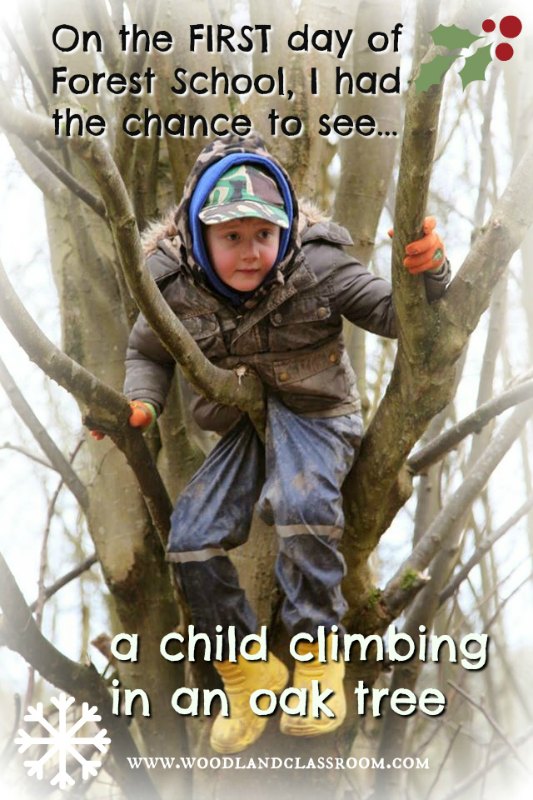
first day of forest school christmas


second day of forest school christmas


third day of forest school christmas


fourth day of forest school christmas


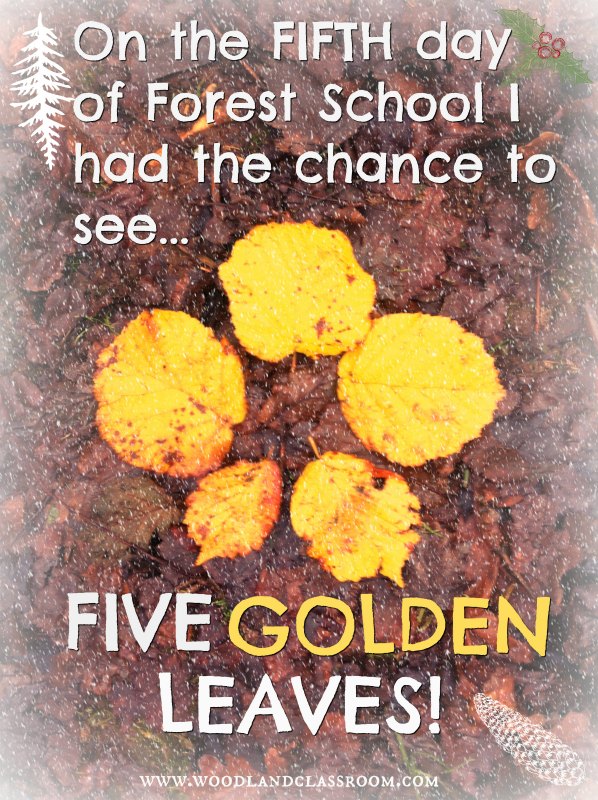
fifth day of forest school christmas


sixth day of forest school christmas


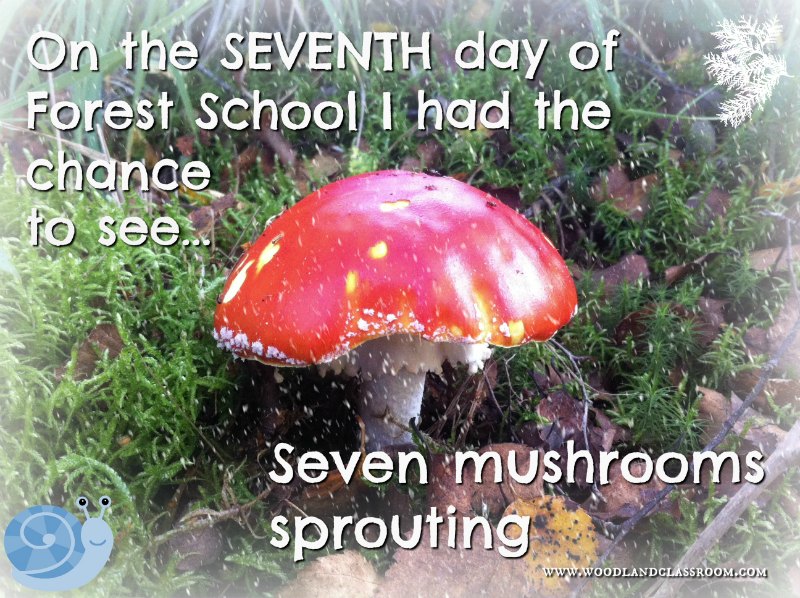
seventh day of forest school christmas


eighth day of forest school christmas


nineth day of forest school christmas


tenth day of forest school christmas


eleventh day of forest school christmas


twelth day of forest school christmas

We love singing this round the campfire with the kids through December and you’re very welcome to use this song too. Here’s a run down of the lyrics:

“On the first day of forest school I had the chance to see…

A child climbing in an oak tree.

Two muddy boots

Three storytimes

Four crawling bugs

Five golden leaves!

Six kids a whittling

Seven mushrooms sprouting

Eight campfires blazing

Nine shelter builders

Ten monkeys swinging

Eleven axes chopping

Twelve hunters tracking”


Happy Holidays, Merry Christmas and a Happy New Year to all.

ray mears champions forest school

RAY MEARS CHAMPIONS FOREST SCHOOL

TV presenter, author and bushcraft expert Ray Mears has given forest schools his seal of approval. Having observed a forest school group during a recent canoe trip he described how one boy “… was building his own legend, the person he was going to become. He’d become something more and that’s what it’s about. There’s a chance (in forest schools) for self-discovery and self-empowerment.”

Forest School is a thriving, growing movement worldwide which is getting children of all ages outdoors to learn at their own pace and embrace the natural world around them. As a forest school leader myself and long term follower of Ray’s work I felt really lucky to be able to join in a televised discussion on the merits of learning in the great outdoors.

ray mears champions forest schoolAbove: Ray Mears in his element. Photograph by Goh Iromoto

Ray Mears is a world-renowned champion of bushcraft and wilderness skills, having starred in numerous television series and written books on the subject, which have inspired millions.

During a recent television debate in the UK, the panel, including Ray, was posed the question; would they send their kids to a summer crammer where they could brush up on their academic skills and get ahead of the class, or would they pack their kids off to a forest school where they could learn skills like fire-lighting, den building and woodcraft.

Ray replied, “the child has got to want to be there, they might want to go to a crammer, I think there’s a place for both.” This, to me, underlies a key point that parents and teachers each have a responsibility to fire children’s passions and interests in whatever subject or activity it is that gets them excited about learning.

Ray explained how the forest school camp system works in Canada where this approach to learning is well-established, “…a child goes very young and gets to do activities and then they go back the next year, they’re a little older and get given more responsibility and eventually they’re doing 21 day trips on their own by canoe, boys or girls, through the wilderness and they’re capable.” What an amazing adventure for any young person that would be.

During the debate a recent study was quoted which states, “three quarters of kids who go to a summer crammer will end up at a top university, compared to half of those from similar backgrounds who don’t.” But on the flip side of that argument, “child psychologists say that outdoor exploits aren’t only great for physical health but for mental health as well. The same psychologists also have concerns about ‘tiger parents’ who want to hothouse their kids in some sort of obsessive bid to produce pint-sized prodigies, who could end up stressed, frazzled and burned out by their late-teens and who could actually end up with mental health problems.”

I hadn’t heard of tiger parents, so I looked it up. Tiger parenting is a term which refers to strict or demanding parents who push their children to be successful in education by attaining high levels of scholastic and academic achievement, to the detriment of the child’s social, physical, psychological and emotional well-being. It sounds a world away from the child-led approach of a typical forest school where kids learn resourcefulness, team-work and determination. I feel that forced study risks leading kids toward depression, anxiety and stress.

ray mears championing outdoor learningAbove: Ray Mears has seen first hand the positive benefits of forest school teachings. Photograph by Goh Iromoto

Ray spoke about his recent trip to Canada where he got the chance to observe children who attended a forest school camp. “I gave a presentation at a festival and in the audience there were some kids from one of these summer camps. I was watching one of these youngsters because he was carrying a book around with him. The book was written by a naturalist I’m really fond of, Grey Owl, who lived in that area. This was a heavy tome for a youngster to read by today’s standards but I saw that he treasured that book.”

“The next day I’m out on a canoe trip and I could see that same party of youngsters (canoeing) on the other side of the lake. These were boys of about fifteen and they had passed the hardship point, because it’s a hard way to travel.” Seeing that same boy who the day before had been clutching his precious book Ray described the look on the child’s face, “you could actually see that with every paddle stroke he took he was building his own legend, the person he was going to become. He’d become something more and that’s what it’s about. There’s a chance for self-discovery, self-empowerment and it’s no surprise that the youngsters who go to these summer schools very often end up as leaders in that part of the world and it’s a great thing to see.”

The main thrust of the debate was a parent’s choice between a summer crammer or forest school for their kids and during the phone-in I got the chance to add my own observations to bolster Ray’s championing of forest school. “There’s no doubt that academia is important but what forest school does is give an opportunity for child-led learning away from the formal classroom setting. The kids who attend forest school are gaining a nature intelligence and an emotional intelligence, which in the long run, I believe, makes better rounded, more confident people. You give a child a sharp tool and it’s empowering, they get a fantastic experience from that.” Many children today have a disconnection between the natural world and the modern world we live in and forest school projects are providing an antidote for that.

Some cynics might say that today’s kids would rather be in front of their iPad than building dens outdoors, but I don’t think forest school is a hard sell to children. I believe it appeals to their sense of adventure and children should be allowed to have that experience and so much of that is getting lost now with the increasing time that kids spend on screens.

Ray added that, “There are a lot of British parents now sending their children to these camps in Canada and North America.” But for those wanting to keep their kids a bit closer to home you’ll be glad to know that forest school camps are growing in the UK too with providers offering everything from one day activity sessions to week-long wilderness experiences. I believe we will see more of these holiday clubs and camps in the future as more parents take action to combat the dangers of too much indoor screen time for their kids.

children at forest schoolAbove: Children immersed in nature and learning empowering new skills at one of our own forest school sessions. 

Regarding the ongoing fight in many family households to get kids away from their screen and back to the outdoors, Ray saved his best advice to parents for last, “The secret is that the parents need to do these things (outdoor activities) for themselves, that’s the best way, it’s just the normal way of growing up. If you want children to take an interest in nature, don’t just send them somewhere, have an interest yourself and it will be the most natural thing in the world for them to follow on.”

If you want to know more about what exactly a forest school is, check out our short video, appropriately titled “What Is Forest School?” RIGHT HERE

If you’re a parent who wants to find out more about local forest school providers in your area, I’d advise googling it, you’ll soon be heading down a rabbit hole of amazing projects to inspire your kids.

You can watch the full television debate with Ray Mears HERE. Skip ahead to 01:24:44 to see ‘Forest School vs Summer Crammer” You’ll be able to hear me trying not to sound nervous whilst talking to Ray, one of my childhood heroes.

children learning firelighting skills

LETTING YOUR CHILD PLAY WITH FIRE

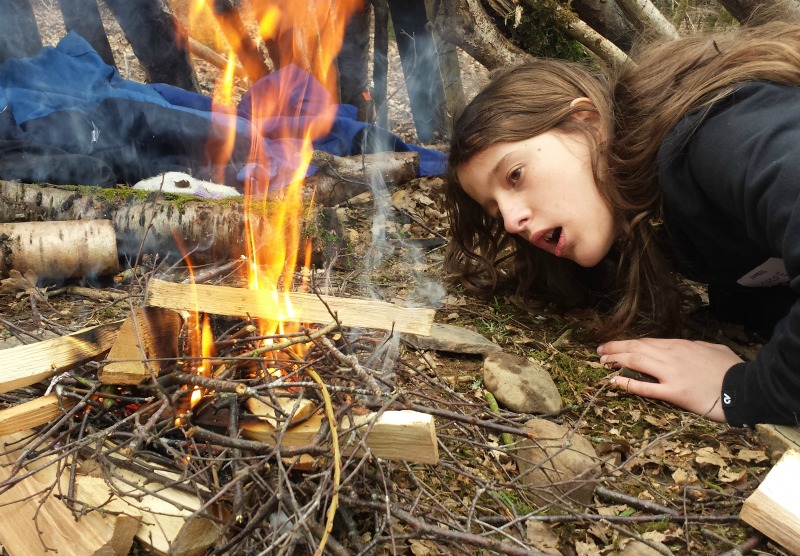
Would you let your child play with fire? It seems to be wired into us from a young age that fire is not something to mess around with, but where’s the fun in that? Of course, fire can be dangerous but if we introduce our children to it using safe methods we can nurture a healthy respect for the hazards of fire alongside their natural wonder for it.

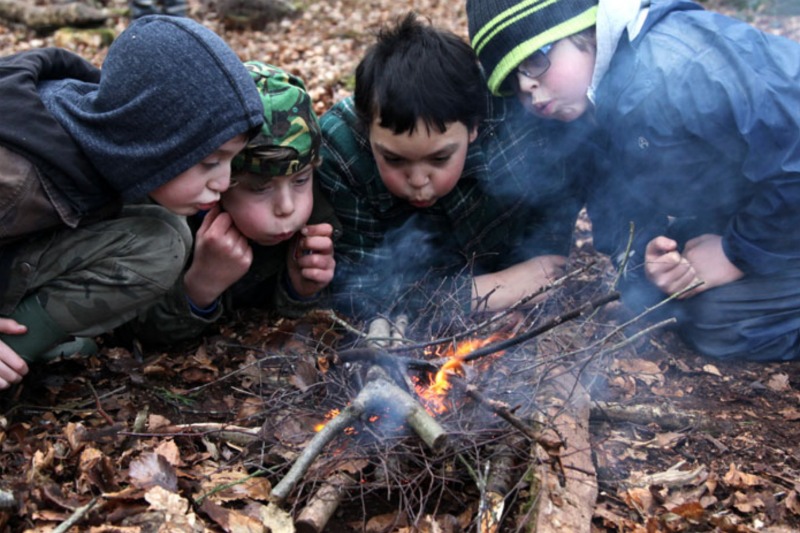
Here’s the thing, children LOVE playing with fire – so we might as well teach them how to play with it safely and how to be responsible when lighting their own fires out in the woods. We’ve never had a burn injury at our Forest School sessions. We have established boundaries for the main campfire and clear rules on what kids can and cannot do with their own fires.

In this episode of our vlog Rewild My Child you can see our regular Young Rangers lighting their own fires and passing on some of what they’ve learned.

YOU CAN WATCH THIS EPISODE OF OUR VLOG RIGHT HERE…

I find it so encouraging to see how far these children have come with their firelighting skills and knowledge of camp craft. It’s very satisfying (as a teacher) to see them gathering enough kindling to start their fire, picking out dry sticks rather than wet, soggy ones and to see how they can rekindle a struggling fire using the right techniques. These children love lighting fires and are happy simply to let them blaze away  – I’ve never seen a child trying to burn the woods down. They might make smoke signals, make charcoals for drawing or simply poke away at the embers with burning sticks. The fire acts as a warming and comforting focal point for the group to be together, enjoying nature. This has been the role of campfires for generations and long may it continue.

If you liked this and want to see more – check out our YouTube Channel, where we have a whole host of videos from How To Make Wild Teas to How To Use An Axe With Kids.

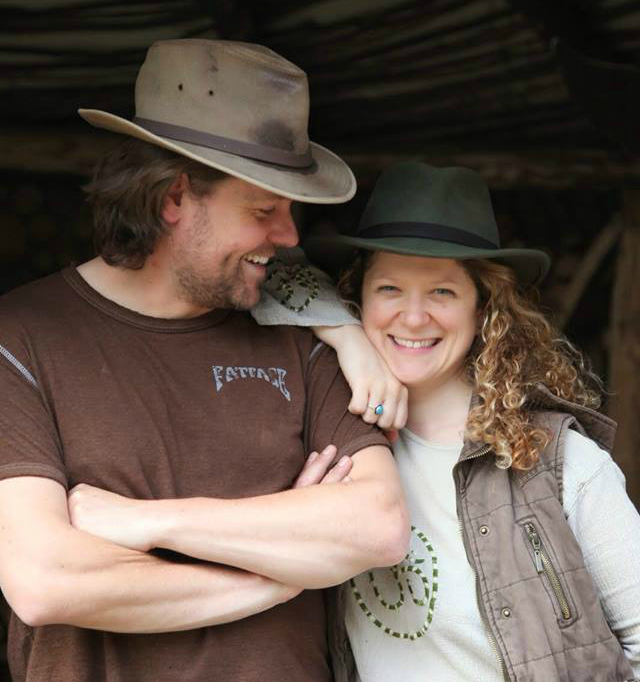
james and lea from woodland classroom

WE DID A PODCAST

We were recently invited to be interviewed for The DIY Learner podcast hosted by Laura Armer all the way from Texas, USA. She had been inspired by our story of empowering children to get outdoors and learn for themselves through child-led play.

In the podcast, Laura asks us about how we got to where we are today, our approach to outdoor learning and where we’re heading next.

The DIY Learner podcast, features interviews with leaders in nextGen education and stories from successful DIY Learners. Each week the podcast will inspire you to take learning into your own hands, with how-to’s for getting skills and credentials without a formal degree, advice on self-directed learning, mentorships, internships, apprenticeships, and creating portfolios and other ways to show your work.

LISTEN TO OUR PODCAST HERE

So what is DIY Learning?  The show’s host Laura Armer explains, “Well, it doesn’t mean learning alone, but rather taking charge of your own personal lifelong learning path using next generation learning options and strategies.”

“There’s never been a better time in history to learn whatever you want or need to take your life or career to the next level!  Join Laura and her guests on this wave of change in learning, and you can help push over the tipping point at which unconventional learning one day becomes conventional.  Let the learning begin!”

diy learner podcast

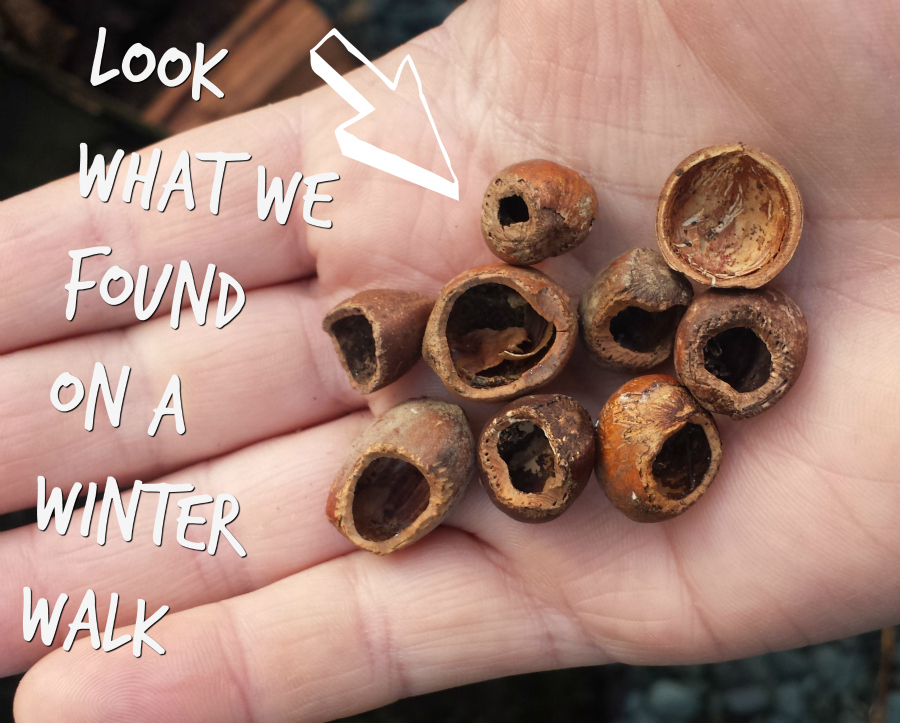
nibbled nuts found on winter scavenger hunt

Awesome Winter Scavenger Hunt

So… it’s winter. The days are cold and short, but it’s still a great time to be out and about and see a host of things in the woods that you’d not see at other times of the year. Winter leaves our countryside bare, open to deeper exploration and let’s you poke your nose into all sorts of nooks and crannies that would be walled off with greenery come summertime.

Kenneth Grahame, author of the popular children’s novel The Wind In The Willows, painted an evocative picture of the countryside in winter, which hints at the secrets that are waiting to be discovered;

“The country lay bare and entirely leafless around him, and he thought that he had never seen so far and intimately into the insides of things as on that winter day when Nature was deep in her annual slumber and seemed to have kicked the clothes off… He was glad that he liked the country undecorated, hard, and stripped of its finery. He had got down to the bare bones of it, and they were fine and strong and simple.”

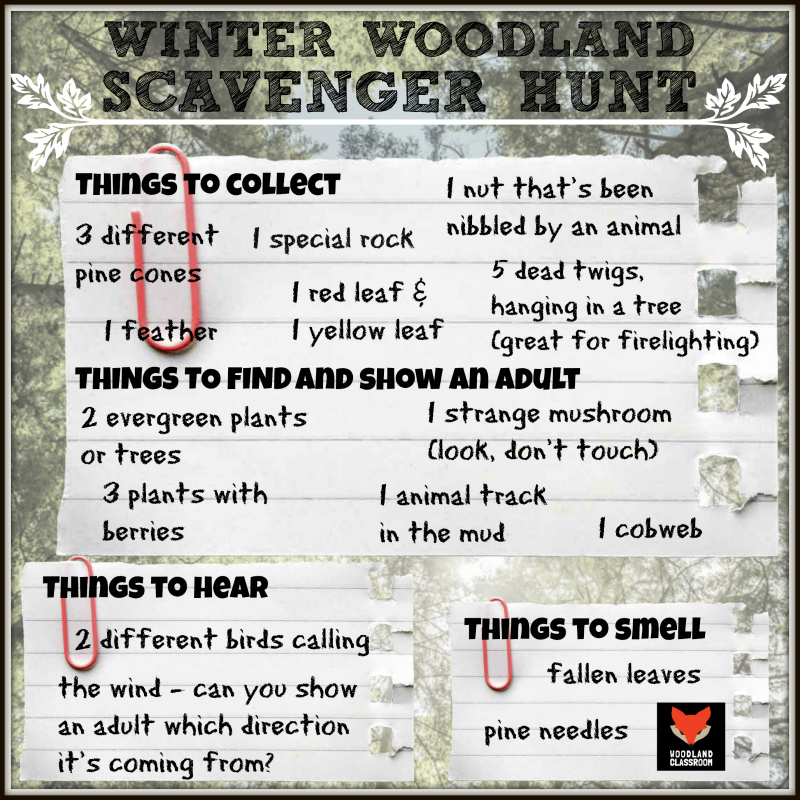
There were plenty of winter adventures for Mole, Ratty and Badger, so in order to inspire you to make your outdoor experience one that the kids will love too we have devised an awesome Winter Scavenger Hunt that will stimulate all the senses of your child. The only sense we haven’t got covered is taste – but we’re sure a nice hot chocolate at home after the walk will tick that box. We hope our scavenger hunt will make going outside in winter a memorable and exciting experience for the whole family. Give it a go and let us know how you got on.

DOWNLOAD OUR AWESOME WINTER SCAVENGER HUNT HERE

winter woodland scavenger hunt

You can share pics of your scavenging adventures on our facebook page, we’d love to see them.

We always host a great range of activity days right through the Autumn and Winter months, because we believe it’s important for kids and adults to get outside more than ever during these times when many people shut themselves away indoors. You can check out our upcoming events HERE.

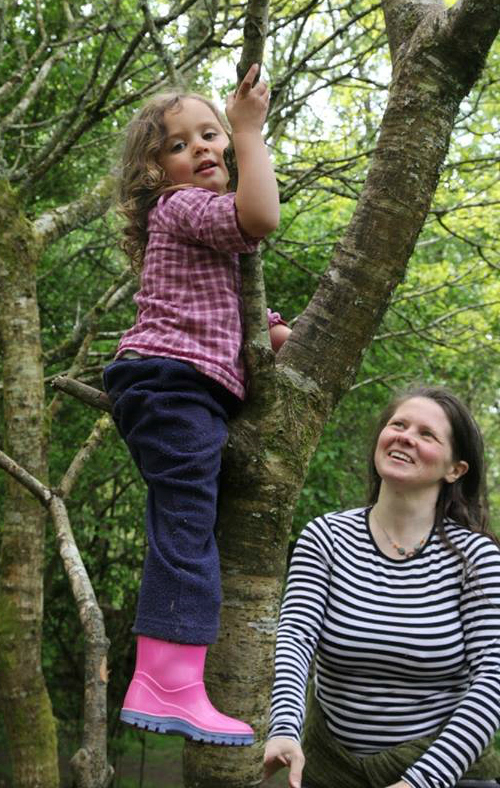
parent and child at forest school

Got the Winter Blues? Nature Has the Answer

We NEED To Get Outdoors, even though it’s wet & cold. It’s essential for our health and happiness, here’s why…

Winter is a time of year when many people hide away indoors, mirroring the hibernation of some animals and with all this wind and rain we’ve had for what feels like forever, who can blame them?

Christmas and New Year are behind us and there doesn’t seem much to look forward to. Many of us feel like cuddling up on the sofa and watching a movie when it’s cold, wet and going dark so early. Spring feels like a lifetime away, doesn’t it? When we do have to go out to work or get the kids to school, we dive out of the car and straight indoors, then it’s back out into the car, dive in and out of shops and back home, back to the world of central heating and electric lighting. Although this might make us feel more comfortable, it’s no compensation for the benefits of fresh air and sunlight. Without direct sunlight our bodies cannot produce vitamin D, which is important for maintaining normal blood levels of phosphorus and calcium, and helps keep our bones healthy and strong.

The amount of daylight we get each day has a dramatic effect on our mood too. Without this daylight our body produces substances that make us feel lethargic and lacking in energy. Idun Haugan of the Norwegian University of Science and Technology says that when sunlight hits our retinas at the back of our eyes, light sensitive nerve cells are activated which stimulates the production of serotonin and cortisol;

These substances are important in determining our physical and mental health. Insufficient levels of serotonin can result in depression, lack of energy, sleep problems, mood swings and poor impulse control.” (Haugan 2013)

It is not always easy to get motivated to go outside in the middle of winter but remember this lack of motivation is caused by our lack of sunlight and the over production of melatonin (our body’s sleep hormone). So in the winter months with so little daylight available it’s even more important to get outside and feel the sun on your face, in fact, I guarantee you will feel more energised and invigorated for making the effort.

Check out our Winter Scavenger Hunt as a great excuse for a walk in nature with your kids. There’s plenty of other ideas on our Pinterest page too.

boys in forest school at winter

boy at forest school in winter with candles

Making the Most of Winter in the Woods

boy at forest school in winter with candles

Wintertime in the woods changes things quite dramatically. The cold, wet and early darkness means thinking differently about the activities we do with our children. Something that the kids look forward to as we approach midwinter is our Winter Wishes activity, something that’s simple enough to recreate yourself.

As the nights draw in I’ve found the children are naturally drawn to the campfire, they head for its light and warmth. Here stories can be told, chestnuts roasted and fire-sticks made. There is also a magical feel to this time of year that can be embraced as well as encouraging the kids to think about what’s going on in nature around them.

Children are full of excitement and anticipation for Christmas and the school holidays. They are mesmerised by the darkness and the dancing flames, it is a time for wishes and wonder and staying close to each other for warmth and protection.

Winter solstice (which falls between December 20th & 21st) is a turning point where (in the northern hemisphere) we are at the peak of the darkness, it being the shortest day and longest night. There is the knowledge of more light to come, as from this day forth the days get slowly longer and with that comes a deep sense of hope, new beginnings and the promise of spring.

At our Forest School we winter solstice at forest school with kidslike to mark the winter solstice as this is all about welcoming the returning light to the earth and it gives the children a chance to reflect on their year just gone and their wishes for the coming year.

We mark this occasion with out Winter Wishes activity. Whilst sat in a circle, away from the campfire, each child has a turn to light a candle and make three wishes;

One wish for themselves

One wish for their community

and one wish for the Earth.

We don’t insist that the children speak their wishes out loud if they don’t want to. This gives them the option to make a very personal wish that they may otherwise be too embarrassed to speak out loud to the group.

As each child lights a candle and adds it to the growing cluster of others the light increases, mirroring the increase of sunlight and turn of the wheel of the year as we move through winter and toward spring.

Winter solstice is a moment of pause between two cycles, a moment of transition that can be held and savored….take a moment to experience this edge between these two great cycles. It is also a moment to look forward, to name the new seeds and intentions we wish to take into the next cycle.” Glennie Kindred, Letting in the Wild Edges

I feel that it is important that we give the children a chance to wish for the wider community, especially as at this time of year it can be very easy for kids to get wrapped up in themselves as they receive so much over the Christmas period. Setting good intentions for the world can be their way of giving.

children around campfire in winter forest school

There’s plenty of other fun and games to be had in the winter woods. Our kids cook damper breads on a stick, use flashlights and Morse code to send messages through the dark, they light their own fires and cook baked beans in their tin (cowboy style) to share. All this helps dispel the fear of the darkness and develops their night vision by using all their senses. The kids go back to their homes with rosy cheeks, smelling of wood smoke and full of tales of shadows and mystery. Outdoor learning and play certainly doesn’t need to stop just because it is winter.

Happy holidays!

Social Share Buttons and Icons powered by Ultimatelysocial