Call us on: 07876 794098

woodland skills

bushcraft leader with shelter

My Bushcraft Journal: Part #1 Building Better Shelters

Hello folks. My name is James and I am an outdoor activity leader at Woodland Classroom, where we pass woodland skills and nature knowledge onto others with our sessions. Bushcraft is an element of what we do, fire-lighting, den building and campfire cooking etc but mostly it’s at a basic level. For a while now I’ve been wanting to improve my bushcraft skills and really go much further in depth not only because I love being out in the woods but also so that I can pass these skills onto others someday and continue to inspire children to fall in love with nature and being outdoors.

So, I’ve taken the plunge and enrolled on a 2 year Bushcraft Instructor training course which is going to really push me to up my game which is not only going to be a lot of fun but will also help me to offer so much more to our customers in the future.

Fire by friction, wild food, whittling, advanced shelter building, natural cordage and plant identification are just some of the skills I’ll be covering over the next two years. I’m quite excited.

Who knows, perhaps I’ll be able to call myself a proper bushcraft instructor when it’s all done. Saying that though, you never stop learning and with any good subject worth getting your teeth into, bushcraft is one of those fields of learning that the more questions you answer, the more questions there are. I imagine I will never stop learning.

Part of my training includes keeping a journal of my time learning bushcraft skills, so I though why not make it a blog and you can share my journey, my successes and my inevitable failures too.

As an old teacher once said to me though, “There are no mistakes. Just learning opportunities.”

So without further ado, here is my account of a day spent shelter building.

bushcraft leader with shelter

Building Better Shelters

Aim of the Day: To construct a one-person shelter using only natural materials, preferably with no cordage, which would be rain-proof.

I had a dry and sunny winter day to do this with no distractions which was good because proper shelter building is a lengthy task. From my training I knew that it took 6 of us a couple of hours to construct an effective shelter from scratch, so I would have my work cut out if I as to get it done all in one day.

There had been some recent tree felling work in the woods, cutting down young hazel stools under the power lines, so this as perfect material with which to construct the frame with as hazel is strong, flexible and being freshly cut it should have a longer life span than using older, more seasoned wood from the forest floor.

I wanted to build a classic kennel shelter, sometimes called the a-frame shelter, which uses just 3 sticks to support the whole structure. The shelter also has little room for movement once you’re inside so that there is less air space to be warmed up.

building a kennel shelter

Above: In Ray Mears’ Outdoor Survival Handbook, he describes the stages of building the kennel shelter.

The first task was to find a piece of ground that is flat, no mean feat in Wales. Another tip I had been given was to get down low to the ground so that you can see the small undulations that make up the lay of the land. This way I could pick out a spot that was not only flat, but would not be a pool for water if the weather turned wet and also was slightly raised from the surrounding land, again to shed ground surface water if needed.

My tutor had told me the importance of of ensuring that the triangular frame is locked together well and that each pole is well supported. The most effective way to do this (without using cordage) is using the method seen in the next picture.

shelter build - interlocking polesHere, the ridge pole is resting on both forked sticks and these are also interlocked. This should help prevent slippage and ensures that the weight of the shelter is evenly distributed. I don’t want it all coming down on me in the middle of the night. For some additional support, I saw that there was a convenient stump which I could rest the base of the right-hand pole against. This is certainly not essential, but a bit of added piece of mind.

Next up I started placing the uprights on either side of the shelter frame. These were no closer than a good hand span apart as if they were too close then I would have trouble weaving between them later when building up the walls of the shelter.

I had also been advised to not allow the uprights to stick up too much above the ridge pole as this would encourage rainwater to run down poles and then drip through into the shelter – which I imagine could be very annoying at 2am.

For weavers between the uprights I mostly used birch branches that were lying around the woodland, as when green they are still flexible. Any that were too far gone and dry, went in  a separate pile for firewood. It was time to start a fire for a well earned brew in my billy can. Think birch is quickly becoming my favourite tree because the more I learn about it, the more uses it seems to have – perhaps that’s the subject of a future journal entry.

Birch’s associations with fire are well known in the outdoor pursuits world and it makes great kindling for getting a blaze going. As soon as the fire was going I felt like I had arrived properly.

building a natural shelter in the woodsAbove: Burying the end of the ridge pole into the earth to help prevent it from slipping. Resting one of the forked poles against a convenient stump for added stability. And getting my tea on with my new billy can.

During my Bushcraft Instructor training we had plenty of bracken around us to use as a thatched covering for the weavers on the roof. You can see an example of that in the first picture on this blog page. But at my local woods bracken was not an option so I would have to go with the less effective (so I’m told) leaf litter – which was in abundance at this time of year. There was plenty of beech trees about and their leaves make a carpet on the woodland floor and I know these leaves to last pretty well rather than rot away quickly so this seems a good choice.  Using a blanket I could gather up lots of leaves quickly and then drag the full blanket over to the shelter.

This was still much more work than I had anticipated though and I had been advised to have a full arm’s length depth of leaf litter on the shelter to make it effective against the worst the weather could throw at it. This was a real eye opener as it soon became apparent just how much material I would need just for my little one-man shelter.

shelter building in the woods of wales

Above: The complete naked skeleton of my kennel shelter, complete with weavers from fallen birch with some hazel brash too for good measure.

Another thing I noticed when using the leaf litter was that leaves had a habit of tumbling down to the base of the shelter so that I was ending up with a lot of material close to the ground and hardly any on top. Stuffing handfuls of leaves between the weavers seems to help this to an extent as it gave the leaves something to grip to. But I wonder if this is also a common problem when using leaf litter like this and whether with enough depth of material you eventually over come it? I wasn’t going to find out today.

The day was drawing on and I still wasn’t complete. By the time the light was failing I had to accept that the shelter would not be completed today (the luxury of not actually being in a real survival situation) and I would have to return another day. I had got one side of the shelter completely covered with a fair depth of leaves, but by no means enough, and I was satisfied that I could return another day and complete the job, ready for a trial sleep out.

My last job was to put out my small brew fire and scatter the cold ashes to leave no trace – an important philosophy in bushcraft.

So, what were the main learning points for me:

  1. Shelter building takes longer than you think.
  2. It’s important to get the 3 main poles locked together correctly to maximise stability and strength.
  3. Don’t put the uprights too close together.
  4. Don’t let the uprights protrude too far above the ridge pole, so avoiding night time drips.
  5. If using leaf litter – allow for A LOT of material.
  6. Stuff the leaves into the weavers to encourage them to group to the shelter sides.
  7. Get up earlier in the morning and start sooner *laugh*

half built shelter

Above: The end of a day’s work.. well a leisurely days work anyway. I’m looking forward to coming back to complete the job and test it out.

That’s all for now. I hope to keep my Bushcraft Journal up to date with regular posts, so watch this space.

Thanks for reading.

James K

ray mears champions forest school

RAY MEARS CHAMPIONS FOREST SCHOOL

TV presenter, author and bushcraft expert Ray Mears has given forest schools his seal of approval. Having observed a forest school group during a recent canoe trip he described how one boy “… was building his own legend, the person he was going to become. He’d become something more and that’s what it’s about. There’s a chance (in forest schools) for self-discovery and self-empowerment.”

Forest School is a thriving, growing movement worldwide which is getting children of all ages outdoors to learn at their own pace and embrace the natural world around them. As a forest school leader myself and long term follower of Ray’s work I felt really lucky to be able to join in a televised discussion on the merits of learning in the great outdoors.

ray mears champions forest schoolAbove: Ray Mears in his element. Photograph by Goh Iromoto

Ray Mears is a world-renowned champion of bushcraft and wilderness skills, having starred in numerous television series and written books on the subject, which have inspired millions.

During a recent television debate in the UK, the panel, including Ray, was posed the question; would they send their kids to a summer crammer where they could brush up on their academic skills and get ahead of the class, or would they pack their kids off to a forest school where they could learn skills like fire-lighting, den building and woodcraft.

Ray replied, “the child has got to want to be there, they might want to go to a crammer, I think there’s a place for both.” This, to me, underlies a key point that parents and teachers each have a responsibility to fire children’s passions and interests in whatever subject or activity it is that gets them excited about learning.

Ray explained how the forest school camp system works in Canada where this approach to learning is well-established, “…a child goes very young and gets to do activities and then they go back the next year, they’re a little older and get given more responsibility and eventually they’re doing 21 day trips on their own by canoe, boys or girls, through the wilderness and they’re capable.” What an amazing adventure for any young person that would be.

During the debate a recent study was quoted which states, “three quarters of kids who go to a summer crammer will end up at a top university, compared to half of those from similar backgrounds who don’t.” But on the flip side of that argument, “child psychologists say that outdoor exploits aren’t only great for physical health but for mental health as well. The same psychologists also have concerns about ‘tiger parents’ who want to hothouse their kids in some sort of obsessive bid to produce pint-sized prodigies, who could end up stressed, frazzled and burned out by their late-teens and who could actually end up with mental health problems.”

I hadn’t heard of tiger parents, so I looked it up. Tiger parenting is a term which refers to strict or demanding parents who push their children to be successful in education by attaining high levels of scholastic and academic achievement, to the detriment of the child’s social, physical, psychological and emotional well-being. It sounds a world away from the child-led approach of a typical forest school where kids learn resourcefulness, team-work and determination. I feel that forced study risks leading kids toward depression, anxiety and stress.

ray mears championing outdoor learningAbove: Ray Mears has seen first hand the positive benefits of forest school teachings. Photograph by Goh Iromoto

Ray spoke about his recent trip to Canada where he got the chance to observe children who attended a forest school camp. “I gave a presentation at a festival and in the audience there were some kids from one of these summer camps. I was watching one of these youngsters because he was carrying a book around with him. The book was written by a naturalist I’m really fond of, Grey Owl, who lived in that area. This was a heavy tome for a youngster to read by today’s standards but I saw that he treasured that book.”

“The next day I’m out on a canoe trip and I could see that same party of youngsters (canoeing) on the other side of the lake. These were boys of about fifteen and they had passed the hardship point, because it’s a hard way to travel.” Seeing that same boy who the day before had been clutching his precious book Ray described the look on the child’s face, “you could actually see that with every paddle stroke he took he was building his own legend, the person he was going to become. He’d become something more and that’s what it’s about. There’s a chance for self-discovery, self-empowerment and it’s no surprise that the youngsters who go to these summer schools very often end up as leaders in that part of the world and it’s a great thing to see.”

The main thrust of the debate was a parent’s choice between a summer crammer or forest school for their kids and during the phone-in I got the chance to add my own observations to bolster Ray’s championing of forest school. “There’s no doubt that academia is important but what forest school does is give an opportunity for child-led learning away from the formal classroom setting. The kids who attend forest school are gaining a nature intelligence and an emotional intelligence, which in the long run, I believe, makes better rounded, more confident people. You give a child a sharp tool and it’s empowering, they get a fantastic experience from that.” Many children today have a disconnection between the natural world and the modern world we live in and forest school projects are providing an antidote for that.

Some cynics might say that today’s kids would rather be in front of their iPad than building dens outdoors, but I don’t think forest school is a hard sell to children. I believe it appeals to their sense of adventure and children should be allowed to have that experience and so much of that is getting lost now with the increasing time that kids spend on screens.

Ray added that, “There are a lot of British parents now sending their children to these camps in Canada and North America.” But for those wanting to keep their kids a bit closer to home you’ll be glad to know that forest school camps are growing in the UK too with providers offering everything from one day activity sessions to week-long wilderness experiences. I believe we will see more of these holiday clubs and camps in the future as more parents take action to combat the dangers of too much indoor screen time for their kids.

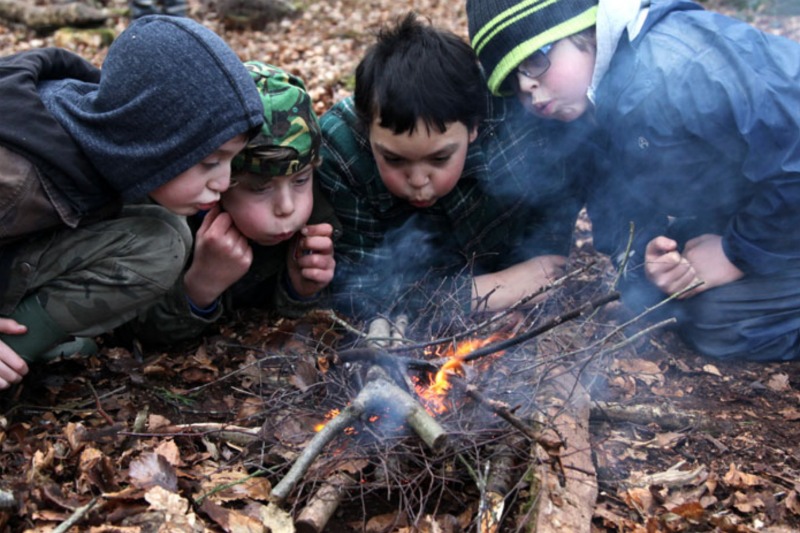
children at forest schoolAbove: Children immersed in nature and learning empowering new skills at one of our own forest school sessions. 

Regarding the ongoing fight in many family households to get kids away from their screen and back to the outdoors, Ray saved his best advice to parents for last, “The secret is that the parents need to do these things (outdoor activities) for themselves, that’s the best way, it’s just the normal way of growing up. If you want children to take an interest in nature, don’t just send them somewhere, have an interest yourself and it will be the most natural thing in the world for them to follow on.”

If you want to know more about what exactly a forest school is, check out our short video, appropriately titled “What Is Forest School?” RIGHT HERE

If you’re a parent who wants to find out more about local forest school providers in your area, I’d advise googling it, you’ll soon be heading down a rabbit hole of amazing projects to inspire your kids.

You can watch the full television debate with Ray Mears HERE. Skip ahead to 01:24:44 to see ‘Forest School vs Summer Crammer” You’ll be able to hear me trying not to sound nervous whilst talking to Ray, one of my childhood heroes.

why kids should use axes

Why I would buy my kids an AXE

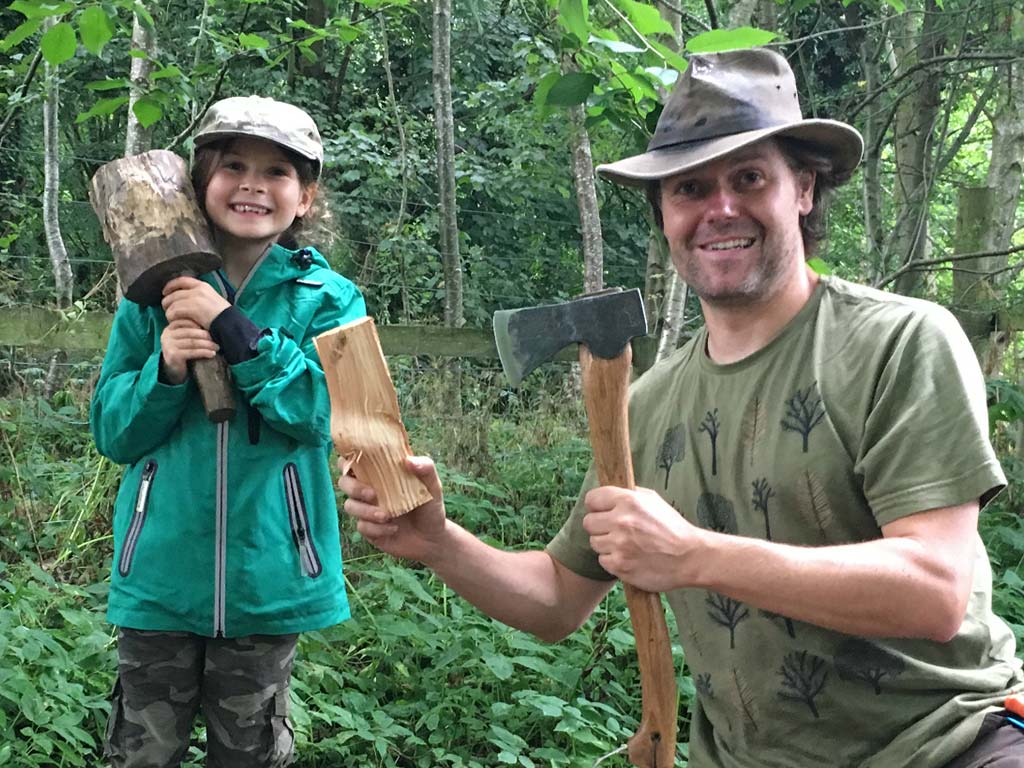
At a time when many children are being wrapped up in too much cotton wool (not literally) to keep them safe from the perceived hazards of modern life, I’ve become more and more a champion of allowing the children I look after (at Forest School sessions) to take risks and show they can be responsible for managing their own safety. So, with that in mind, we’ve been chopping firewood together, using a very sharp axe, and here’s a little video which shows you how I teach those basic axe skills to kids. I’d encourage you to try it for yourself.

Autumn has definitely arrived here in the UK and with the long, dark and cold nights closing in my mind’s turned to getting some firewood in. Yes, like many others I’ve left it late again. It’s always good to have some help with tasks like this and I’ve found that chopping firewood is an effective and simple activity for kids to get stuck into as well as a great introduction to the axe. Kids can understand the task and (most folks agree) splitting logs is very satisfying to do. So what about giving a razor sharp axe to a child? Well, here’s what the children’s author Roald Dahl had to say about risk;

“…the more risks you allow children to take, the better they learn to take care of themselves. If you never let them take any risks, then I believe they become very prone to injury. Boys should be allowed to climb tall trees and walk along the tops of high walls and dive into the sea from high rocks… The same with girls. I like the type of child who takes risks. Better by far than the one who never does so.”

Mabli (one of our regular Young Rangers) is just six years old and it was really encouraging to see her progress recently from using the potato peeler (which we give to kids first to practice their knife technique) to using a proper whittling knife. She was confident, calm and sensible with the tool, which I like to think she learnt through clear mentoring, encouragement and close supervision. There’s a voice in my head which jostles for centre stage telling me that there’s going to be a terrible accident and that it would be better to just let kids like Mabli play at something safer. But of course, children are just like us, they don’t want to hurt themselves, so along with a good mentor (like any parent), they’re their own regulator.

teaching children to use an axe

Anyway, back to the axe and chopping wood. I think this is a great introductory activity for kids to sharp tools as with an axe you have a fair distance between the sharp edge and little fingers. Also, whoever heard of such a thing as an ugly piece of firewood? So, no fine craft skills are required. You could even follow wood chopping with learning fire-lighting so that they get to burn what they’ve chopped themselves. I’ll give the last word on ‘risk’ to Richard Louv, author of the fantastic book Last Child in the Woods;

“An indoor (or backseat) childhood does reduce some dangers to children; but other risks are heightened, including risks to physical and psychological health, risk to children’s concept and perception of community, risk to self-confidence and the ability to discern true danger.”

So, would you use sharp tools with your own kids at home? Have you had success with whittling, wood chopping or using a saw with little ones? We’d love to hear from you.

If you enjoyed this video, we’ve got MORE videos on our YouTube channel giving you ideas for engaging kids in the great outdoors. You can find it by clicking HERE.

Social Share Buttons and Icons powered by Ultimatelysocial