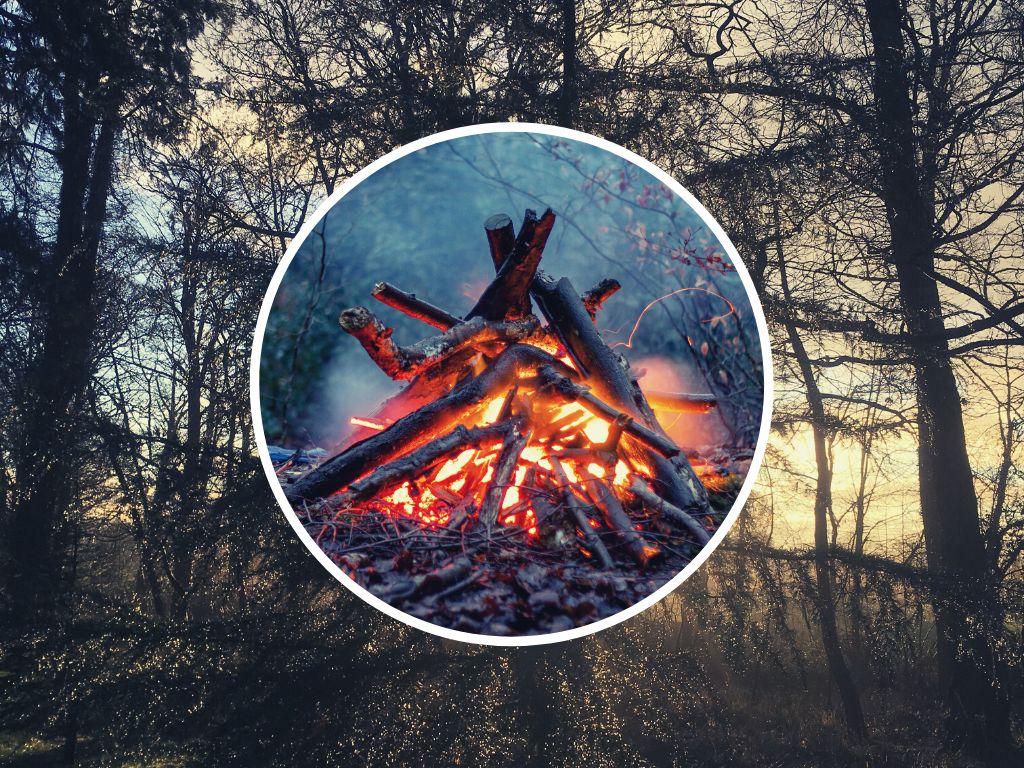
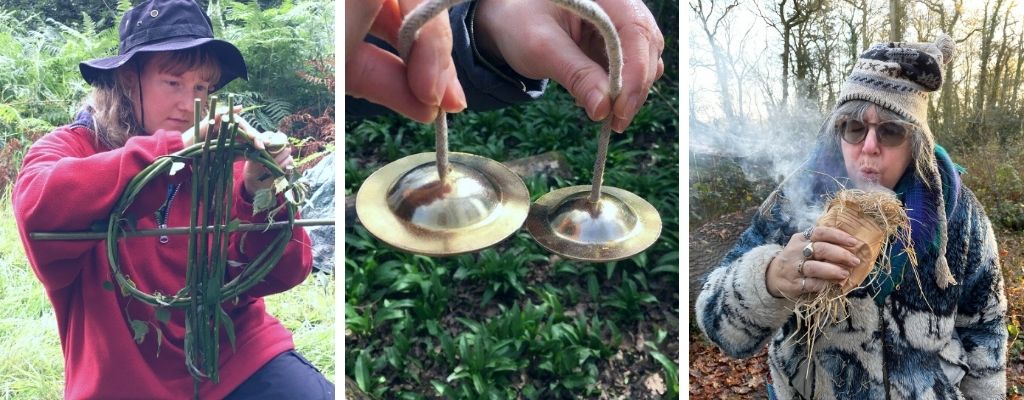
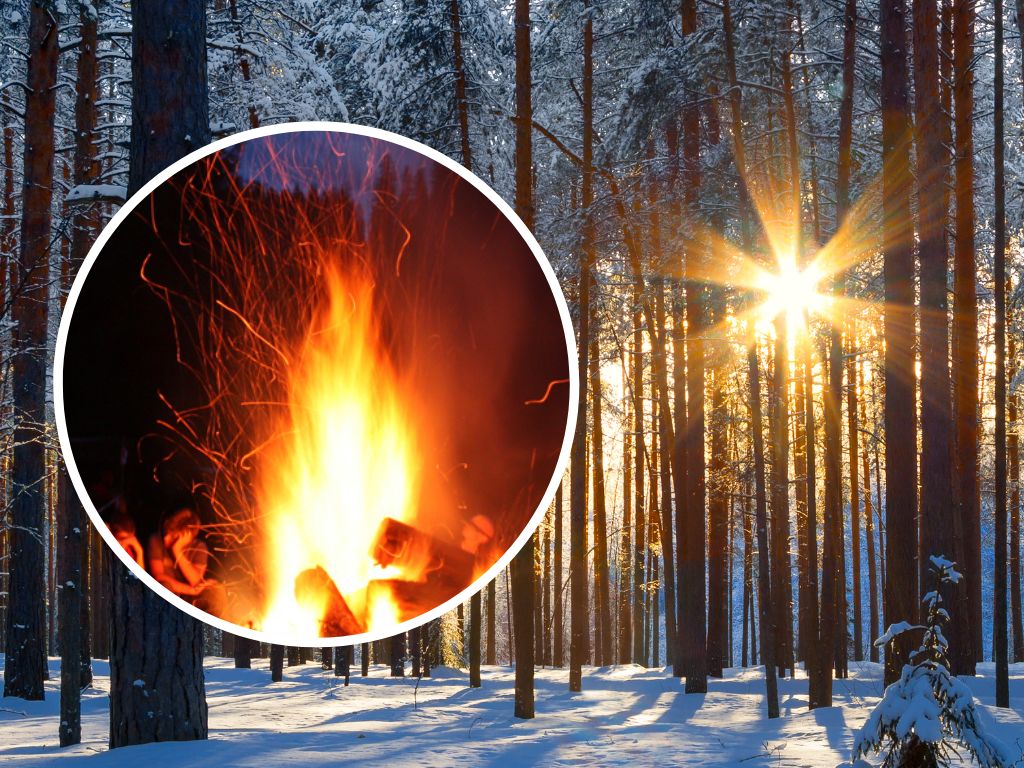
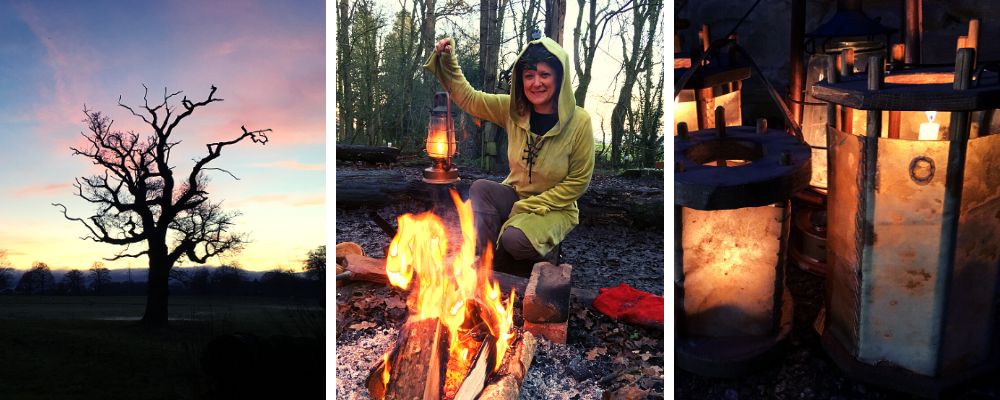
Give yourself the gift of quality time in nature as you join us around the midwinter campfire, for a celebration of the Winter Solstice. You will be guided through a range of activities aimed at deepening your nature connection whilst we mark this special moment in the calendar year together.
Experiencing nature with all our senses is a powerful doorway to practising mindfulness which is proven to improve your health & well-being. Practising bushcraft brings us closer to our ancestors and a very old way of understanding the natural world around us. It also fosters a stronger connection to nature. Fire has a hypnotic quality which can really aid getting into a mindful head space. Lighting fires at the darkest time of the year is also an ancient custom and symbolises creating our positive intentions for the new year.
“Winter Solstice, like Summer Solstice, is a moment of pause between two cycles, a moment of transition that can be held and savoured, a doorway, an opening, a place on the edge, when we can stop our busy lives and take a moment to experience this edge between these two great cycles of the year.” Glennie Kindred
James and Kay will guide you through a range of seasonal activities aimed at giving you real techniques which you can use to foster a deeper nature connection in your own time.
You will join us around the campfire amoungst the beautiful ancient woodland of the National Trust’s Erddig estate in North East Wales for a relaxing session of learning and celebrating in amongst the trees.
Enjoy a winter warmer; hot spiced apple cider (non-alcoholic) from our campfire
Awaken your ‘five animal senses’
Use traditional tools; knife, axe and froe
Identify native tree species in winter
Craft your own wild weaving to take home
Unwind with a tree meditation
Roast chestnuts on an open fire
Build your own Midwinter campfire; bring light to the dark
Set your intentions for the new year ahead
Make herbal teas from wild plants
Discover what your Celtic Birth Tree is and what it says about you
Event details
Date: Dec 21, 2022
Time: 10:00 am – 2:00 pm
Venue: Erddig
Cost: £30
Your Tutor: James Kendall
James is the Head Bushcraft Instructor at Woodland Classroom, having worked in environmental education & conservation for over 10 years. James’ approach to teaching steers his students toward fostering a deeper connection with nature through understanding the landscape around us; “Bushcraft skills are an effective way to do this as we learn how to make use of natural materials and live lightly with the land, whilst also connecting with our own ancient past by seeing the land through the eyes of our ancestors.”
Your Tutor: Kay Ribbons-Steen
Kay has worked for a number of years in eco-therapy having trained as a Mindfulness in a Woodland Setting practitioner. Kay studied a work based diploma in Environmental Conservation with Flintshire Countryside & Coast Service. She is also an Ambassador for the National Autistic Society, and an autism awareness speaker.
She is also a qualified Forest School Leader and Social Forester.
“I am passionate about reconnecting people with nature for our own holistic wellbeing whilst conserving our unique and irreplaceable environment.”
Skills you will learn
Over the course of the programme you will learn a range of skills, including…
Nature Connection
Hedgerow Medicine
Mindfulness
Greenwood crafts
Firelighting Skills
Ancestral Skills
Tree & Plant identification
Meditation techniques
Book now
This session costs £30 per person and is open to adult learners aged 16 years and over. You can read our Event Terms & Conditions here.
Give yourself the gift of quality time in nature as you join us around the midwinter campfire, for a celebration of the Winter Solstice. You will be guided through a range of activities aimed at deepening your nature connection whilst we mark this special moment in the calendar year together.
Experiencing nature with all our senses is a powerful doorway to practising mindfulness which is proven to improve your health & well-being. Practising bushcraft brings us closer to our ancestors and a very old way of understanding the natural world around us. It also fosters a stronger connection to nature. Fire has a hypnotic quality which can really aid getting into a mindful head space. Lighting fires at the darkest time of the year is also an ancient custom and symbolises creating our positive intentions for the new year.
“Winter Solstice, like Summer Solstice, is a moment of pause between two cycles, a moment of transition that can be held and savoured, a doorway, an opening, a place on the edge, when we can stop our busy lives and take a moment to experience this edge between these two great cycles of the year.” Glennie Kindred
Lea and James will guide you through a range of seasonal activities aimed at giving you real techniques which you can use to foster a deeper nature connection in your own time.
You will join us around the campfire amoungst the beautiful woodland of Park in the Past in North East Wales for a relaxing session of learning and celebrating in amongst the trees.
Enjoy a winter warmer; hot spiced apple cider (non-alcoholic) from our campfire
Awaken your ‘five animal senses’
Use traditional tools; knife, axe and froe
Identify native tree species in winter
Craft your own wild weaving to take home
Unwind with a tree meditation
Roast chestnuts on an open fire
Use traditional firelighting tools; flint & steel
Build your own Midwinter campfire; bring light to the dark
Set your intentions for the new year ahead
Make herbal teas from wild plants
Discover what your Celtic Birth Tree is and what it says about you
Event details
Date: Sun 21st Dec 2025
Time: 10:00 am – 2:00 pm
Venue: Park in the Past
Cost: £37
Your Tutors: James & Lea Kendall
James is the Head Bushcraft Instructor at Woodland Classroom, having worked in environmental education & conservation for over 10 years. James’ approach to teaching steers his students toward fostering a deeper connection with nature through understanding the landscape around us; “Bushcraft skills are an effective way to do this as we learn how to make use of natural materials and live lightly with the land, whilst also connecting with our own ancient past by seeing the land through the eyes of our ancestors.”
Lea is a qualified Counsellor and Mindfulness in a Woodland Setting practitioner. She is a firm believer in the power of nature to be therapeutic for everyone. Lea is an active forager, passionate about how we can use common plants for both food and medicine. She enjoys making her own tinctures and medicinal remedies for treating common ailments.
Skills you will learn
Over the course of the programme you will learn a range of skills, including…
Nature Connection
Hedgerow Medicine
Mindfulness
Greenwood crafts
Firelighting Skills
Ancestral Skills
Tree & Plant identification
Meditation techniques
Book now
This session costs £35 per person and is open to adult learners aged 16 years and over. You can read our Event Terms & Conditions here.
Celebrate the Winter Solstice with us in the woods. Adults or families with children of all ages are welcome to join us at our sheltered fire circle hidden in the beautiful woodland of Park in the Past for an early evening session of solstice celebration around the campfire. We will start with a lantern-lit walk along the trail, across the river and into the woods where our crackling campfire will give us a warm and welcome light at the darkest time of the year. Our previous events have been amazing, and this year promises to be a very special and magical event with music, food and good company.
Be sure to wrap up well with appropriate clothing as old Jack Frost will be out and about.
“We can look back on our journey since Summer Solstice, to acknowledge what we have completed in this cycle, what we have experienced and what wisdom we have gained. It is also a moment to look forward, to name the new seeds and intentions we wish to take into the next cycle.” Glennie Kindred
Lea and James will be your guides as we gather under our huge parachute canopy and share the warmth of the midwinter fire.
We are hosting this session on two consecutive nights so if this date fills up, check out our event on the Sun 21st Dec.
Lantern walk down the trails to the fire circle
Hot spiced apple cider (non-alcoholic)
Festive fireside storytelling
Wishing Tree
Gentle games for the kids; night-line, glow worm trail & more
Roasted chestnuts
Sing-along with seasonal songs; James will bring his mandolin
Light a candle of your own and make a wish for the coming year
Event details
Date: Sat 20th Dec 2025
Time: 4:30 am – 6:30 pm
Venue: Park in the Past
Cost: Adult £14, Child £11, Under 3’s Free
Want a sneak preview of this event? Watch this short video of a previous Woodland Winter Solstice gathering we hosted.
Your Guides: James & Lea Kendall
James is the Head Bushcraft Instructor at Woodland Classroom, having worked in environmental education & conservation for over 10 years. James’ approach to teaching steers his students toward fostering a deeper connection with nature through understanding the landscape around us; “Bushcraft skills are an effective way to do this as we learn how to make use of natural materials and live lightly with the land, whilst also connecting with our own ancient past by seeing the land through the eyes of our ancestors.”
Lea is a qualified Counsellor and Mindfulness in a Woodland Setting practitioner. She is a firm believer in the power of nature to be therapeutic for everyone. Lea is an active forager, passionate about how we can use common plants for both food and medicine. She enjoys making her own tinctures and medicinal remedies for treating common ailments.
Skills you will learn
Over the course of the evening you will experience a range of activities, including…
Nature Connection
Campfire Treats
Family Bushcraft
Ancestral Skills
Campfire
Stargazing
Tree & Plant identification
Wellbeing in Nature
Book now
Adults tickets £14 each, Child tickets £11 each. Under three’s come for FREE. Children of all ages are welcome. You can read our Event Terms & Conditions here.
Celebrate the Winter Solstice with us in the woods. Adults or families with children of all ages are welcome to join us at our sheltered fire circle hidden in the beautiful woodland of Park in the Past for an early evening session of solstice celebration around the campfire. We will start with a lantern-lit walk along the trail, across the river and into the woods where our crackling campfire will give us a warm and welcome light at the darkest time of the year. Our previous events have been amazing, and this year promises to be a very special and magical event with music, food and good company.
Be sure to wrap up well with appropriate clothing as old Jack Frost will be out and about.
“We can look back on our journey since Summer Solstice, to acknowledge what we have completed in this cycle, what we have experienced and what wisdom we have gained. It is also a moment to look forward, to name the new seeds and intentions we wish to take into the next cycle.” Glennie Kindred
Lea and James will be your guides as we gather under our huge parachute canopy and share the warmth of the midwinter fire.
We are hosting this session on two consecutive nights so if this date fills up, check out our event on the Sun 21st Dec.
Lantern walk down the trails to the fire circle
Hot spiced apple cider (non-alcoholic)
Festive fireside storytelling
Wishing Tree
Gentle games for the kids; night-line, glow worm trail & more
Roasted chestnuts
Sing-along with seasonal songs; James will bring his mandolin
Light a candle of your own and make a wish for the coming year
Event details
Date: Sun 21st Dec 2025
Time: 4:30 am – 6:30 pm
Venue: Park in the Past
Cost: Adult £14, Child £11, Under 3’s Free
Want a sneak preview of this event? Watch this short video of a previous Woodland Winter Solstice gathering we hosted.
Your Guides: James & Lea Kendall
James is the Head Bushcraft Instructor at Woodland Classroom, having worked in environmental education & conservation for over 10 years. James’ approach to teaching steers his students toward fostering a deeper connection with nature through understanding the landscape around us; “Bushcraft skills are an effective way to do this as we learn how to make use of natural materials and live lightly with the land, whilst also connecting with our own ancient past by seeing the land through the eyes of our ancestors.”
Lea is a qualified Counsellor and Mindfulness in a Woodland Setting practitioner. She is a firm believer in the power of nature to be therapeutic for everyone. Lea is an active forager, passionate about how we can use common plants for both food and medicine. She enjoys making her own tinctures and medicinal remedies for treating common ailments.
Skills you will learn
Over the course of the evening you will experience a range of activities, including…
Nature Connection
Campfire Treats
Family Bushcraft
Ancestral Skills
Campfire
Stargazing
Tree & Plant identification
Wellbeing in Nature
Book now
Adults tickets £14 each, Child tickets £11 each. Under three’s come for FREE. Children of all ages are welcome. You can read our Event Terms & Conditions here.
Celebrate the Winter Solstice with us in the woods. Adults or families with children of all ages are welcome to join us at our sheltered fire circle hidden in the beautiful woodland of Park in the Past for an early evening session of solstice celebration around the campfire. We will start with a lantern-lit walk along the trail, across the river and into the woods where our crackling campfire will give us a warm and welcome light at the darkest time of the year. Our previous events have been amazing, and this year promises to be a very special and magical event with music, food and good company.
Be sure to wrap up well with appropriate clothing as old Jack Frost will be out and about.
“We can look back on our journey since Summer Solstice, to acknowledge what we have completed in this cycle, what we have experienced and what wisdom we have gained. It is also a moment to look forward, to name the new seeds and intentions we wish to take into the next cycle.” Glennie Kindred
Lea and James will be your guides as we gather under our huge parachute canopy and share the warmth of the midwinter fire.
We are hosting this session on two consecutive nights so if this date fills up, check out our event on the Sat 21st Dec.
Lantern walk down the trails to the fire circle
Hot spiced apple cider (non-alcoholic)
Festive fireside storytelling
Wishing Tree
Gentle games for the kids; night-line, glow worm trail & more
Roasted chestnuts
Sing-along with seasonal songs; James will bring his mandolin
Light a candle of your own and make a wish for the coming year
Event details
Date: Fri 20th Dec 2024
Time: 4:30 am – 6:30 pm
Venue: Park in the Past
Cost: Adult £14, Child £11, Under 3’s Free
Want a sneak preview of this event? Watch this short video of a previous Woodland Winter Solstice gathering we hosted.
Your Guides: James & Lea Kendall
James is the Head Bushcraft Instructor at Woodland Classroom, having worked in environmental education & conservation for over 10 years. James’ approach to teaching steers his students toward fostering a deeper connection with nature through understanding the landscape around us; “Bushcraft skills are an effective way to do this as we learn how to make use of natural materials and live lightly with the land, whilst also connecting with our own ancient past by seeing the land through the eyes of our ancestors.”
Lea is a qualified Counsellor and Mindfulness in a Woodland Setting practitioner. She is a firm believer in the power of nature to be therapeutic for everyone. Lea is an active forager, passionate about how we can use common plants for both food and medicine. She enjoys making her own tinctures and medicinal remedies for treating common ailments.
Skills you will learn
Over the course of the evening you will experience a range of activities, including…
Nature Connection
Campfire Treats
Family Bushcraft
Ancestral Skills
Campfire
Stargazing
Tree & Plant identification
Wellbeing in Nature
Book now
Adults tickets £14 each, Child tickets £11 each. Under three’s come for FREE. Children of all ages are welcome. You can read our Event Terms & Conditions here.
Celebrate the Winter Solstice with us in the woods. Adults or families with children of all ages are welcome to join us at our sheltered fire circle hidden in the beautiful woodland of Park in the Past for an early evening session of solstice celebration around the campfire. We will start with a lantern-lit walk along the trail, across the river and into the woods where our crackling campfire will give us a warm and welcome light at the darkest time of the year. Our previous events have been amazing, and this year promises to be a very special and magical event with music, food and good company.
Be sure to wrap up well with appropriate clothing as old Jack Frost will be out and about.
“We can look back on our journey since Summer Solstice, to acknowledge what we have completed in this cycle, what we have experienced and what wisdom we have gained. It is also a moment to look forward, to name the new seeds and intentions we wish to take into the next cycle.” Glennie Kindred
Lea and James will be your guides as we gather under our huge parachute canopy and share the warmth of the midwinter fire.
We are hosting this session on two consecutive nights so if this date fills up, check out our event on Fri 20th Dec. UPDATE: Tickets for this evening are now SOLD OUT but you can still grab tickets for Fri 20th Dec HERE.
Lantern walk down the trails to the fire circle
Hot spiced apple cider (non-alcoholic)
Festive fireside storytelling
Wishing Tree
Gentle games for the kids; night-line, glow worm trail & more
Roasted chestnuts
Sing-along with seasonal songs; James will bring his mandolin
Light a candle of your own and make a wish for the coming year
Event details
Date: Sat 21st Dec 2024
Time: 4:30 am – 6:30 pm
Venue: Park in the Past
Cost: Adult £14, Child £11, Under 3’s Free
Want a sneak preview of this event? Watch this short video of a previous Woodland Winter Solstice gathering we hosted.
Your Guides: James & Lea Kendall
James is the Head Bushcraft Instructor at Woodland Classroom, having worked in environmental education & conservation for over 10 years. James’ approach to teaching steers his students toward fostering a deeper connection with nature through understanding the landscape around us; “Bushcraft skills are an effective way to do this as we learn how to make use of natural materials and live lightly with the land, whilst also connecting with our own ancient past by seeing the land through the eyes of our ancestors.”
Lea is a qualified Counsellor and Mindfulness in a Woodland Setting practitioner. She is a firm believer in the power of nature to be therapeutic for everyone. Lea is an active forager, passionate about how we can use common plants for both food and medicine. She enjoys making her own tinctures and medicinal remedies for treating common ailments.
Skills you will learn
Over the course of the evening you will experience a range of activities, including…
Nature Connection
Campfire Treats
Family Bushcraft
Ancestral Skills
Campfire
Stargazing
Tree & Plant identification
Wellbeing in Nature
Book now
Adults tickets £14 each, Child tickets £11 each. Under three’s come for FREE. Children of all ages are welcome. You can read our Event Terms & Conditions here.
Give yourself the gift of quality time in nature as you join us around the midwinter campfire, for a celebration of the Winter Solstice. You will be guided through a range of activities aimed at deepening your nature connection whilst we mark this special moment in the calendar year together.
Experiencing nature with all our senses is a powerful doorway to practising mindfulness which is proven to improve your health & well-being. Practising bushcraft brings us closer to our ancestors and a very old way of understanding the natural world around us. It also fosters a stronger connection to nature. Fire has a hypnotic quality which can really aid getting into a mindful head space. Lighting fires at the darkest time of the year is also an ancient custom and symbolises creating our positive intentions for the new year.
“Winter Solstice, like Summer Solstice, is a moment of pause between two cycles, a moment of transition that can be held and savoured, a doorway, an opening, a place on the edge, when we can stop our busy lives and take a moment to experience this edge between these two great cycles of the year.” Glennie Kindred
Lea and James will guide you through a range of seasonal activities aimed at giving you real techniques which you can use to foster a deeper nature connection in your own time.
You will join us around the campfire amoungst the beautiful woodland of Park in the Past in North East Wales for a relaxing session of learning and celebrating in amongst the trees.
Enjoy a winter warmer; hot spiced apple cider (non-alcoholic) from our campfire
Awaken your ‘five animal senses’
Use traditional tools; knife, axe and froe
Identify native tree species in winter
Craft your own wild weaving to take home
Unwind with a tree meditation
Roast chestnuts on an open fire
Use traditional firelighting tools; flint & steel
Build your own Midwinter campfire; bring light to the dark
Set your intentions for the new year ahead
Make herbal teas from wild plants
Discover what your Celtic Birth Tree is and what it says about you
Event details
Date: Sat 21st Dec 2024
Time: 10:00 am – 2:00 pm
Venue: Park in the Past
Cost: £35
Your Tutors: James & Lea Kendall
James is the Head Bushcraft Instructor at Woodland Classroom, having worked in environmental education & conservation for over 10 years. James’ approach to teaching steers his students toward fostering a deeper connection with nature through understanding the landscape around us; “Bushcraft skills are an effective way to do this as we learn how to make use of natural materials and live lightly with the land, whilst also connecting with our own ancient past by seeing the land through the eyes of our ancestors.”
Lea is a qualified Counsellor and Mindfulness in a Woodland Setting practitioner. She is a firm believer in the power of nature to be therapeutic for everyone. Lea is an active forager, passionate about how we can use common plants for both food and medicine. She enjoys making her own tinctures and medicinal remedies for treating common ailments.
Skills you will learn
Over the course of the programme you will learn a range of skills, including…
Nature Connection
Hedgerow Medicine
Mindfulness
Greenwood crafts
Firelighting Skills
Ancestral Skills
Tree & Plant identification
Meditation techniques
Book now
This session costs £35 per person and is open to adult learners aged 16 years and over. You can read our Event Terms & Conditions here.
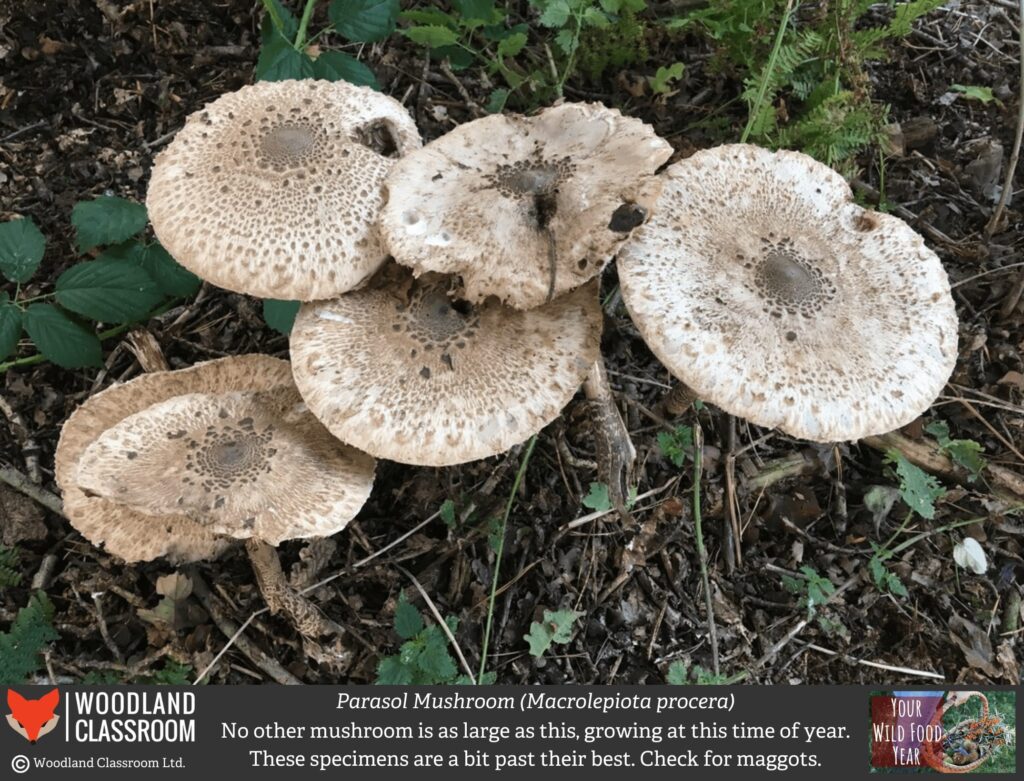
There is something magical about the idea of going out to the countryside and finding wild mushrooms to cook with. It scratches an ancient itch in our hunter-gather brains. If you’re looking to get into this addictive hobby then the Parasol Mushroom (Macrolepiota procera) is a great beginners fungi for anyone wanting to start wild mushroom foraging.
My name is James, I teach Bushcraft and Foraging in North Wales. I am the co-creator of Your Wild Food Year, an online course for anyone wanting to gain confidence in identifying, harvesting and cooking with wild foods. In this article I will introduce you to this commonly found edible fungi. You will learn how to identify it, where and when to find it, how to cook with it and what poisonous lookalikes you will need to avoid. Let’s dive in.
Where & When Can you Find Them
We have found good specimens as early as late July but it’s most often seen from late August and through September.
You’re most likely to find it in meadows and unimproved grassland. I’ve also found it at the edges of ancient woodland. The three locations I see it often are all National Trust estates, so that points to land that has been consistently managed over a long period.
At what growth stage should you harvest them? Well you can pick them when they’re not yet fully opened. But if doing this be sure you’re not confusing them for the Shaggy Parasol (more on that below). Basically if the specimen looks like it’s in good condition you’re good to go. Ensure you fungi is free of mold, sliminess on the gills and the cap is not starting to wilt. One word of caution, you do often get the odd maggot or two inside the cap, which you only find when you’ve taken them home and started to chop them up. These are more typically found in older specimens. If there’s just one or two, I pick them out and use the mushroom anyway. What you do is down to personal preference.
How To Identify Parasol Mushrooms
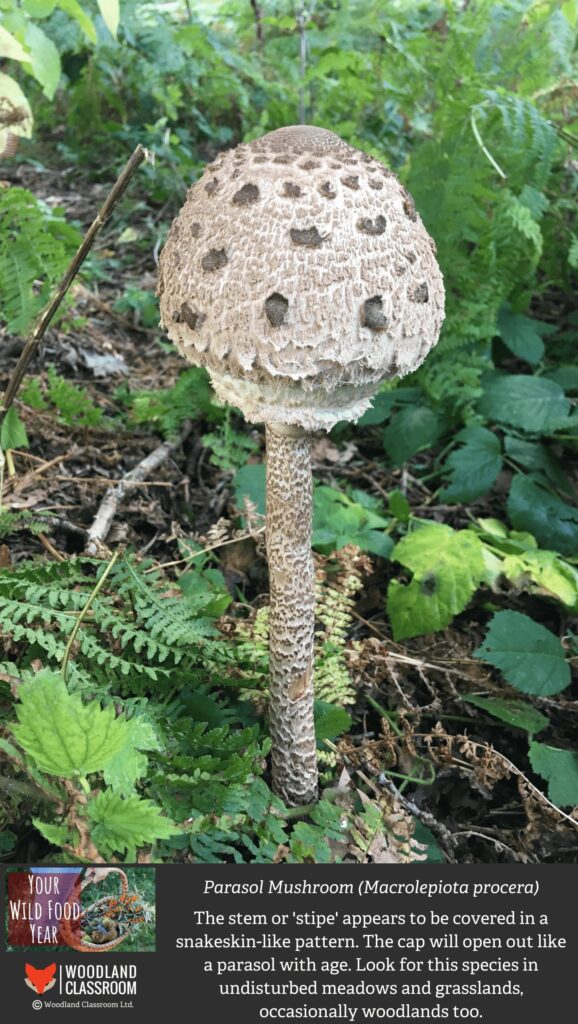
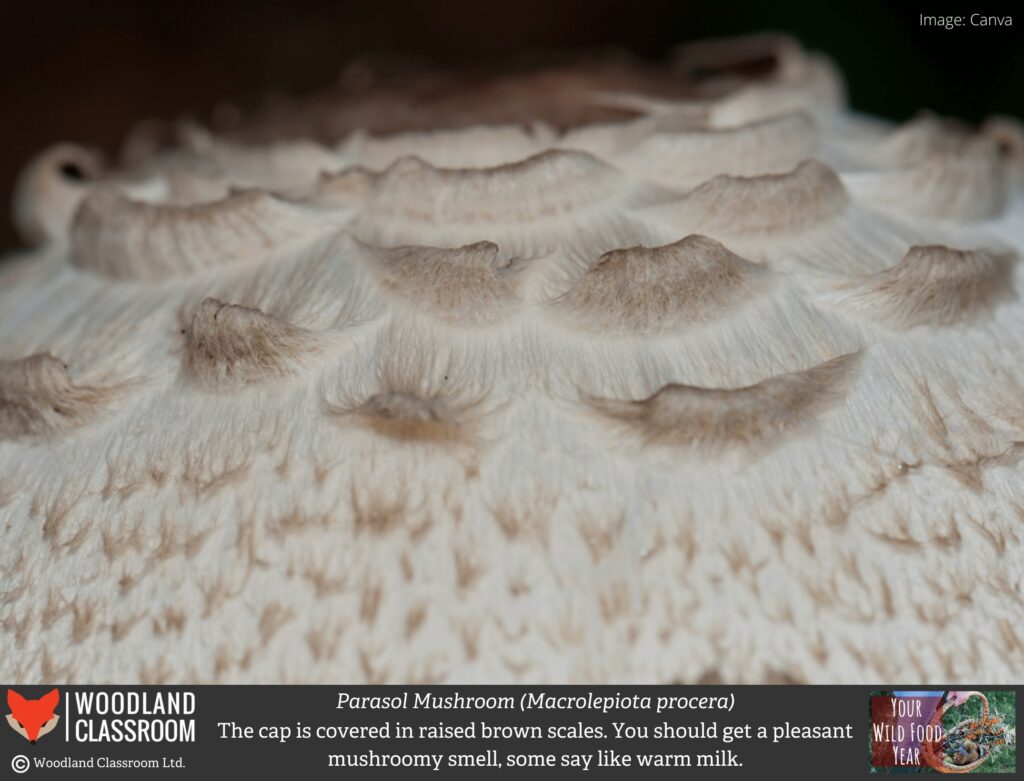
Well, true to its name it resembles a parasol umbrella. You’ll find a distinctive brown ‘nipple’ raised in the centre of the cap. The cream-white cap meanwhile is also patterned with light brown scales. Something that is important (you’ll see why later) is the typical size of the cap. When fully open they can grow to 15-35cm across diameter, so they get seriously big! You’re getting a lot of food from your forage here.
Looking underneath the cap you will find gills rather than pores. These are cream-white in colour. The flesh of the mushroom doesn’t discolour when bruised, it stays cream-white.
The stem (otherwise known as a stipe) is again cream-white in colour and looks like it’s covered in a snakeskin pattern. It can grow quite tall, reaching up to 25cm in height. You will also typically find a ring surrounding the stem. If handled carefully this can be separated from the stem and then it runs up and down freely. Another good way to identify this fungi.
You shouldn’t forget to use your nose when learning to identify wild mushrooms. Some fungi have really distinctive aromas, like Dryad’s Saddle which smells surprisingly like melon. Parasols have a pleasant mushroom-like smell which some say reminds them of warm milk.
How To Use Parasol Mushrooms In Cooking
Parasols have a nice, firm texture and a pleasant mushroom flavour. They do dry well, retaining their smell and flavour. So, we often slice up any excess mushrooms and pop them in our dehydrator. This means you can enjoy them right through the winter in your cooking.
Some people prefer just eating the caps but you can eat the stem, in fact some experts say there’s more goodness to be found in the stem of fungi than the cap. The flesh is not as soft as the cap though, so some folks use these for making a mushroom stock.
Like most mushrooms they go great in an omelette, in a quiche, stir fry or added to a stew. Try deep-frying them in breadcrumbs and serving with lemon and garlic mayo. The sheer size of the cap makes them an excellent replacement for the a large field mushroom in your cooked breakfast. Lovely stuff all round!
We made this tasty wild mushroom and nettle tart, cooked in our dutch oven over the campfire.
Caution: Beware The Shaggy Parasol
As with any foraging of wild mushrooms, you need to widen your knowledge beyond just the species you’re looking for, or think you’re looking at. As the old saying goes; “There are old foragers and bold foragers, but there are no old, bold foragers.” Heed these wise words folks.
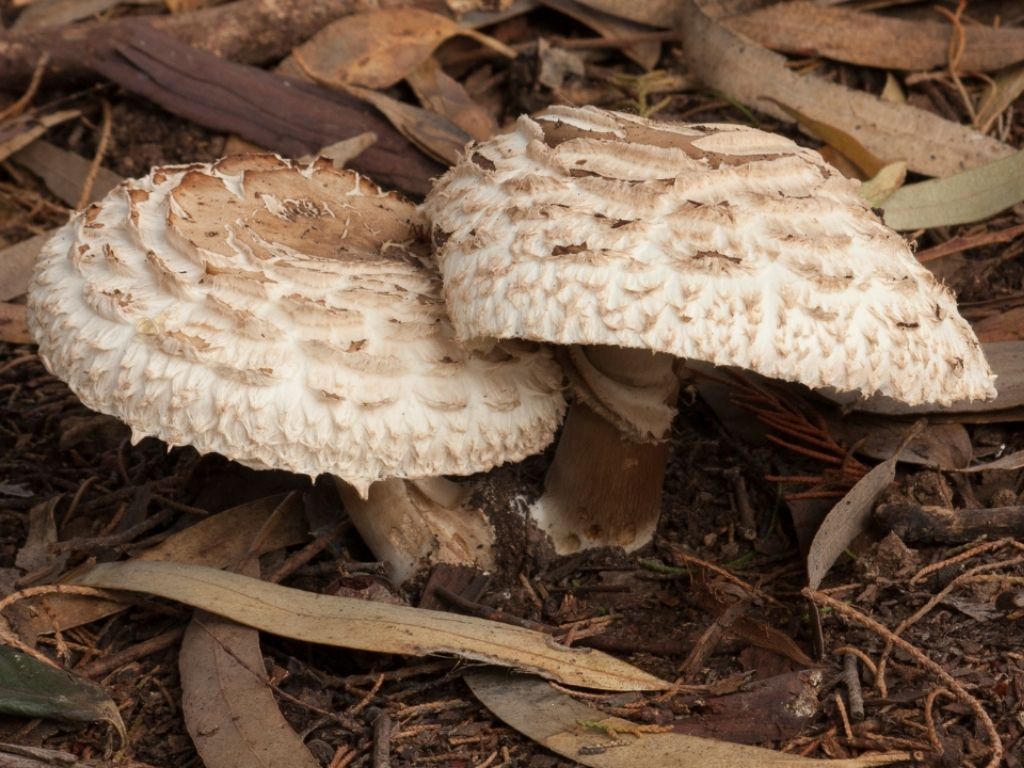
If you’re going out looking for Parasols then you need to be aware of the closely related and similar looking Shaggy Parasol (Macrolepiota rhacodes). This is not a poisonous species, however with around 20% of people it’s been known to give them a bit of an upset stomach. It’s found in similar habitats and at the same time of year. Let’s learn more about the differences between the two fungi.
As the name suggests it is shaggier in appearance. Also the base of the stem is typically more bulbous than with the Parasol. It also doesn’t grow as large as the Parasol, the cap only getting to around 8-15cm in diameter and the stem reaching 12-18cm height. So a good way to avoid Shaggy Parasols would be to only pick fungi that are larger than this.
Remember that the flesh of the Parasol doesn’t bruise when handled? With the Shaggy Parasol this isn’t the case. The gills will bruise red and the flesh will turn an orange/red when you cut it.
This fungi also has a ring around the stem, but unlike the Parasol, this ring will not separate from the stem. So there’s another method of differentiating between the two.
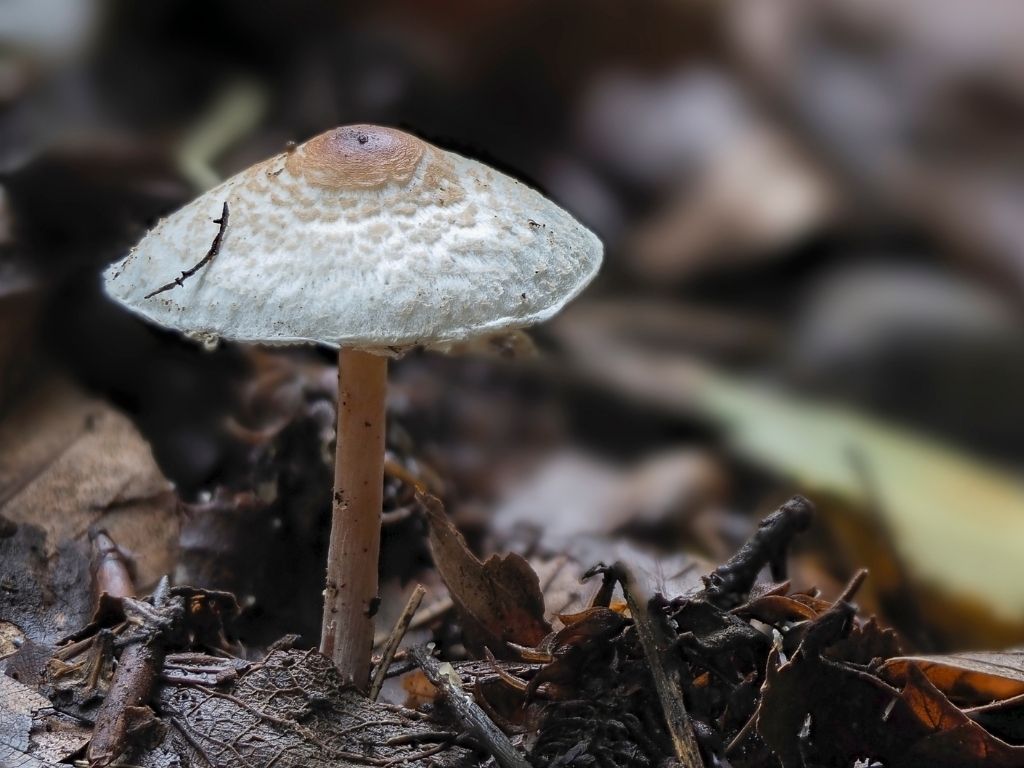
Shaggy Parasol (Macrolepiota rhacodes). It can give some people an upset stomach. Image by Canva.
So, can you eat this mushroom? Well yes, but as I’ve said it can disagree with some people. So good practise is to try just a little bit and leave it 48 hrs to see if your stomach is happy. If so, tuck in. Be aware though if you are going to eat the Shaggy Parasol, it must be cooked first.
One last fungi to mention here are the Dapperlings (Lepiota spp.) They are poisonous so need to be avoided. How could they be confused with Parasols though? Well they have a distinctive brown spot in the centre of the cap too. However, the saving grace is that they do grow much smaller than the Parasols. As a general rule, avoid picking any Parasols whose cap is less than 12cm in diameter.
Hopefully this has not put you off heading out the door for your first Parasol mushroom. If anything I hope it will make the thrill of the hunt even more enjoyable and the reward of positively identifying your Parasol all the more satisfying.
Stinking Dapperling (Lepiota cristata). A common member of this poisonous group. Note how much smaller it is than the Parasols when fully opened out. Get to know them. Image by Canva.
Discover More Wild Food
If all this talk of wild food and foraging has whetted your appetite then you can take your learning further with us either outdoors or online.
You can immerse yourself in the world of foraging through our outdoor courses hosted in beautiful National Trust estate woodlands in North-East Wales. Or if that’s too far afield for you we also host regular online workshops, live through Zoom where we focus on wild foods of the season and give you delicious recipe ideas, foraging tips and expertise from special guest speakers. If this all sounds interesting, check out what’s coming up on our Events page right here.
I think you’ll also be interested in our flagship online foraging course called Your Wild Food Year. When you enrol on this course you will go from clueless to confident on your journey to enjoying foraged plants, fungi, fruits and more with this detailed guide to identifying and cooking with the best wild edibles of Great Britain & Ireland.
Discover the joy of finding, harvesting and cooking with wild food with the very best each month has to offer. You will learn what to look for, where to look, and what to do with it in the kitchen. You will have videos, photo galleries, recipes and more at your fingertips, all taught by experienced foragers. Discover over 70 wild foods!
Crucially, you’ll also learn when to look. As each month we bring you the edible fungi, flowers, fruits and foliage which are in season from January to December.
There is even a FREE TASTER version of the course so you can try before you buy and see if the larger course is something that’s a good fit for you. So, start your journey to becoming a confident wild food forager today. Find out more right here.
“I’d always loved the idea of foraging for wild mushrooms but was too scared to try it. This course has shown me which species I can pick with confidence. The wild fungi hot spots I’ve discovered in my local area are now my closely guarded secret 😉 Thanks Lea and James.” Matt Corcoran
Until next time, stay safe and remember to always be 100% sure you have correctly identified a wild edible before consuming it. Good luck with your own foraging journey.
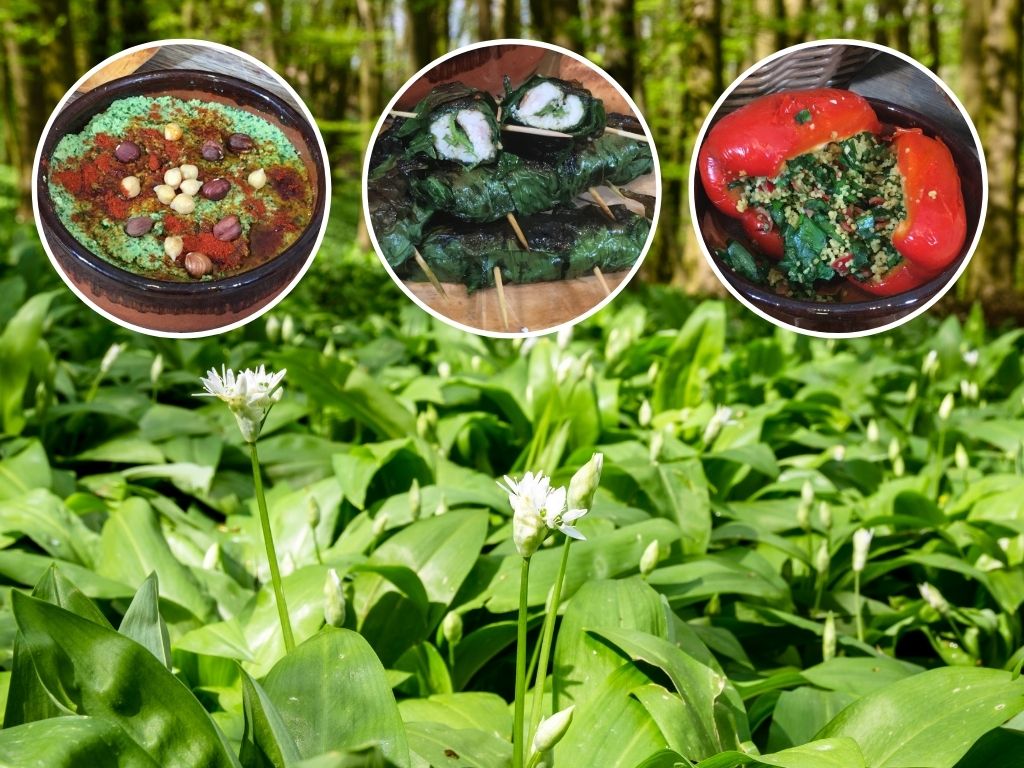
Spring has sprung and with it comes one of the edible plants for the forager, wild garlic (Allium ursinum). Most people who have dabbled in foraging will know wild garlic (or ramsons) as a great plant to start with as it’s simple to recognise and use in cooking. It’s one of our absolute favourite wild foods. Not only because it tastes great but because it’s so versatile. So, it’s a shame that the main recipe you see online again and again is wild garlic pesto. There’s so much more to it than that, as you’ll see. We’ve done the trial and error, so you don’t have to and in this blog we have made a list of our top 11 recipes for you to try at home. And yes, pesto is included below too.
If you prefer to watch rather than read, you should have a look at our video 11 Easy Wild Garlic Recipes here, where we go into even more detail on ingredients, quantities and methods. We also put together a spicy Indian banquet bursting with wild garlic flavour. Check it out!
Every part of this plant is edible; leaves, stem, flower and bulb. So with that in mind there’s a bunch of ways we can use the plant. As a general rule, if you’re cooking wild garlic you want to treat it like spinach, don’t over cook it but throw it into a dish near the end so it doesn’t wilt too much and lose it’s flavour and goodness. Now, on with the recipes…
Recipe 1: Sandwich, Toastie or Wrap
Let’s start with something simple, if you haven’t got the time to make a whole meal why not incorporate the goodness of wild garlic into something as easy as a cheese sandwich, toastie or wrap. This way you get all of the benefits without any of the faff. Why not use it as a replacement for lettuce or spinach for a fresh garlicky addition. Don’t use too much – it’s pokey stuff!
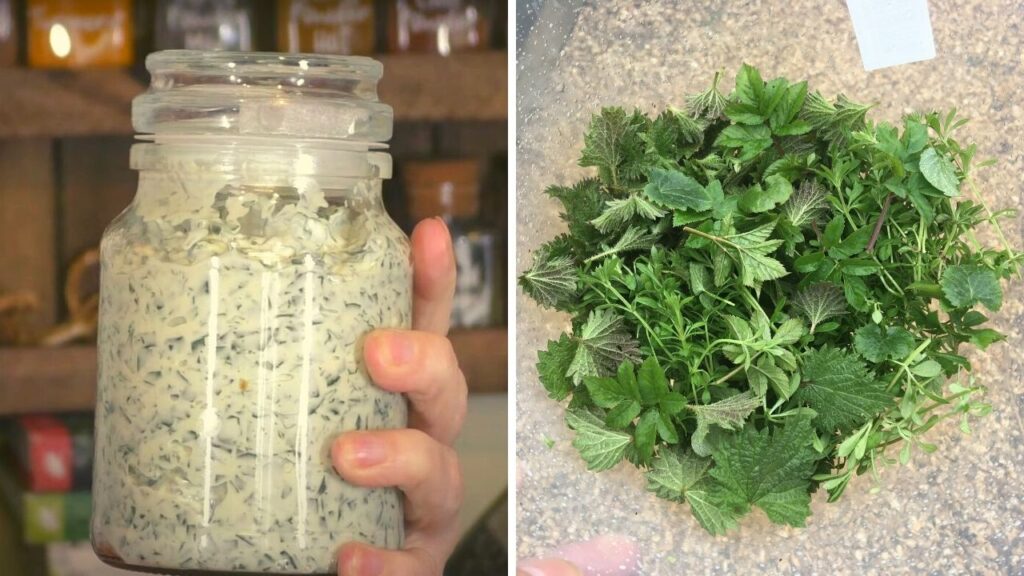
Recipe 2: Wild Green Mayonnaise
This is a super easy way to incorporate all your essential greens into your diet by adding them to a spread. Mayonnaise is a favourite, and I can then add it to sandwiches or use it as a healthy dip. Just shred the wild garlic and stir it into your dip of choice. If you want to push the boat out why not add a few more wild greens; garlic mustard, hairy bittercress, chickweed, nettle (blanch the leaves first) and cleavers are all in season now and are just as good for you!
Recipe 3: Wild Spring Salad
This is another easy recipe to incorporate wild garlic into. If you’re a fan of salads and making them interesting and delicious, why not add some shredded wild garlic? I’ve found that all parts of the plant can be used in the salad to add some interesting flavours and textures. The stems have a real crunch to them and make a substitute for beansprouts. You could substitute lettuce with wild garlic leaves, but you might find you want to bulk it out a little with some shop-bought leaves, or later in the season why not use the wild garlic seeds (lightly toasted) to add a sharp pep of garlic to your salads.
This is another great recipe to experiment with your wild greens, why not add some cleavers, nettle, ground elder or ground ivy. You could also add some fresh edible wildflowers like primrose, gorse or dog violet to give your salad a pop of colour.
Recipe 4: Wild Garlic Bread
This is a great way to get some wild food into your kids. Most children love garlic bread and this is a classic recipe that is just so moreish it could quickly become your favourite wild garlic recipe. It’s also unbelievably easy; chop up the leaves fine and mix with butter. Next, simply cut some horizontal slices into a bake-at-home baguette and add a dollop of the garlic butter to each gap. Stick it in the oven as per the pack instructions and you’re done. This of course goes great with Italian food.
Recipe 5: Wild Garlic Pesto
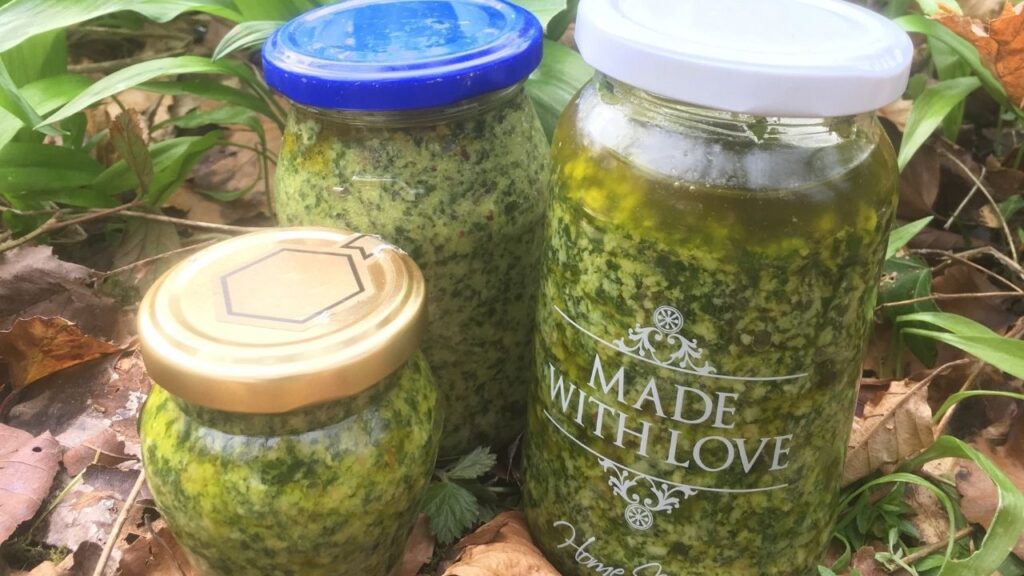
This recipe needs the least description or introduction as you’ll find recipes for this all over the web. It’s such a classic and one of the easiest recipe there is. In a nutshell you replace the basil in your standard pesto recipe with wild garlic to make a subtle garlicky pesto that can be used in a range of ways. Mixed into pasta is the most obvious use but you could spread a little onto a cheese toastie, mix it into a rice dish or as a filling in a pastry. We’ve made our own pestos that bit more wild by replacing the pine nuts for chopped hazelnuts.
Recipe 6: Wild Garlic Kimchi
We think this beats pesto hands down any day. This recipe is one of our favourites of the year, so much so that we even have a whole separate video on how to make this. You can check out that video below and also learn about the fantastic health benefits of eating kimchi. Kimchi is a Korean side dish, traditionally of fermented vegetables with ginger and chilli and is incredibly good for gut health. We’ve substituted the radish and cabbage for wild garlic leaves.
Fermenting is a fantastic way of preserving and extending the season for wild foods into the whole year. Not only this but the process of preserving our foods is something our ancestors would have practised regularly in order to have the food they would’ve needed to survive winter, it’s an essential skill and connects us with our predecessors and their way of life. It’s often the case that we can put little thought into what we eat, but fermenting foods helps us foster a deeper connection with the earth and importantly, our food. I would highly recommend trying this if you want to enjoy wild garlic beyond spring. A jar of this stuff doesn’t last long in our household.
The reason kimchi is so good for us is that it creates live, healthy bacteria which goes into our gut and aids in digestion, boosting the immune system and overall health of the body. The bacteria encourages everything to function as it should. In order to ensure there is no harmful bacteria fermenting in the kimchi it’s important to sterilise your equipment before you start, this can be done in a hot wash in the dishwasher, but you’ll need a more thorough sterilisation of the jar you’ll be fermenting in.
For this dish you will need a generous helping of wild garlic as it will reduce down quite a lot. If you want the full recipe and step-by-step instructions on how to make this fantastic dish check out our video tutorial here.
Recipe 7: Pasta Sauce
This is another really easy way to incorporate healthy greens into your diet with minimal prep time. We’ve made a tomato based sauce, but you can incorporate wild garlic into any pasta dish you want, and with any combination of vegetables, there’s a lot of creative freedom with this recipe. We’ve also chosen to make a batch of this sauce and jar it for later use, which means we pre-cooked the vegetables we added, but you can make enough just for one portion of pasta and simply add it all to a pan. Once left in the fridge this sauce should last for a week or so.
We added fried onions, chopped basil and sun dried tomatoes alongside the garlic to a base of chopped tomatoes, stirred all together and jarred. Alternatively, you could make a pea pesto and stir in your garlic leaves, broccoli, peas and fennel for a vibrant green sauce, or mushroom and garlic leaves with a splash of cream for a warming mushroom sauce. Bear in mind that any dairy products used will mean the sauce won’t keep as long.
If you pre-make your sauce and add it to the pasta once it has cooked, stir it in for only a couple of minutes, if the wild garlic leaves are cooked for too long they will lose all their structure and goodness. Similarly, if you’re cooking a sauce from scratch, add the garlic leaves last thing so they’ve just wilted.
Recipe 8: Baked Hummus
Just like regular shop bought hummus, this dip goes really well on toast or with some vegetable sticks, but this recipe adds the beautiful taste of wild garlic too. We bake this hummus to soften the sharpness of the raw wild garlic but if you don’t mind strong garlic flavours with your hummus why not give it a go without cooking it. Again, this recipe is very simple, just add some shredded wild garlic leaves into your favourite hummus recipe and bake.
Baking it also gives the top layer a really lovely crust that adds some lovely texture. As well as adding wild garlic we’ve made this really unique by drizzling a little oil and adding some hazelnuts before baking to really make a showstopper of a dip. If you’re extremely organised you might have foraged and stored your own hazelnuts last autumn but if not (which is most of us) the shop bought ones will do instead.
Recipe 9: Wild Garlic & Elf Cup Stuffed Pepper
These stuffed peppers can be eaten as a side but really they take centre stage, they’re visually very vibrant and beautiful. We use couscous as the main filling and as well as wild garlic we take advantage of another seasonal delight; the scarlet elf cap mushroom (Sarcoscypha austriaca).
We pre-cooked the couscous and made a batch of the filling so we can make as many stuffed peppers as we want. Just remember when you’re cutting your pepper you want to remove a circle around the stalk and scrape out the seeds without damaging the structure, then simply add your filling and roast in a pan.
You can switch the filling up as well, why not use rice instead of couscous, or add a little wild garlic pesto and mozzarella for a lovely cheesy filling.
Recipe 10: Wild Saag Aloo
This is one of our favourite additions to the Indian feast we prepared, its delicious and the wild garlic really enhances the flavour of all the spices. We swap out the spinach you would typically put in this dish for the wild garlic, so you do need quite a lot as it will reduce as it cooks. Equally this would work very well using nettle instead of spinach. You can get the full recipe and method by watching the video.
As a side dish this goes really well with our other Indian themed recipes; the chicken tikka parcels, stuffed peppers and pakoras. If you want this as more of a main attraction why not have this on some naan bread with mango chutney. Let us know how you get on with this dish.
Recipe 11: Chicken Tikka Parcels
This one is a little different, using the wild garlic in a new way. This is a really interesting way to incorporate wild garlic into a meal; wrap garlic leaves around strips of chicken to make a parcel that can be fried in a pan, cooked on a bbq or roasted directly on hot coals over an open fire.
Marinade diced chicken in tikka paste with a little oil. Next pick the largest wild garlic leaves you can find wrap several layers around a few chunks of chicken. The wrapped leaves can be pinned into place with cocktail sticks but if you want to be authentically wild you can whittle a pointed end onto foraged sticks as a makeshift skewer. Once cooked, any burnt outer leaves can be peeled away, leaving a succulent garlicky parcel which surrounds the juicy chicken. If you prefer you can substitute chicken breasts for a vegetarian alternative.
The fantastic thing about this dish is that you can use any combination of spices to make it fit with a range of cuisines, the tikka curry powder we use in this recipe makes it a perfect addition to a foraged Indian feast. You could also try making a herb mix of rosemary, oregano, thyme and basil to make a side for an Italian dish or turmeric, cumin and nutmeg as part of a mezze platter.
For anyone who loves simple, outdoor cooking, using the leaves in this way eliminates the need for a pan or grill. The leaves and skewers used are all biodegradable of course and any waste can go back to the woods. This recipe really feels like a connection to our ancestors and how they would’ve cooked, it’s simple and connects us to our roots, so give it a go.
Discover More Wild Food
If all this talk of foraging has your mouth watering then you can find more inspiration from us with more good wild food stuff including; blogs, videos, outdoor courses and online courses too. If you haven’t checked out our YouTube channel already, be sure to do that here.
You can immerse yourself in the world of foraging through our outdoor courses hosted in beautiful National Trust estate woodlands in North-East Wales. Or if that’s too far afield for you we also host regular online workshops, live through Zoom where we focus on wild foods of the season and give you delicious recipe ideas, foraging tips, and expertise from special guest speakers. If this all sounds interesting, check out what’s coming up on our Events page right here.
Another way to get instant access to a whole backlog of wild food & foraging videos, recipes and pre-recorded workshops is to join our Tribe over on Patreon. In return for supporting our mission, our patrons get access to loads of exclusive resources. You can join the Tribe from as little as the price of a cup of dandelion coffee, just £3.60 per month. Find out about all the benefits right here.
Until next time, good luck with your own foraging journey.
Are you confused by conifers and flummoxed by firs? In this article you’re going to get to know the native conifer trees of Britain & Ireland and learn the top five key features you need to look for so that you can easily recognise them in the countryside and tell them apart from the many non-native conifers you may find.
Conifers are not rare in this country, you can find them everywhere. As a general rule, they are also evergreen (though there is an exception, the Larch) so they hang on to their foliage right through our winter. With the majority of our native trees being broadleaves, losing their leaves in autumn, this makes a conifer easy to spot from a mile off.
But are you looking at one of our native conifer trees or is it one of the many non-native species which have been introduced to this country?
Before we get into this topic, you might be interested in my FREE Tree ID Course online, it’s called Kickstart Your Tree ID Skills and it includes videos, downloads, photo galleries and quizzes on trees in all four seasons of the year. If this sounds good to you then you can enrol for free right here.
What is a Conifer?
Conifers are a very old group of trees that includes firs, cedars, cypresses, junipers, kauri, larches, pines, hemlocks, redwoods, spruces and yews. As a rule, conifers bare cones, though some don’t look much like cones as we think of them. The other key feature they share is they have very small leaves in the form of needles or scales.
With the exception of some Scots Pine in Scotland and a few Yew woodlands, you will not comes across a natural forest of conifer trees in the UK and Ireland. They are most likely planted non-native species, usually for timber production or as a shelter-belt woodland.
When we picture a conifer, we usually have a Christmas tree in mind, which is typically a Spruce. But there’s more to conifers than simply this conical cone-baring form. Especially when it comes to our own natives.
Above: Conifers can come in a variety of weird and wonderful forms.
How Many Native Conifers Do We Have in the UK & Ireland?
Well the good news here is that we have only three native conifers. By native, we mean a species which have been naturally present on these isles since the last Ice Age and before we became disconnected from the continent. Our three native conifers are Scots Pine, Juniper and Yew.
Take a trip around the globe and you could be dealing with up to 800 conifer species. So, we’re quite lucky in the UK & Ireland that we only have three to tackle.
It’s not just the trees featured in this article that you could well see on your country walk though. There are several species and families of conifer trees that are very commonly planted here, either for forestry or in country estates and parks for their sheer beauty. You’d be forgiven for thinking that Larch, Spruce, Firs and Hemlock could be part of the natural make of our landscape but they are all guests from exotic lands.
So, let’s get to know our three natives and pick out the key identifying features you need to look for.
Scots Pine (Pinus sylvestris)
There are several pines which has been introduced to this country including the Corsican Pine (Pinus nigra var. maritima) and Lodgepole Pine (Pinus contora ssp. latifolia) to name a couple, but we have only one native and the clue is in the name, Scots Pine. However, don’t be fooled, this tree isn’t found only in Scotland, you could see it anywhere. In its natural range though it does favour uplands and poor soils. The oldest Scots Pine in the UK can be found in Scotland in the Caledonian Forest.
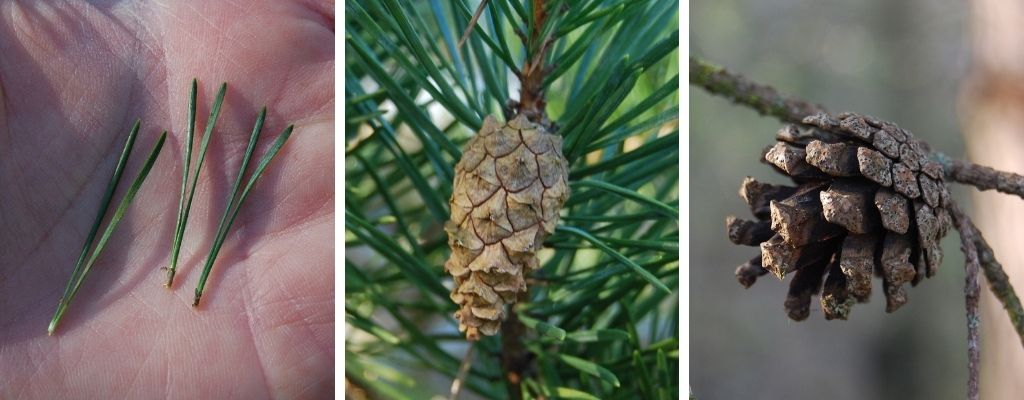
Left: Needles are in pairs, joined at their base. Middle: A ripe cone, still closed. Right: A mature cone having dropped its seeds.
Before we get into the specific details of Scots Pine, it’s worth mentioning a feature that is unique to pines. If you follow a single pine needle back to its base, where it joins the twig, you will discover it is joined to one or more other needles. Pine needles come in twos, threes or fives. This is important because conifers like spruce have needles which are attached singly to the twig.
I was told this handy little rhyme by Dave Watson of Woodland Survival Crafts to help me remember this rule; “If it’s a pair, it’s a pine, but not all pines are pairs.” By using this rhyme we can eliminate other families of conifers and know that we are looking at a pine. So, that leads to the question, how do we know it’s a Scots Pine?
To identify the Scots Pine there’s a few key features to look for:
Needles come in pairs, joined at their base to the twig. Needles are approx 5 to 7.5cm in length. This is important as a commonly planted non-native, the Corsican Pine, also has needles in pairs, but they are significantly longer. Corsican Pine needles can grow to 15cm long.
Needles often have a twist to them.
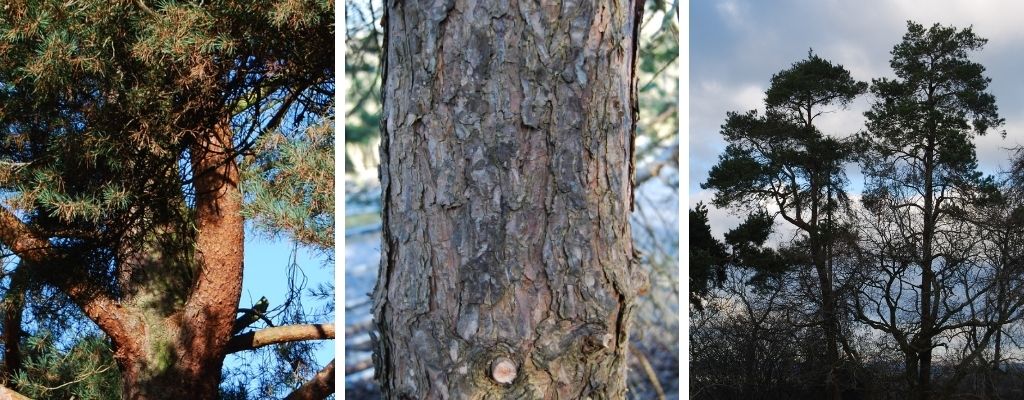
Mature bark is a warm brown to orange colour with a craggy character. Also, look for a band of orange on the main trunk about a third to two-thirds up the tree. This is especially visible in clear sunlight.
Pine cones. These are the typical cones used for Christmas decorations that you are probably familiar with. They take two years to mature. Cones are green and conical in their first year on the branch. In their second year they become more rounded and brown-grey in colour.
Mature trees have a habit of spreading and flattening out in their crown, so losing the “Christmas tree” conical shape we think of when picturing a conifer.
Left: Look for an orange band on the trunk some way up the tree. Middle: Bark is craggy and covered in plates. Right: The crown of mature trees flatten out.
Juniper (Juniperus communis)
You might know this tree best from its berries, or rather what’s its berries are used to flavour… gin.
This is by far the least common of our three native conifers. It is mostly a tree of upland areas, but you can find it formally planted in country estate gardens where it can be trimmed to shape. It’s worth noting though that Juniper is probably the most widespread tree species in the world, found from the Arctic to the Mediterranean.
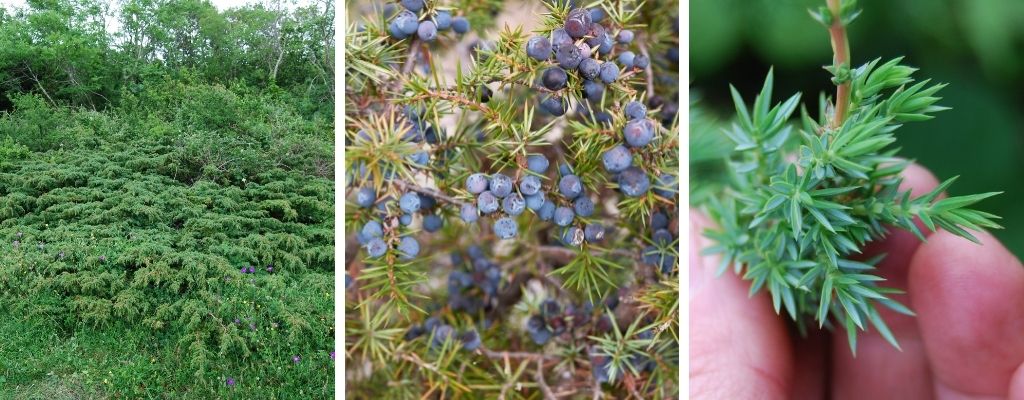
Left: Typically a low-growing and spreading tree. Middle: Ripe berries are blue to black in colour. Right: Needles grow in threes. They are very spiky.
In the UK, Juniper tends to favour chalk and limestone sites.
To identify Juniper you’re looking for the following things:
Typically a low-growing, sprawling shrub of a tree. Though not always.
Needles are small (up to 2cm long), very spiky to touch and they grow in threes.
The mature bark is a reddish-brown colour which has a peeling habit.
Berries. When mature they are dark blue/black. They are small and spherical. When young they are green in colour. You will only find them on the female trees. So, this feature can be a little unreliable.
Crush a berry between you fingers, it will smell of gin. This also works with the twigs & foliage, but be careful, it’s spiky!
The ripe fruit of the female Juniper are generally called berries, but they are actually classed as cones.
There are several cultivated varieties of Juniper which you can pick up in your local garden centre.
Left: Bark is reddish-brown and peeling. Middle: Young berries are blue/green. Right: Juniper can be an upright, single-trunked tree, but this is less common.
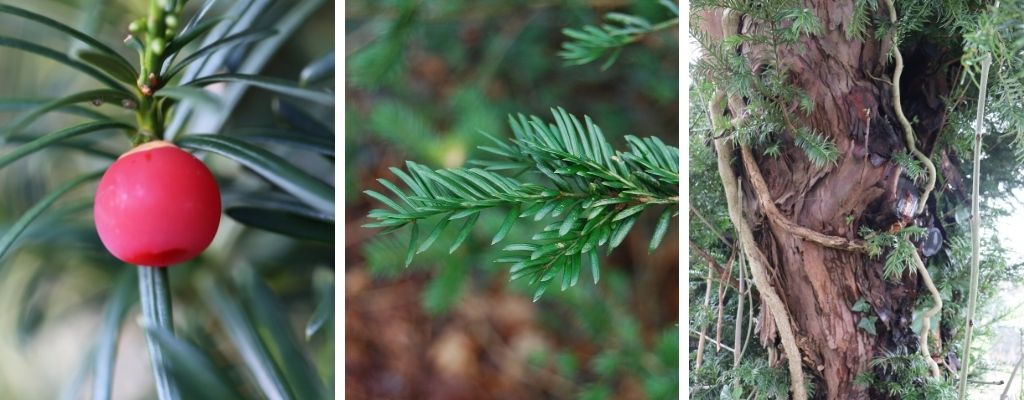
Yew (Taxus baccata)
We can lay claim to some of the most spectacular Yew trees in the world, as they are the oldest living organisms in the UK. It’s thought that some are as old as five thousand years! There is hot debate as to which is the oldest living Yew, but the most likely candidates, in my opinion, are in Wales.
Left: Yews are often found in churchayrds. Middle: Needles are soft to touch. Right: Bark is patchy with reds, browns & purples.
You are most likely to find a Yew in your local churchyard, looming over the gravestones. Many of these trees predate the church they are paired with.
To identify the Yew tree you’re looking for a few key things:
Glossy needles are up to 4cm long. They are arranged flat, along green twigs.
The needles are soft to the touch, unlike spikier spruce trees.
The mature bark of Yew is quite beautiful. Look for red-brown bark with a peeling habit that can show patches of oranges, purples and blood red. When wet, patches of the bark can look like they’re bleeding.
The bright pink/red oval berries of the Yew are very different from anything else you’ll find on a conifer. You will only find these on female trees, so don’t rely on this alone.
Mature trees will typically have more than one stem, growing from the base.
Yew trees don’t have cones. This makes them easy to distinguish from pine, spruce and fir.
Left: Pink/red berries are unmistakable. Middle: Needles arranged flat, on green twigs. Right: Bark is peeling and full of character.
Discover More About Trees
It can be so interesting to really look in to the details of our native trees and notice the changes that they undergo throughout the four seasons. That’s just what I’ve created for my FREE introductory online course called Kickstart Your Tree ID Skills. Here you will find a whole host of resources to take you from clueless to confident on your way to really knowing your trees.
When you sign up to this free mini-course you’ll be identifying common trees with video tutorials and photo galleries at your fingertips. Start your journey to becoming a fully fledged Tree Expert today. The course includes Tree ID Cheat Sheets which you can download and take outdoors with you.
“I’ve been frustrated for so long trying to learn my trees myself and haven’t gotten far. This course answered everything and has seriously upped my game.” Dr. Patrick Alexander
We use cookies on our website to give you the most relevant experience by remembering your preferences and repeat visits. By clicking “Accept All”, you consent to the use of ALL the cookies. However, you may visit "Cookie Settings" to provide a controlled consent.
This website uses cookies to improve your experience while you navigate through the website. Out of these, the cookies that are categorized as necessary are stored on your browser as they are essential for the working of basic functionalities of the website. We also use third-party cookies that help us analyze and understand how you use this website. These cookies will be stored in your browser only with your consent. You also have the option to opt-out of these cookies. But opting out of some of these cookies may affect your browsing experience.
Necessary cookies are absolutely essential for the website to function properly. These cookies ensure basic functionalities and security features of the website, anonymously.
Cookie
Duration
Description
cookielawinfo-checkbox-analytics
11 months
This cookie is set by GDPR Cookie Consent plugin. The cookie is used to store the user consent for the cookies in the category "Analytics".
cookielawinfo-checkbox-functional
11 months
The cookie is set by GDPR cookie consent to record the user consent for the cookies in the category "Functional".
cookielawinfo-checkbox-necessary
11 months
This cookie is set by GDPR Cookie Consent plugin. The cookies is used to store the user consent for the cookies in the category "Necessary".
cookielawinfo-checkbox-others
11 months
This cookie is set by GDPR Cookie Consent plugin. The cookie is used to store the user consent for the cookies in the category "Other.
cookielawinfo-checkbox-performance
11 months
This cookie is set by GDPR Cookie Consent plugin. The cookie is used to store the user consent for the cookies in the category "Performance".
viewed_cookie_policy
11 months
The cookie is set by the GDPR Cookie Consent plugin and is used to store whether or not user has consented to the use of cookies. It does not store any personal data.
Functional cookies help to perform certain functionalities like sharing the content of the website on social media platforms, collect feedbacks, and other third-party features.
Performance cookies are used to understand and analyze the key performance indexes of the website which helps in delivering a better user experience for the visitors.
Analytical cookies are used to understand how visitors interact with the website. These cookies help provide information on metrics the number of visitors, bounce rate, traffic source, etc.
Advertisement cookies are used to provide visitors with relevant ads and marketing campaigns. These cookies track visitors across websites and collect information to provide customized ads.