Call us on: 07876 794098

Author - James Kendall

girl climbing tree at forest school

Forest Schools in a Nutshell

This is a guest-blog written by Loretta Hourigan, author of From Little Acorns to Mighty Oaks: Creating a Path to Happier, Healthier Children. This article was originally printed in the magazine ‘Independent Schools’ in August 2015.


“A Student led approach to learning in the great Outdoors”

Forest Schools are sweeping through the UK and despite the notion that the concept is relatively new; this type of Outdoor Learning pre dates back to the 1800’s where in Scandinavia ‘friluftsliv’ (free air life) remains a childhood staple.

Forest Schools offer children the opportunity to take part in regular outdoor sessions, often in all weathers in a woodland environment where leaders act as facilitators rather than teachers. A broad range of skills are developed; problem solving, conflict resolution, confidence and communication. Crucially Forest Schools differ from other organisations in their awareness that children need to attend regular sessions of Outdoor Learning over an extended period of time in order to reap the benefits. An evaluation by Liz O’Brien & Richard Murray support this theory, stating “a number of children took a long time to become familiar and confident with Forest Schools”.

irls playing with water at forest school

The evaluation found that parent’s attitudes to the outdoors changed over time, including how they perceived risks in an outdoor setting (making fires, using sharp tools, climbing trees.) Rather than excluding or avoiding risks, at Forest Schools risks are managed. Far from traditional lesson planning; most activities evolve from the spark of interest a child demonstrates in a particular task and around which future sessions are planned. This leads to engaging experiences meaningful to the children.

James Kendall, an experienced Forest Schools leader set up Woodland Classroom in 2013 with Lea Wakeman; both have seen children who struggle to perform within a traditional educational setting thrive in the woodland classroom. I would highly recommend the video on their website which answers the question “What is Forest Schools’ succinctly. (You can find that video HERE)

James explained how one of the key features of every Forest School session is to gather around the fire circle. “Firstly, in a circle everyone is equal. Ideas can be readily passed around; games and activities all work well in a circular setting. Minus the constraints of four walls; children’s confidence increases alongside their freedom to roam further away, the fire provides the ideal base to return to.”

Forest Schools don’t quantify success through standardised testing; how therefore can we be confident that spending time outdoors really does benefit our children? Apart from numerous studies on the subject, a simple way is to reflect on how you felt when you played outdoors as a child.

child at forest school in net

My own memories of jumping through long grass and hiding beneath the cool boughs of the weeping willow provided much of the inspiration for my children’s book ‘The Adventures of Cameron Carter, Knight in the Forest’ where a young boy sets out on a series of outdoor challenges following the discovery of a tent in his garden.

Sessions are available from qualified Forest School leaders using a suitable green space in your school; alternatively at an established external location. Children learn and develop through outdoor play and with many links to the National Curriculum; Forest Schools are engaging both children and adults alike.


You can find out more about Loretta and her work at lorettahourigan.com

Find her on Twitter @LorettaHourigan
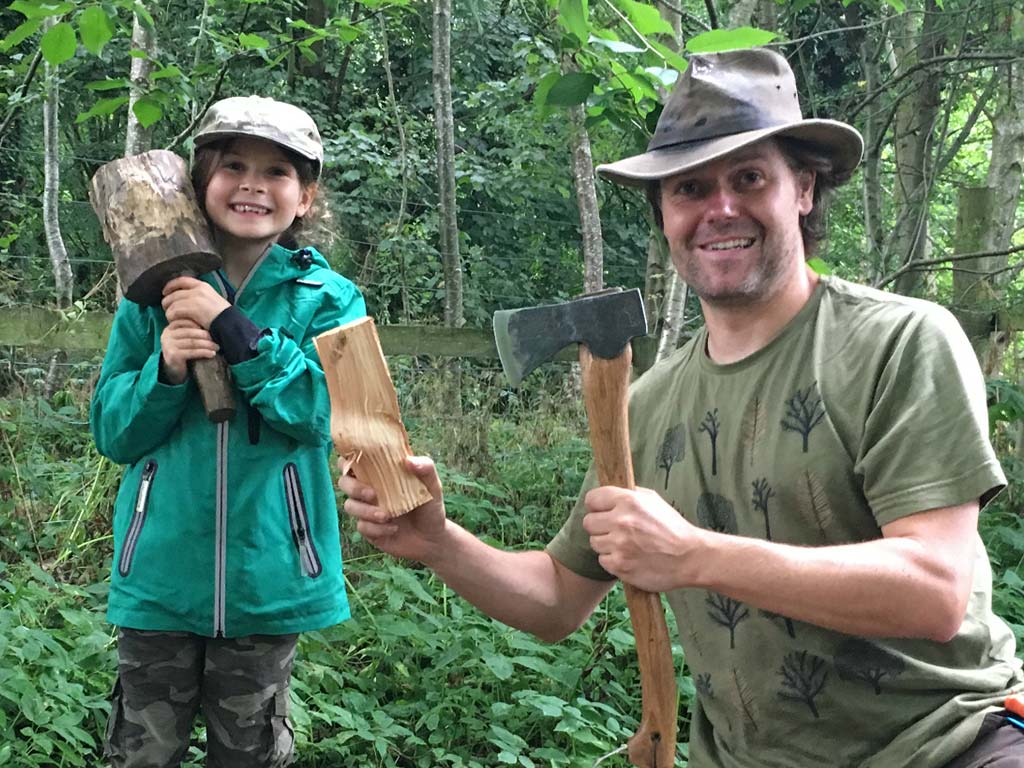
why kids should use axes

Why I would buy my kids an AXE

At a time when many children are being wrapped up in too much cotton wool (not literally) to keep them safe from the perceived hazards of modern life, I’ve become more and more a champion of allowing the children I look after (at Forest School sessions) to take risks and show they can be responsible for managing their own safety. So, with that in mind, we’ve been chopping firewood together, using a very sharp axe, and here’s a little video which shows you how I teach those basic axe skills to kids. I’d encourage you to try it for yourself.

Autumn has definitely arrived here in the UK and with the long, dark and cold nights closing in my mind’s turned to getting some firewood in. Yes, like many others I’ve left it late again. It’s always good to have some help with tasks like this and I’ve found that chopping firewood is an effective and simple activity for kids to get stuck into as well as a great introduction to the axe. Kids can understand the task and (most folks agree) splitting logs is very satisfying to do. So what about giving a razor sharp axe to a child? Well, here’s what the children’s author Roald Dahl had to say about risk;

“…the more risks you allow children to take, the better they learn to take care of themselves. If you never let them take any risks, then I believe they become very prone to injury. Boys should be allowed to climb tall trees and walk along the tops of high walls and dive into the sea from high rocks… The same with girls. I like the type of child who takes risks. Better by far than the one who never does so.”

Mabli (one of our regular Young Rangers) is just six years old and it was really encouraging to see her progress recently from using the potato peeler (which we give to kids first to practice their knife technique) to using a proper whittling knife. She was confident, calm and sensible with the tool, which I like to think she learnt through clear mentoring, encouragement and close supervision. There’s a voice in my head which jostles for centre stage telling me that there’s going to be a terrible accident and that it would be better to just let kids like Mabli play at something safer. But of course, children are just like us, they don’t want to hurt themselves, so along with a good mentor (like any parent), they’re their own regulator.

teaching children to use an axe

Anyway, back to the axe and chopping wood. I think this is a great introductory activity for kids to sharp tools as with an axe you have a fair distance between the sharp edge and little fingers. Also, whoever heard of such a thing as an ugly piece of firewood? So, no fine craft skills are required. You could even follow wood chopping with learning fire-lighting so that they get to burn what they’ve chopped themselves. I’ll give the last word on ‘risk’ to Richard Louv, author of the fantastic book Last Child in the Woods;

“An indoor (or backseat) childhood does reduce some dangers to children; but other risks are heightened, including risks to physical and psychological health, risk to children’s concept and perception of community, risk to self-confidence and the ability to discern true danger.”

So, would you use sharp tools with your own kids at home? Have you had success with whittling, wood chopping or using a saw with little ones? We’d love to hear from you.

If you enjoyed this video, we’ve got MORE videos on our YouTube channel giving you ideas for engaging kids in the great outdoors. You can find it by clicking HERE.

Making Wild Teas with Kids

Want a great and simple way to get kids engaged in the outdoors? We’ve uploaded a video to our YouTube channel showing how to make yummy wild teas and how successful this has been with children. Enjoy!

So, to recap….

We used the following common plants in our wild teas; stinging nettles, goosegrass or cleavers, dandelion (petals only) and mint.

You can play around with the combinations of these and there’s plenty of information out there in Google land on other wild plants to use to flavour your teas.

Try making your very own herbal teas or “woody waters” as our Forest School group calls it. All you need is a cafetiere. It’s a great excuse to go for a walk in nature, get kids looking closely at the plants around them and dip your toe into the wonderful world of wild food and foraging. You’ll be pleased to hear that the plants you’re looking for are easy to find and identify.

Picking nettles without getting stung can be tricky but a great trick to impress kids once you’ve mastered it. Most of the stinging hairs are on the top of the leaves so grab the plant by the bottom of the leaves or the stem. Of course, you can always use gloves if you want to be extra safe. The tastiest parts of the nettle are the young tops. Once you’ve got enough nettle leaves place them in to the cafetiere, pour on hot water (which you’ll be pleased to hear also eliminates the sting) and leave to brew for a few minutes before pushing the plunger and serving up.

For a sweeter brew, try adding some mint leaves and even the fussiest eater should enjoy the refreshing tea especially if they have foraged for the leaves and made it for themselves.

Everyone knows the dandelion, and when in flower they’re easy to spot. The petals have a sweet taste to them, like liquid sunshine. You can also eat the leaves, though they’re quite bitter – give it a go.

Let us know how your experimental recipes go. We’d love to hear from you.

Why Kids Need “1hr a Day” in Nature

Here in the UK, the government and health boards tell us we need to get our ‘5 a Day’ of fruit and veg into our diet. So, what about nature time? I say we should introduce a minimum ‘1 hour a Day.’ After all don’t we get essential vitamins from sunlight too?

kids need at least 1 hour per day spent in nature

By Lea Wakeman.

I have always wanted to work with children in a therapeutic way and never more than now! After running over eighty Forest School sessions with my partner James, I am really seeing first hand the therapeutic benefits of natural play.

Let me take you back 7 years… I first noticed the beneficial effects of nature and the outdoor environment when I worked in a primary school. My role was specifically supporting children who had challenging behaviour or were classed as vulnerable. I found it was instinctual for me to remove a child who was displaying extreme stress and take them outside. Why?

Well, firstly, it removed any possible danger to the rest of the class, as chairs would sometimes be thrown. But what I found was that the child in question responded positively to the open space by eventually calming down. If the child stayed indoors it took relatively longer to calm them, there was so much stimulus inside the building and nowhere they could be alone.

I learnt to keep my running shoes by the school entrance so I could quickly change into them when a child left the building, it was usually a state of anger that led them to go outside without permission in the first place.

Sometimes, they seemed to stay angry for a long time but this was different to them being angry inside the school where children (or adults) could be hurt. Indoors, there seemed no escape for them from their emotions, it just escalated until they became too tired to carry on being angry.

Outside it was different, the open space seemed to clear their busy minds, the flood of emotions and rage was given breathing space somehow, it had somewhere to go and there was a sense of freedom, a release from being trapped.

There is a common way of thinking which takes the stance that outside the confines of the school walls lay danger, children could be taken, in bad weather there was the risk of them falling on ice, getting wet or sun burnt. This apprehension has been compounded by the media as well as valid concerns about fast traffic and playing near roads. Yet I saw the children were always drawn to the the playing field and school grounds.

While working in the school there were times when I could take the kids out into the garden and let them plant flowers and dig in the soil but the busy curriculum never allowed much time for this, it was seen as a treat rather than the norm. Teachers needed to be creative in their lesson planning to incorporate nature and the outdoors into everyday school life and that only really happened with teachers who already had a passion for the outdoors.

Once or twice a year the class would get to go for a walk in the countryside or visit the local woodland, in fact, this is where I had my first experience of Forest School and it completely fired my imagination. The activities were so simple yet so much pleasure was had, there was no completion of a task to be ‘marked off’ and graded, no child was put into a group based on their ability, all kids were equally able to contribute something to the activities, in fact differences were seen as creativity in action. Yet days like this were few and far between, the national curriculum just doesn’t allow for much time away from the classroom.

Now, I don’t want to make that particular school sound bad in any way at all, it was a wonderful and nurturing place with a dynamic and forward thinking Head and staff, I learned so much there. There are also some great examples of in-school projects where teachers are incorporating nature into their lessons. But since I’ve been running regular Forest School sessions myself I can reflect back on the way the general schools system can compound the growing disconnection of children from nature. I still hear from angry parents about kids being kept in at play times because of snow, so things have not changed all that much.

But the good news is, we’re getting there. Over the last few years there has been a huge push towards outdoor education, but this is still only in addition to the current education system, we would still do very well to look towards Scandinavia and their model of education where being outdoors is integrated throughout school.

So what can we all do to help? It isn’t just our schools that need to adopt a different attitude to this subject but every person, whether a parent or not. We need to follow our instinct, that gut feeling we all know to be true, and start shouting about the great outdoors as the place where healing occurs and as the place to go in order to prevent emotional and physical imbalance in ourselves and our children, whatever form that may take.

Felin Puleston Outdoor Centre

Make Your Own Seed Bomb!

The bees need our help. The UK has lost 98% of its wildflower meadows in the last 70 years. March to May is a good time to plant wildflower seeds, and for kids, making seed bombs is a great way to get them excited about native flowers and so get them noticing the plight of our pollinators. You can plant these out in your garden or do some guerilla gardening by scattering them along the route to school or on a roadside verge.

seed bombs

What You Need: Clay (or heavy mud), compost, sand, wildflower seed mix, and an egg box to store them in.

1. Make a ball of clay by rolling it in your hands, just smaller than a golf ball. Flatten it out and mix in some compost and sand, then roll it back into a ball.

2. You want enough compost and sand to give the seeds something to grow in but enough clay to make sure the bomb holds together. Just play about with it until it looks right – the messier your hands are, the better.

3. Push your thumb into the middle to make a bowl shape and sprinkle a few pinches of seeds into the bowl. Fold up the bowl so the seeds are captured inside and roll back into a ball.

4. You can store the seed bombs in an egg box until you’re ready to plant out.

5. The best place to scatter the bombs is in a patch of bare soil. Wildflowers prefer poorer soil and don’t want to compete with grass.

6. Crumble up the bombs and scatter over the bare soil. Then either tread or rake them in.

7. They’re best planted before rain, but if the weather is dry – just add water.

Our natural habitat

What do we mean when we say natural habitat? I remember a day when I was visiting Llyn Brenig in Denbighshire, and I heard a comment that got me thinking about our perception of what is natural.

As the couple gazed at the view, one of them said “What a beautiful natural landscape.” I took in the same view and this is what I saw from lake to peak; a man-made reservoir (Llyn Brenig itself), improved pasture for grazing, a forestry plantation of conifers, followed by a moorland managed for grouse shooting, topped off with a few wind turbines.

All of these are very much managed features, sculpted by human influence. There was nothing ‘natural’ about the view whatsoever. However, this is how the visitor perceived it. The reality is that in the UK, we don’t have any wilderness left. Every piece of land has had management decisions imposed upon it, for better or worse.

Of course, beauty is in the eye of the beholder and I agree that managed habitats can very much be appreciated and inspiring in themselves, but they should also be recognised for what they are – unnatural. So, many people’s perception of wildness can be a little skewed and much of modern life can serve to detach us from the natural world from which we came.

Human beings have thrived far longer outdoors, living from and with the land, than we have in houses. So perhaps we can say that the outdoors is our natural habitat. I feel it’s important that we all make time for nature and reconnect with the land around us in whatever way we can. Time invested will increase our understanding of the habitats we see and the ecosystems that are entwined with them.

At Young Rangers we give children an early start in encouraging this understanding. At their most basic level, sessions can be simply seen as ‘time spent in nature’ and Denmark Farm has a wide range of habitats for visitors to explore including broadleaf woodland, wetland and grassland. There are areas of the site where nature is left to its own devices, but even this ‘non-intervention’ approach is a management decision. What makes Denmark Farm different is where its priorities lie. Land is managed for biodiversity and wildlife first, rather than for agricultural output and the value that this sensitive approach has for environmental education is huge. Children who come to Young Rangers (and all visitors to Denmark Farm) get the opportunity to see the effects this approach has on their habitats, compared with the surrounding landscape. We hope such experiences will fire imaginations and lead children to ask more questions so they can make their own decisions about the land around them and what they think of as natural.

March update

Our weekly Young Rangers after-school club sessions have been going well up in Denmark Farm’s woods, near Lampeter. We’ve had a guest tutor, Bernadette O’Grady (a professional musician) who has been showing the kids how to make music from nature. Thanks to Bernie, we’ve even got our own theme song.

It’s an exciting time for learning outside the classroom. Landmark books like Richard Louv’s Last Child in the Woods have brought attention to the increasing issue of what he calls nature deficit disorder. Louv campaigns for ‘no child left inside.’ He tells us; “Passion is lifted from the earth itself by the muddy hands of the young; it travels along grass-stained sleeves to the heart. If we are going to save environmentalism and the environment, we must also save an endangered indicator species: the child in nature.” Alongside this there is a growing movement in an approach to environmental education which began in the U.S. called the Art of Mentoring. This is by no means a new way of thinking, but rather a method which calls on the knowledge passed on by generations of indigenous peoples from across the world. In the U.S. this has been championed by Tom Brown Jr. (America’s answer to Ray Mears) who learnt his bushcraft skills and nature awareness from an Apache scout he called ‘Grandfather.’ Rather than to give learners the answers to each question, the Art of Mentoring encourages them to find the answers for themselves through trial and error. A child learning fire-lighting skills is going to have more success if they have discovered the best methods for themselves; this makes their learning experience more personal and valuable as they have strived for it rather than being handed the secret. It is important for the teacher to allow the student to fail. How does that old saying go? That; “there are no mistakes, only learning opportunities.” Their eventual triumph will be all the sweeter.

3

New Tuesday Group Taster Day

The people have spoken and demanded it, so after the Easter holidays we will be running a second weekly after-school group on Tuesdays out in the woods at Denmark Farm. On Tues 17th March we hosted an introductory taster session for new children that wanted to try out this Forest School club before committing to the full term after Easter. The regular Thursday sessions are continuing as usual. This taster session included woodland games, a walk to spot the signs of spring and rounded out with marshmallows cooked over the open fire. Every child that attended signed up for the full term starting after Easter, so we’ll call that a resounding success.

If you’d like to find out more about booking a place for your child on the upcoming Tuesday after-school sessions then get in touch with us via our contact page.


School Easter Hols Activity Day: “Way of the Wilderness!”

wilderness day collage

On Thursday 2nd April. We’ll be hosting a full day of activities in the woods for kids, from 10am until 4pm entitled ‘Way of the Wilderness.’ Ever wanted to see like an owl or walk like a fox? We’ll be stepping into the wilds as we learn ancient tracking and stalking skills, how to observe wildlife and nature awareness. There will be a hot campfire lunch for all. To find out more, get in touch via or contact page.

Aboriginal Art – Be a Tracker.

symbol collageWe’ve been tapping into the theme of ancient knowledge from native peoples around the world, so here’s something that children can try when making dens and secret paths for themselves. The Aborigines of Australia used these symbols to tell stories, but they can also be used to share observations and camp secrets for other travellers, but only if you know how to read the symbols.

Can you make up your own symbols and meanings to add to these?

Make a Birdfeeder on a Budget

With the winter still upon us, February is a lean time of the year for our feathered friends, so why not give them a helping hand, whilst also recycling something we all have hanging around the house – loo rolls. Why pay out for a plastic feeder when this simple solution will do the trick.

Birdfeeder CollageWhat You’ll Need:
Loo roll or kitchen roll tube • Lard • Mixed birdseed • Some string and a stick

Method

1. Tie a length of string around the middle point of your stick, securing it and making a loop in the loose end, leaving it long enough to hang outside your tube.

2. Melt some lard in a pan and then pour it onto an old baking tray. Allow it to cool and almost solidify, then roll the tube in the fat a few times to build up the layers.

3. Either roll the sticky tube in a tray of birdseed or sprinkle the seed onto the tube to get good coverage.

4. Carefully thread the string through the tube, so that the stick acts as a perch at the base.

5. You’re now ready to hang it in the garden, watch and wait for the birds to tuck in.

6. Any leftover lard and birdseed can be rolled up into a fat ball for the birds to enjoy.

February Update

With the darkest period of the year behind us, the Young Rangers popular after-school club (for 6-11 year olds) will be returning this month for a new year of Forest School activities, learning from nature, woodland games and arts & crafts in the outdoors with Lea and James. We are planning to return to our regular Thursday sessions beginning 5th Feb. Sessions run from 4pm-6pm. To find out more or book a place for your child, see the events listing.

Our Winter in the Woods event on Dec 22nd proved a big hit with a bright, crisp winter’s day where children built dens and made birdfeeders. It was also very rewarding to see them all succeed at basic fire-lighting skills, especially as the ground was damp and much of the kindling wet from the previous day’s rain. Well done to all for meeting the challenge.

10814169_332955393556123_489162494_n 10806953_332954003556262_1240520216_n

Going Twice Weekly?

Following such a positive response from children and parents, we are seriously looking into running a second weekly session. The previous term of Young Rangers was oversubscribed and we’ve had many requests for a second night. We’ve decided on Tuesdays being best and beginning after the school Easter holiday. Our first session would be on Tuesday 14th April, from 4pm to 6pm. If you would like to register your interest then please get in touch. If we get enough bookings, this will happen. The Thursday sessions will continue as normal.

February Half Term: The Vikings Are Coming!

viking day collage

On Monday 16th Feb, we’ll be hosting a full day of half term activities for local children where we’ll be taking them back to the Dark Ages. Beorn and Freya will be your hosts, giving children the chance to find out how the Vikings lived, try their hand at fire-lighting and axe skills and get close to props, clothes, armour and tools from the period. There’ll also be the usual woodland games, campfire cooked lunch and maybe… a troll hunt.

Social Share Buttons and Icons powered by Ultimatelysocial